Techno-Economic Analysis for Engineering Projects: A Practical Guide for Project Developers
Learn how techno-economic analysis evaluates project feasibility, CAPEX, OPEX, technology alternatives and investment risks for energy and industrial projects.
Introduction
Before investing in an engineering project, developers need to understand more than its technical design. They must evaluate the investment required, expected operating expenditure, project risks and potential economic outcomes.
Techno-economic analysis brings these factors together to support better project planning and investment decisions.
For solar power plants, battery energy storage systems, thermal power facilities, industrial plants, water treatment systems and infrastructure developments, a techno-economic assessment can help compare alternatives and establish a realistic project development strategy.
What Is Techno-Economic Analysis?
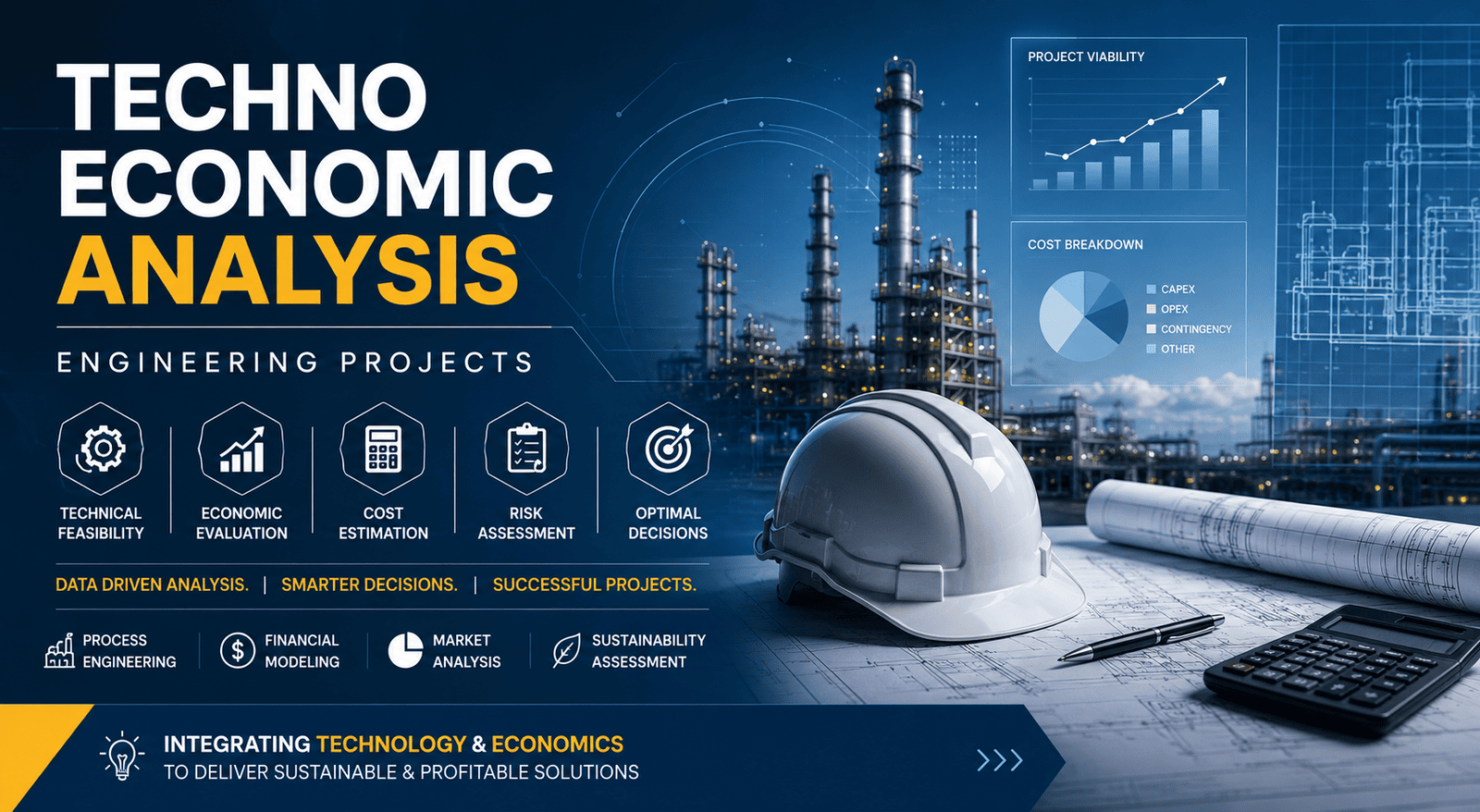
Techno-economic analysis combines engineering evaluation with economic assessment. It examines technical feasibility, technology selection, equipment requirements, project costs, operating assumptions and economic performance.
The analysis typically considers:
Technical configuration and plant capacity.
Site and infrastructure requirements.
Capital expenditure (CAPEX).
Operating expenditure (OPEX).
Expected production or energy output.
Lifecycle costs and equipment replacement.
Project risks and sensitivity to changing assumptions.
Relevant financial and economic indicators.
The scope depends on the project stage and the decision the client needs to make.
Why Is Techno-Economic Analysis Important?
Better technology selection
Engineering alternatives can differ in reliability, efficiency, installation requirements, maintenance and lifecycle costs. A structured comparison helps stakeholders identify an appropriate solution.
Improved project cost estimation
A transparent CAPEX estimate identifies major equipment, civil works, mechanical systems, electrical systems, utilities, engineering and construction costs.
Understanding operating expenditure
OPEX assessment considers energy, raw materials, labour, maintenance, consumables and replacement requirements.
Investment decision support
A techno-economic study connects engineering assumptions to economic outcomes, helping stakeholders identify the conditions under which a project may be viable.
Early identification of risks
Sensitivity and scenario analysis help identify variables that could materially affect project cost, output or returns.
CAPEX and OPEX in Engineering Projects
CAPEX represents the investment required to establish the project. OPEX represents the costs of operating and maintaining it.
Both must be evaluated using a consistent scope and documented assumptions.
A low initial equipment cost may not produce the lowest lifecycle cost if the equipment consumes more energy, requires frequent maintenance or has a shorter operating life.
Similarly, a project budget that excludes grid connectivity, utility infrastructure or commissioning can understate the total investment.
A well-prepared techno-economic assessment should identify cost inclusions, exclusions, sources, assumptions and material uncertainties.
Applications Across Energy and Infrastructure
Solar power and battery storage
Assessment may include energy yield, equipment selection, plant configuration, grid connectivity, battery degradation, operating strategy and replacement costs.
Thermal power and industrial projects
Evaluation may cover fuel consumption, plant efficiency, production capacity, equipment reliability, maintenance, utility requirements and environmental systems.
Water and wastewater treatment
Assessment may consider treatment capacity, electricity consumption, chemical requirements, sludge handling, maintenance and lifecycle costs.
Green hydrogen and compressed biogas
The analysis may examine feedstock or renewable power availability, process efficiency, utilization, storage, transportation and expected operating costs.
Key Deliverables
Depending on the agreed scope, a techno-economic feasibility study may include:
Project definition and design basis.
Technical alternatives and preliminary engineering.
CAPEX and OPEX estimates.
Production or energy-yield assumptions.
Economic model and relevant financial indicators.
Sensitivity analysis and risk register.
Recommended project development roadmap.
These deliverables should be defined before work begins so that the assessment supports the intended investment, feasibility or DPR decision.
Choosing a Techno-Economic Analysis Consultant
Project owners should evaluate a consultant's multidisciplinary engineering capability, relevant sector experience, cost-estimation methodology, deliverables and ability to support subsequent project development.
For international projects, the assessment must also address the applicable local regulations, project location, cost basis, currency assumptions and technical standards.
Techno-Economic Analysis Services from AlgEnergy
AlgEnergy Engineering Consultancy Services supports energy, renewable energy, industrial, water and infrastructure projects through feasibility studies, techno-economic analysis, DPR preparation, project planning and engineering consultancy.
Our objective is to help clients evaluate technical alternatives, understand investment requirements and identify the next steps needed to develop their projects.
Explore our Engineering Consultancy and Feasibility Services for further information.
Request a Project Assessment
Planning a new engineering project in India or an international market?
Share your project type, location, proposed capacity, development stage and required deliverables with AlgEnergy to discuss a suitable assessment scope.
Visit the AlgEnergy Engineering Consultancy Services website to initiate a project enquiry.
This article is for general information. Project viability and costs depend on project-specific engineering, assumptions, market conditions and applicable requirements.