
Solar + BESS Feasibility Study: Technical, Financial & Design Guide
Learn how to evaluate solar + BESS projects through technical sizing, load analysis, storage configuration, CAPEX, performance, grid integration and financial analysis.
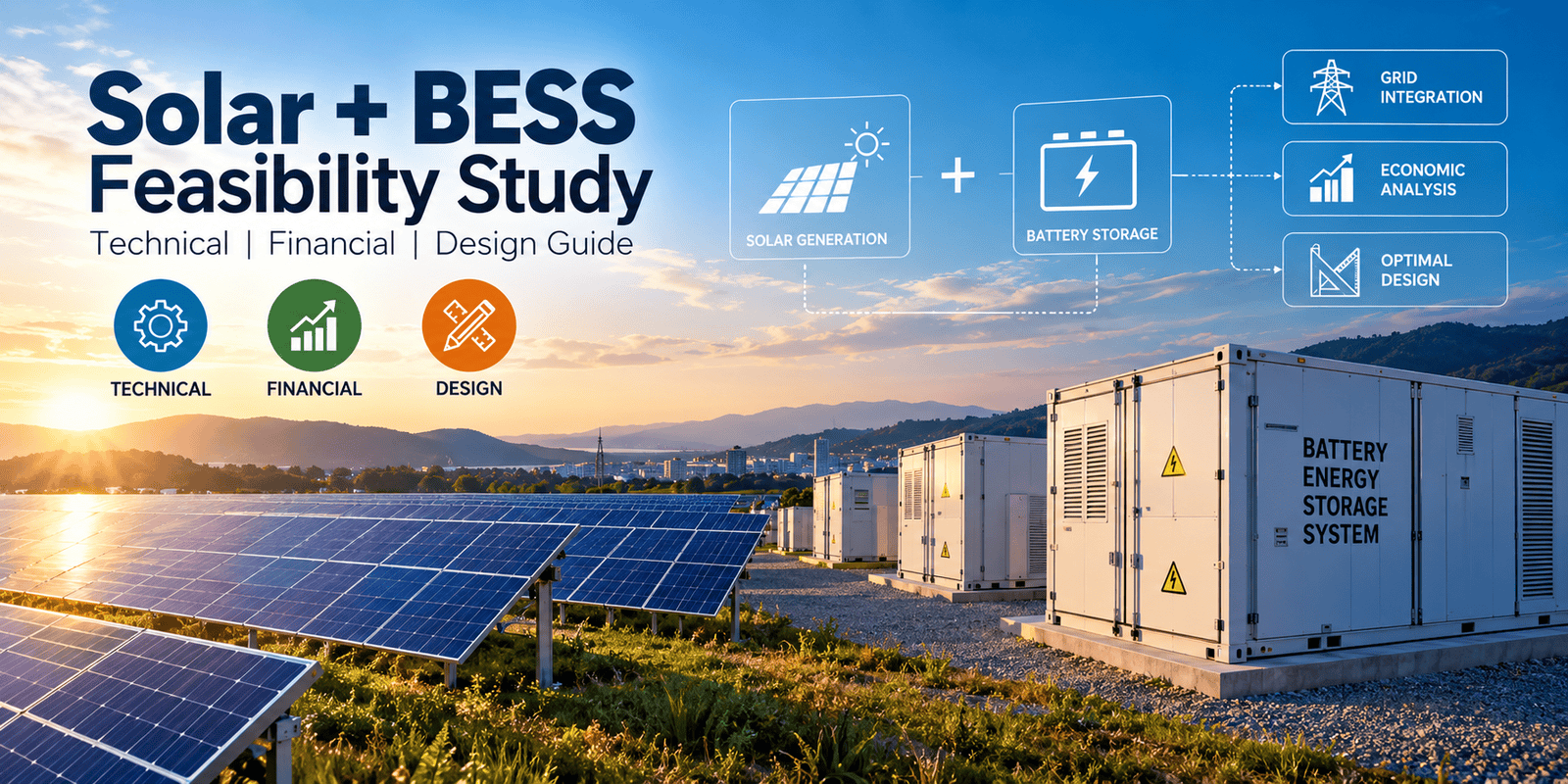
Introduction: Why a Solar + BESS Feasibility Study Matters
The rapid growth of renewable energy is changing how power projects are planned, designed and financed. Solar photovoltaic generation has become an important source of low-carbon electricity, but its output varies throughout the day and depends on solar irradiation and weather conditions.
Battery Energy Storage Systems, or BESS, provide a way to shift, manage and control electrical energy. When solar PV is integrated with battery storage, the combined system can potentially improve renewable-energy utilization, reduce curtailment, support peak demand, provide grid services and increase the reliability of electricity supply.
The International Energy Agency identifies utility-scale batteries as an increasingly important flexibility resource because they can respond quickly, shift renewable generation and provide grid-support services. IEA
For project developers, however, simply combining solar PV with batteries does not automatically produce a commercially viable project.
The project needs to answer fundamental questions:
- How much solar capacity should be installed?
- What should the BESS power rating be?
- How many MWh of battery storage are required?
- What duration should the battery provide?
- Should the system be AC-coupled or DC-coupled?
- How will the battery be charged?
- Will charging come exclusively from solar or also from the grid?
- What is the expected annual energy yield?
- What level of battery degradation should be considered?
- What are the grid-connection requirements?
- What fire protection and safety systems are required?
- What are the CAPEX and OPEX?
- What revenue or savings streams will support the investment?
- How sensitive is project economics to battery prices, electricity prices and degradation?
- Is the project technically bankable and suitable for financing?
These questions form the core of a Solar BESS feasibility study.
For Africa and Europe in particular, project conditions can vary significantly between countries and sites. Grid strength, electricity tariffs, renewable penetration, land availability, permitting requirements, weather conditions, financing costs and market structures all influence the optimal configuration.
A properly executed BESS feasibility study therefore needs to integrate solar resource assessment, electrical engineering, battery sizing, grid studies, safety engineering, CAPEX/OPEX estimation and financial modelling.
AlgEnergy Engineering Consultancy Services provides multidisciplinary engineering support covering feasibility studies, techno-economic analysis, DPR preparation, renewable energy, BESS and detailed engineering. Its website identifies renewable energy and BESS among its core engineering capabilities. algenergywebsite.zohosites.in
1. What Is Solar + BESS?
Solar + BESS refers to an integrated renewable-energy system combining solar photovoltaic generation with a Battery Energy Storage System.
A typical system may include:
Solar PV modules → DC collection → inverter → transformer → grid/load
with the battery integrated through an appropriate power-conversion architecture:
Battery → Battery Management System → Power Conversion System → AC/DC network → load/grid
Depending on the project architecture, the BESS may be:
- Co-located with a solar PV plant
- Behind the meter at an industrial facility
- Connected directly to a distribution network
- Connected to a transmission network
- Used in a microgrid
- Integrated with diesel generation
- Integrated with wind and other renewable sources
- Designed as a standalone grid-scale BESS
- Designed for renewable-energy firming or time shifting
The purpose of a solar plus battery energy storage project depends on the business model.
For example, an industrial facility may use BESS to store excess solar generation during the day and discharge during expensive evening periods.
A utility-scale project may use storage to shift solar generation into higher-value periods.
A weak-grid or off-grid project may use BESS to stabilize the system and reduce diesel-generator operation.
IRENA identifies multiple applications for battery storage, including renewable-energy integration, frequency response, reserve capacity, black start, mini-grids and self-consumption. IRENA
Solar + BESS is not simply “solar plus batteries”
A successful project requires coordinated engineering.
The solar plant affects:
- Energy generation
- Battery charging opportunity
- DC capacity
- Grid export
- Curtailment
- Land requirements
The BESS affects:
- Dispatchability
- Peak power
- Energy shifting
- Grid support
- CAPEX
- Degradation
- Fire safety
- Auxiliary consumption
- Replacement requirements
The Solar BESS feasibility study must therefore evaluate the two systems as one integrated energy project.
2. Why Combine Solar with Battery Storage?
The principal reason for combining solar with BESS is to better align renewable generation with electricity demand and grid requirements.
Solar generation typically peaks around the middle of the day. Electricity demand, however, may peak later.
Without storage, surplus solar energy may need to be:
- Exported
- Curtailed
- Used by local loads
- Sold at a lower-value period
With BESS, some of this energy can be stored and discharged later.
2.1 Energy time shifting
One of the most important applications is energy time shifting.
For example:
A solar plant generates surplus energy between 10:00 and 15:00.
The BESS charges during this period.
The battery discharges between 18:00 and 22:00 when electricity demand may be higher.
This changes the temporal value of renewable electricity.
2.2 Peak shaving
For commercial and industrial customers, the BESS may reduce the facility's peak grid demand.
This can be particularly relevant where electricity tariffs include demand charges.
2.3 Renewable firming
Battery storage can reduce short-term variability in solar output.
This can help provide a more controlled generation profile, subject to battery capacity, operating strategy and grid requirements.
2.4 Curtailment reduction
Where the grid cannot absorb all solar generation, storage can potentially capture some otherwise curtailed energy.
2.5 Grid support
Depending on market rules and technical configuration, BESS can provide services such as:
- Frequency response
- Voltage support
- Reserve capacity
- Ramp-rate control
- Reactive power support
- Black-start capability
The exact services available depend on the local electricity market and grid code.
2.6 Energy access and weak-grid applications
Battery storage can be especially relevant in regions where grid reliability is a challenge.
IEA notes increasing deployment of distributed solar PV with storage in countries with unreliable electricity networks, including South Africa. IEA
Africa also has growing examples of solar-storage developments. IRENA has documented solar-plus-storage projects and hybrid renewable developments across African and island markets. IRENA
This makes solar and BESS feasibility study for industrial projects particularly relevant for:
- Mining operations
- Manufacturing plants
- Data centres
- Commercial facilities
- Water-treatment plants
- Remote industrial facilities
- Hospitals
- Airports
- Ports
- Telecom infrastructure
- Rural electrification
- Island grids
3. Project Data Requirements
A high-quality Solar BESS feasibility study begins with reliable project information.
Insufficient input data can result in incorrect sizing, unrealistic financial projections and poorly defined EPC requirements.
A feasibility consultant should establish a structured data request at the beginning of the project.
Solar data
Typical requirements include:
- Site coordinates
- Available land area
- Solar irradiation data
- Historical meteorological data
- Ambient temperature
- Wind speed
- Humidity
- Soiling assumptions
- Topography
- Shading information
- Site access
- Geotechnical information
- Flood risk
- Existing infrastructure
Electrical data
The study may require:
- Existing single-line diagram
- Grid voltage
- Short-circuit level
- Transformer information
- Substation information
- Grid connection point
- Import/export limits
- Protection philosophy
- Power factor requirements
- Grid-code requirements
- Existing generators
- Existing renewable systems
Load information
For industrial projects:
- 15-minute or 30-minute load data
- Hourly load profile
- Monthly energy consumption
- Maximum demand
- Minimum demand
- Seasonal variations
- Critical loads
- Non-critical loads
- Load-growth forecast
- Electricity tariff
- Demand charges
- Time-of-use rates
BESS information
Where a vendor has already been selected, obtain:
- Battery chemistry
- Rated capacity
- Usable capacity
- Nominal voltage
- Round-trip efficiency
- C-rate
- Operating temperature
- Depth-of-discharge limits
- Cycle life
- Calendar life
- Degradation curve
- Warranty
- Augmentation philosophy
- PCS rating
- HVAC requirements
- Fire protection requirements
If a vendor has not been selected, the feasibility study should establish appropriate technical criteria for competitive procurement.
4. Load Profile Analysis
Load analysis is one of the most important parts of a BESS project feasibility assessment.
Battery sizing should not be based only on a nominal MW/MWh ratio.
The project team needs to understand when energy is consumed and when renewable energy is available.
Typical load-profile analysis includes:
- Daily demand profile
- Weekly demand pattern
- Monthly demand pattern
- Seasonal variation
- Peak demand
- Minimum demand
- Base load
- Critical load
- Flexible load
- Existing generation
- Grid import
- Grid export
- Electricity tariff
- Demand charges
For an industrial facility, consider a simplified example.
Suppose:
- Peak load = 20 MW
- Average daytime load = 12 MW
- Evening load = 17 MW
- Solar capacity = 15 MWp
- BESS = 10 MW / 20 MWh
The feasibility model would simulate:
- Solar generation
- Facility demand
- Solar self-consumption
- Battery charging
- Battery discharging
- Grid import
- Grid export
- Battery SOC
- Battery losses
The result should be an hourly or sub-hourly energy balance.
Why hourly modelling matters
A project can appear financially attractive using annual energy totals while performing poorly when evaluated hour by hour.
For example:
Annual solar generation might be sufficient to meet annual energy demand, but solar generation could occur when the industrial facility's load is low.
BESS changes this relationship by moving energy across time.
Therefore, solar BESS techno-economic analysis should generally be based on time-series modelling rather than annual averages alone.
5. Solar Plant Sizing
Solar sizing determines how much photovoltaic capacity should be installed relative to the BESS and electrical system.
The feasibility study should assess:
- DC capacity
- AC capacity
- DC/AC ratio
- Inverter capacity
- Module technology
- String configuration
- Orientation
- Tilt
- Tracker versus fixed structure
- Land availability
- Interconnection limit
- Energy yield
- Curtailment
- Battery charging requirements
DC/AC ratio
A solar plant may intentionally install more DC PV capacity than inverter AC capacity.
For example:
100 MWp DC / 80 MW AC
This can improve inverter utilization during lower-irradiance periods but may also increase clipping.
When BESS is integrated, the optimal ratio can change because some surplus energy may be available for battery charging.
Solar resource assessment
A feasibility study should evaluate:
- Global horizontal irradiation
- Plane-of-array irradiation
- Temperature
- Wind
- Soiling
- Availability
- Module degradation
- Inverter efficiency
- Transformer losses
- Cable losses
- Mismatch losses
- Shading
- Clipping
- Curtailment
The resulting energy model should provide annual and monthly production estimates.
Solar and BESS optimization
The solar plant should not necessarily be sized independently of BESS.
For example, oversizing PV relative to grid export capacity may be beneficial when excess solar energy can charge the battery.
Therefore:
Solar capacity + BESS capacity + grid export limit
should be optimized together.
This is one reason why experienced solar and BESS engineering is important during the feasibility stage.
6. Battery Capacity and Duration
Battery sizing is usually expressed using two primary parameters:
Power rating — MW
and
Energy capacity — MWh
For example:
50 MW / 100 MWh BESS
means the battery system can theoretically deliver 50 MW for approximately two hours at the stated operating conditions.
The simple duration relationship is:
Duration = Energy Capacity ÷ Power Capacity
Therefore:
100 MWh ÷ 50 MW = 2 hours.
However, real projects require additional considerations.
Usable versus nameplate capacity
A 100 MWh nameplate battery may not provide 100 MWh of usable energy throughout its operating envelope.
Consider:
- Minimum SOC
- Maximum SOC
- Efficiency
- Temperature
- Degradation
- Auxiliary consumption
- Reserve SOC
- Warranty restrictions
Battery degradation
Battery capacity declines over time.
The financial model should therefore consider:
- Initial degradation
- Annual degradation
- Cycle-related degradation
- Calendar degradation
- Temperature impact
- Operating profile
- Augmentation
A project designed to operate for 20 years may require battery augmentation depending on technology, warranty and operating strategy.
Choosing duration
Battery duration should be derived from the application.
A project requiring:
- Frequency response
may need relatively high power and limited energy.
A project designed for:
- Solar shifting
may require longer duration.
A project intended to provide:
- Evening peak support
may need several hours of discharge.
Consequently, selecting “two hours” or “four hours” simply because it is common in the market is not sufficient.
The Solar BESS feasibility study should identify the duration that produces the appropriate technical and commercial outcome.
7. BESS Technology Selection
Technology selection is a critical part of energy storage engineering.
Lithium-ion systems, particularly lithium iron phosphate (LFP), are widely used in stationary storage, but technology selection should be project-specific.
The evaluation should consider:
- Safety
- Energy density
- Power density
- Cycle life
- Degradation
- Operating temperature
- Efficiency
- Availability
- Warranty
- Supplier bankability
- Local support
- Spare parts
- Fire protection
- Environmental conditions
- Transportation
- Recycling
- End-of-life strategy
LFP versus other chemistries
LFP is widely used for stationary applications because of its combination of performance, cost and safety characteristics.
However, the feasibility study should avoid selecting technology solely based on initial price.
A lower initial CAPEX may not necessarily produce the lowest lifecycle cost.
Vendor evaluation
A battery energy storage system engineering consultant should review supplier documentation carefully.
Key vendor documents can include:
- Battery datasheet
- PCS datasheet
- BMS architecture
- EMS interface
- Thermal management philosophy
- Fire detection philosophy
- Fire suppression system
- Warranty terms
- Performance guarantees
- Degradation guarantees
- Availability guarantees
- Efficiency guarantees
- Factory test requirements
- Certification documentation
The objective is to create a technically consistent basis for tendering.
8. EMS and SCADA
A modern Solar + BESS plant is not simply a collection of batteries and solar modules.
The control architecture is fundamental.
Typical systems include:
- Battery Management System — BMS
- Power Conversion System — PCS
- Energy Management System — EMS
- Supervisory Control and Data Acquisition — SCADA
- Plant Controller
- Protection system
- Metering system
- Communication network
Battery Management System
The BMS monitors battery operating conditions such as:
- Voltage
- Current
- Temperature
- SOC
- State of health
- Cell balancing
- Fault conditions
Energy Management System
The EMS determines how the BESS operates.
Possible strategies include:
- Solar charging
- Time-of-use arbitrage
- Peak shaving
- Renewable firming
- Frequency response
- Reserve
- Grid import limitation
- Export limitation
- Microgrid operation
SCADA
SCADA provides operational visibility.
Typical parameters include:
- PV generation
- Battery SOC
- Battery power
- Grid import
- Grid export
- Voltage
- Current
- Frequency
- Alarm status
- Equipment availability
- Environmental conditions
A good BESS project consultancy assignment should define the control philosophy before procurement.
9. Grid Integration
Grid integration can determine whether a Solar + BESS project is technically viable.
The feasibility study should establish:
- Point of interconnection
- Grid voltage
- Available capacity
- Short-circuit level
- Protection requirements
- Reactive power requirements
- Power factor
- Frequency response
- Voltage control
- Ramp-rate limits
- Harmonic limits
- Anti-islanding requirements
- Metering
- Communication
- Dispatch requirements
Grid studies
Depending on project size and local grid requirements, studies may include:
- Load flow
- Short-circuit analysis
- Harmonic analysis
- Dynamic analysis
- Transient stability
- Voltage stability
- Protection coordination
- Flicker assessment
- Power-quality assessment
The applicable grid code and utility requirements should be established early.
This is particularly important in international projects because European, African and Middle Eastern grid requirements are not identical.
A BESS technical consultant for renewable energy projects should therefore review the applicable utility and country-specific requirements before freezing the design.
10. Fire Protection and Safety
Battery safety is a critical component of any BESS feasibility study.
Lithium-ion battery systems can experience thermal runaway under certain failure conditions. The consequences can include heat generation, gas release, fire and, depending on circumstances, explosion hazards.
NFPA 855 addresses stationary energy-storage-system installation and includes considerations such as fire protection, ventilation, detection, signage, emergency operations and thermal-runaway hazards. NFPA
The exact standards applicable to a project depend on jurisdiction, technology and project requirements.
Typical safety assessment
A feasibility study should consider:
- Battery chemistry
- Container layout
- Separation distances
- Fire detection
- Gas detection
- Ventilation
- HVAC
- Emergency shutdown
- Fire suppression
- Thermal monitoring
- Emergency response
- Access
- Drainage
- Hazardous-area considerations where applicable
- Firewater requirements
- Site emergency plan
Thermal runaway
The design should consider:
- Cell failure
- Module failure
- Propagation
- Gas generation
- Fire exposure
- Re-ignition
- Emergency response
Testing and certification requirements should be confirmed during procurement.
Safety should be treated as a core engineering requirement—not as an EPC-stage addition.
11. CAPEX and OPEX
A robust solar BESS feasibility study must establish project cost.
CAPEX may include:
Solar plant
- PV modules
- Mounting structures
- Trackers where applicable
- DC cables
- Combiner boxes
- Inverters
- Transformers
- MV equipment
- SCADA
- Monitoring
- Civil works
- Roads
- Drainage
- Fencing
- Land development
BESS
- Battery containers
- Battery racks/modules
- PCS
- BMS
- EMS
- HVAC
- Fire protection
- MV transformers
- MV switchgear
- DC systems
- Auxiliary systems
- Communication systems
- Civil foundations
- Cable systems
Grid connection
- Substation
- Transformers
- Switchgear
- Protection
- Metering
- Transmission line
- Communication
- Grid studies
- Interconnection facilities
Development and indirect costs
- Engineering
- Project management
- Permitting
- Surveys
- Geotechnical investigation
- Environmental studies
- Construction management
- Testing and commissioning
- Insurance
- Contingency
OPEX
OPEX may include:
- Preventive maintenance
- Corrective maintenance
- SCADA support
- Software licences
- Insurance
- Land lease
- Security
- Auxiliary energy
- Battery augmentation
- Spare parts
- Replacement equipment
Battery augmentation should be modelled where required by the degradation assumptions.
12. Financial Analysis
The technical configuration needs to be translated into a financial model.
This is where solar BESS techno-economic analysis becomes essential.
Depending on the business model, the analysis may consider:
- CAPEX
- OPEX
- Electricity revenue
- Energy savings
- Capacity revenue
- Ancillary services
- Demand-charge savings
- Curtailment reduction
- Renewable-energy certificates where applicable
- Tax incentives
- Grants
- Financing cost
- Debt-equity structure
- Battery replacement/augmentation
Key financial indicators
Common indicators include:
- NPV
- IRR
- Payback period
- Levelized Cost of Electricity
- Levelized Cost of Storage
- Debt service coverage
- Cash flow
- EBITDA
- Project return
Sensitivity analysis
Financial results can change significantly when assumptions change.
The model should test scenarios such as:
Battery CAPEX
What happens if battery cost is 15% higher?
Electricity price
What happens if electricity prices decline?
Solar yield
What happens if actual generation is lower than forecast?
Battery degradation
What happens if degradation is higher?
Interest rate
What happens if financing becomes more expensive?
Availability
What happens if plant availability is lower?
Curtailment
What happens if grid restrictions increase?
The result should identify the assumptions that have the largest effect on project economics.
13. Solar + BESS DPR
After feasibility and techno-economic assessment, many projects require a BESS feasibility study and DPR.
The Detailed Project Report should convert the feasibility findings into an organized project-development document.
A typical Solar + BESS DPR may include:
1. Executive summary
- Project objective
- Capacity
- Location
- Configuration
- Key findings
2. Site assessment
- Site location
- Land
- Access
- Topography
- Existing infrastructure
3. Solar resource
- Irradiation
- Meteorological data
- Energy yield
4. Solar plant design
- Module technology
- Inverter selection
- DC/AC ratio
- Layout
- Collection system
5. BESS design
- MW rating
- MWh capacity
- Duration
- Battery chemistry
- PCS
- BMS
- EMS
6. Electrical system
- Single-line diagram
- MV system
- Transformers
- Substation
- Grid connection
7. Civil and structural
- Equipment foundations
- Roads
- Drainage
- Buildings
- Container arrangement
8. Fire and safety
- Fire detection
- Fire suppression
- Emergency response
- Safety zones
9. SCADA and communication
- Architecture
- Monitoring
- Control
- Cybersecurity requirements
10. CAPEX/OPEX
- Equipment costs
- Civil works
- Engineering
- Construction
- O&M
11. Financial analysis
- Cash flow
- NPV
- IRR
- Sensitivities
12. Risk register
- Technical
- Commercial
- Regulatory
- Construction
- Supply-chain
13. Implementation schedule
- Development
- Engineering
- Procurement
- Construction
- Commissioning
AlgEnergy's published feasibility methodology includes technical assessment, techno-economic analysis, DPR preparation, project planning and risk assessment. algenergywebsite.zohosites.in
14. Common Design Mistakes
A Solar + BESS project can encounter problems when the feasibility stage is rushed.
Mistake 1: Sizing BESS only by MW
A battery cannot be properly defined by power rating alone.
MW and MWh must be evaluated together.
Mistake 2: Ignoring load profiles
Annual energy consumption does not explain when electricity is required.
Hourly or sub-hourly analysis is often essential.
Mistake 3: Ignoring battery degradation
A battery that starts with a certain capacity may not retain that capacity throughout the project life.
Degradation should therefore be incorporated into technical and financial models.
Mistake 4: Selecting the lowest-cost battery
Lowest purchase price does not necessarily mean lowest lifecycle cost.
Warranty, degradation, efficiency, safety, augmentation and supplier support must be evaluated.
Mistake 5: Treating BESS as a standalone package
The battery must interact with:
- Solar
- Grid
- Protection
- EMS
- SCADA
- HVAC
- Fire systems
- Civil infrastructure
Integration engineering is therefore critical.
Mistake 6: Delaying grid studies
A technically excellent project can face major delays if the grid connection is not adequately evaluated.
Mistake 7: Underestimating safety engineering
Fire detection, thermal management, ventilation, emergency shutdown and fire protection should be incorporated from the feasibility/design stage.
Mistake 8: Using unrealistic financial assumptions
A feasibility model should clearly identify:
- Battery cost assumptions
- Solar cost assumptions
- Electricity price
- Degradation
- Efficiency
- Availability
- Financing
- Replacement
- Inflation
Mistake 9: Ignoring local conditions
Africa and Europe contain very different market environments.
A BESS project in South Africa cannot simply use the same assumptions as a project in Germany, Spain, Greece, France, Poland or another European market.
Local conditions can affect:
- Grid code
- Tariffs
- Market participation
- Permitting
- Taxes
- Land
- Weather
- Financing
- Equipment logistics
- Fire regulations
15. FAQs
What is a Solar BESS feasibility study?
A Solar BESS feasibility study is a technical, commercial and financial assessment of a project combining solar PV generation with battery energy storage.
It evaluates system sizing, energy production, battery capacity, grid integration, safety, CAPEX, OPEX, project economics, risks and implementation requirements.
Why is a BESS feasibility study required?
A BESS feasibility study helps determine whether the proposed battery system is technically suitable and commercially viable before major capital is committed.
It also helps establish the correct battery power, energy capacity, operating strategy and grid connection requirements.
What is solar plus battery energy storage?
Solar plus battery energy storage combines photovoltaic generation with a battery system capable of storing electrical energy and releasing it later.
The configuration can support applications such as energy shifting, peak shaving, renewable firming, self-consumption and grid services.
How is BESS capacity calculated?
BESS capacity depends on the required discharge power, duration, load profile, renewable generation, grid constraints, operating strategy, efficiency, SOC limits and degradation.
For example:
50 MW × 4 hours = 200 MWh
is a simplified four-hour configuration.
Actual usable energy should be determined after considering operating limits and losses.
What is the difference between MW and MWh in BESS?
MW represents the power capability.
MWh represents stored energy.
A 100 MW / 200 MWh system has a nominal two-hour duration.
What is solar BESS techno-economic analysis?
Solar BESS techno-economic analysis compares different technical configurations against their investment and operating economics.
It can include:
- CAPEX
- OPEX
- Energy production
- Battery degradation
- Revenue
- Energy savings
- NPV
- IRR
- Payback
- Sensitivity analysis
What is a BESS technical due diligence?
BESS technical due diligence is an independent technical review of a proposed or existing battery project.
It may examine:
- Technology
- Vendor
- Design
- Energy model
- Grid connection
- EPC scope
- Performance guarantees
- Warranty
- Safety
- Construction
- Operations
- CAPEX
- Risks
It can be particularly useful for investors, lenders, acquisition teams and project owners.
Do industrial projects need solar and BESS feasibility studies?
Yes, particularly where electricity costs, demand charges, unreliable grid supply, diesel dependence or renewable-energy targets create a business case for storage.
A solar and BESS feasibility study for industrial projects should be based on the facility's actual load profile and operating conditions.
What does a solar BESS feasibility study include?
A comprehensive study may include:
- Site assessment
- Solar resource assessment
- Load analysis
- Solar sizing
- Battery sizing
- Technology assessment
- Electrical design
- Grid integration
- EMS/SCADA concept
- Fire and safety assessment
- CAPEX/OPEX
- Financial model
- Risk assessment
- Implementation plan
- DPR
How long does a Solar + BESS feasibility study take?
The duration depends on:
- Project size
- Data availability
- Site complexity
- Grid requirements
- Required engineering depth
- Number of technology options
- Financial modelling requirements
- Regulatory requirements
A preliminary assessment can be completed faster than a bankable feasibility study involving detailed engineering and grid analysis.
Can a feasibility study be followed by detailed engineering?
Yes.
The feasibility stage can establish the technical basis for:
Feasibility → Techno-Economic Analysis → DPR → Basic Engineering → Detailed Engineering → Tendering → Procurement → Construction → Commissioning
This continuity can reduce technical disconnects between development and execution.
Solar + BESS Opportunities in Africa and Europe
The market opportunity for hybrid renewable-energy systems is expanding beyond traditional utility-scale solar.
In Africa, Solar + BESS can support applications ranging from utility-scale renewable generation and mini-grids to industrial power systems and weak-grid applications. IRENA has documented battery-supported renewable projects in African and island markets, including projects involving solar PV and battery storage. IRENA
North Africa also has substantial renewable-energy potential, while IRENA highlights the potential role of increased battery storage and interconnection in supporting higher renewable penetration. IRENA
In Europe, the business case can increasingly involve:
- Renewable integration
- Grid flexibility
- Energy arbitrage
- Ancillary services
- Capacity services
- Congestion management
- Industrial energy optimization
However, the business model is highly market-specific.
A Solar Plus BESS project consultant therefore needs to evaluate the local market structure rather than applying a generic global financial model.
Why Choose an Integrated Solar + BESS Engineering Consultant?
The complexity of hybrid renewable-energy projects makes multidisciplinary coordination increasingly important.
A project may require expertise in:
- Solar PV engineering
- Battery storage
- Electrical engineering
- Grid integration
- Civil engineering
- Structural engineering
- Fire protection
- SCADA
- EMS
- Project management
- Procurement
- Financial analysis
AlgEnergy's current service portfolio covers feasibility and project planning, basic and detailed engineering, tender and bid documentation, technical/vendor coordination, project management and site supervision, and QA/QC and commissioning support. algenergywebsite.zohosites.in
The company also publishes experience supporting a 65 MW Solar + BESS project involving feasibility and DPR requirements, as well as a 45 MW solar PV project integrated with 200 MW BESS. algenergywebsite.zohosites.in
For international clients, an integrated consultancy approach can help maintain continuity between:
Development → Feasibility → Engineering → Procurement → Construction → Commissioning
How AlgEnergy Can Support Your Solar + BESS Project
AlgEnergy Engineering Consultancy Services provides multidisciplinary engineering consultancy for renewable energy, BESS, power, industrial and infrastructure projects.
Its published feasibility capabilities include:
- Pre-feasibility studies
- Detailed feasibility studies
- Technical feasibility
- Techno-economic analysis
- Site assessment
- Technology selection
- Project cost estimation
- Financial assessment
- Risk assessment
- DPR preparation
- Project planning
- Tender support
- Detailed engineering algenergywebsite.zohosites.in
For a Solar + BESS development, the consultancy scope can be structured around the specific project stage.
Development-stage support
- Project concept evaluation
- Site assessment
- Solar resource assessment
- Preliminary BESS sizing
- Grid connection assessment
- Initial CAPEX
- Technology screening
Feasibility-stage support
- Detailed solar modelling
- Load analysis
- BESS sizing
- Energy-flow modelling
- Grid integration
- CAPEX/OPEX
- Financial analysis
- Sensitivity analysis
- Risk assessment
DPR-stage support
- Design basis
- Equipment specifications
- Preliminary layouts
- Electrical configuration
- BESS architecture
- EMS/SCADA philosophy
- Fire protection concept
- BOQ
- Cost estimate
- Implementation schedule
Procurement-stage support
- Technical specifications
- RFQ documentation
- Bid evaluation
- Vendor technical evaluation
- Technical clarifications
- Contract technical requirements
Execution-stage support
- Engineering coordination
- Vendor document review
- Site support
- QA/QC
- Testing
- Commissioning support
Recommended Internal Linking Structure for AlgEnergy
For SEO and lead generation, the article should not exist as an isolated page. It should become part of a topical engineering-content cluster.
Use descriptive anchor text rather than generic anchors such as “click here.”
Internal Link 1 — Solar
Anchor:solar power engineering and feasibility services
The current AlgEnergy site identifies solar PV and renewable energy within its engineering capabilities. algenergywebsite.zohosites.in
Internal Link 2 — BESS
Anchor:BESS engineering and feasibility services
The services page specifically identifies renewable energy and BESS among AlgEnergy's engineering capabilities. algenergywebsite.zohosites.in
Internal Link 3 — Electrical Design
Anchor:multidisciplinary electrical and detailed engineering
Internal Link 4 — SCADA
Anchor:SCADA and control-system engineering
Internal Link 5 — DPR
Anchor:Detailed Project Report and feasibility study services
AlgEnergy's services page specifically describes DPR preparation as part of its feasibility consultancy scope. algenergywebsite.zohosites.in
Internal Link 6 — Technical Due Diligence
Anchor:technical due diligence for renewable energy projects
Important SEO note: I found the site's main and services pages, but I did not find separate indexed URLs for individual Solar, BESS, SCADA or TDD service pages. Therefore, the links above use verified AlgEnergy pages rather than inventing page URLs.
Suggested External Authority Links
Use a small number of authoritative external references rather than linking to many low-authority websites.
IRENA — Energy Storage
Use this when discussing battery applications, renewable integration and storage economics:
IRENA — 24/7 Renewables
Useful for the economics and technical context of renewable generation combined with battery storage:
IRENA — 24/7 Renewables: The Economics of Firm Solar and Wind
IEA — Electricity 2026: Flexibility
Useful for grid flexibility, utility-scale batteries and renewable integration:
IEA — Electricity 2026: Flexibility
NFPA 855
Useful for stationary energy-storage installation and safety considerations:
NFPA 855 — Standard for the Installation of Stationary Energy Storage Systems
Keyword Distribution Strategy
The article should prioritize semantic relevance and search intent rather than repeating the exact keyword excessively.
Primary keyword
Solar BESS feasibility study
Recommended placement:
- SEO title
- URL
- Meta description
- H1
- Introduction
- One H2/H3
- Several natural body-text occurrences
- CTA
- FAQ
- Image alt text where appropriate
Secondary keywords
Naturally distribute:
- solar plus battery energy storage
- BESS feasibility study
- battery energy storage system consultancy
- BESS project consultancy
- solar battery storage design
- solar and BESS engineering
- BESS technical due diligence
- hybrid renewable energy systems
- BESS project feasibility
- energy storage engineering
Long-tail keywords
Use primarily in:
- H2/H3 sections
- FAQ questions
- CTA
- Supporting paragraphs
Examples:
- solar and BESS feasibility study for industrial projects
- Solar Plus BESS project consultant, India
- BESS feasibility study and DPR
- battery energy storage system engineering consultant
- solar BESS techno-economic analysis
- solar BESS design and feasibility services
- BESS technical consultant for renewable energy projects
Avoid forcing every keyword into an exact-match phrase. Google increasingly evaluates the overall topical relevance and usefulness of a page rather than rewarding repetitive keyword insertion.
SEO Image Recommendations
Hero image
Recommended file name:
solar-bess-feasibility-study-solar-battery-energy-storage.jpg
Recommended alt text:
Solar BESS feasibility study showing utility-scale solar PV and battery energy storage system
Recommended title:
Solar BESS Feasibility Study – Technical and Financial Engineering
Recommended caption:
Integrated solar PV and battery energy storage engineering for utility-scale and industrial renewable-energy projects.
Suggested Featured Snippet / Key Takeaway
A Solar BESS feasibility study evaluates the technical, financial and commercial viability of combining solar photovoltaic generation with battery energy storage. It typically covers solar resource assessment, load analysis, PV sizing, BESS MW/MWh sizing, battery technology, EMS/SCADA, grid integration, fire safety, CAPEX, OPEX, techno-economic modelling, risk assessment and project implementation planning.
Conclusion
Solar PV and battery storage are increasingly being developed as integrated energy systems rather than independent technologies. Battery storage can help shift renewable generation, improve flexibility and support different grid and industrial applications. IRENA's recent work on firm renewable electricity highlights the growing importance of co-located renewable generation and battery storage in delivering electricity when it is needed. IRENA
But the commercial success of a Solar + BESS project depends on much more than installing photovoltaic modules and batteries.
The project needs a clear technical basis.
It needs an accurate solar-energy model.
It needs a realistic load profile.
It needs correctly sized battery power and energy capacity.
It needs an appropriate battery technology.
It needs a robust EMS and SCADA philosophy.
It needs grid integration studies.
It needs appropriate fire and safety engineering.
It needs realistic CAPEX and OPEX.
And most importantly, it needs a financial model that reflects actual operating conditions, battery degradation, electricity prices and project risks.
That is why a structured Solar BESS feasibility study should be completed before major procurement or investment decisions are made.
For project developers, IPPs, EPC contractors, industrial companies, utilities and investors in Africa, Europe and international markets, the feasibility stage provides an opportunity to identify technical constraints, optimize system configuration and establish the commercial case before committing significant capital.
A well-developed feasibility study can then become the technical foundation for the next stages:
Solar & BESS Concept → Feasibility Study → Solar BESS Techno-Economic Analysis → DPR → Basic Engineering → Detailed Engineering → Tendering → Procurement → Construction → Testing & Commissioning
AlgEnergy's published project experience includes feasibility and DPR support for a 65 MW Solar + BESS project and engineering/project-planning support for a 45 MW solar PV + 200 MW BESS project, demonstrating its positioning around integrated renewable-energy and storage engineering. algenergywebsite.zohosites.in
If your organization is evaluating a new solar-storage development, expanding an industrial renewable-energy system, assessing a BESS investment or preparing an EPC tender, the right feasibility study can provide the technical and commercial foundation for the next stage.
Start Your Solar + BESS Feasibility Study
Planning a Solar + BESS project in Africa, Europe, the Middle East or another international market?
AlgEnergy can support project developers, EPC contractors, industrial companies, investors and asset owners with:
- Solar + BESS feasibility studies
- Solar PV engineering
- BESS sizing and configuration
- Solar BESS techno-economic analysis
- Battery technology assessment
- Grid integration assessment
- BESS technical due diligence
- DPR preparation
- Basic and detailed engineering
- Technical specifications and BOQ
- Tender documentation
- Vendor technical evaluation
- Project engineering and execution support
Start Your Project with AlgEnergy Engineering Consultancy Services