
Learn how PMC consultants manage engineering, procurement coordination, site supervision, QA/QC, progress monitoring, commissioning and project execution
Project Management Consultancy for Energy & Infrastructure Projects: Scope, Benefits & Deliverables
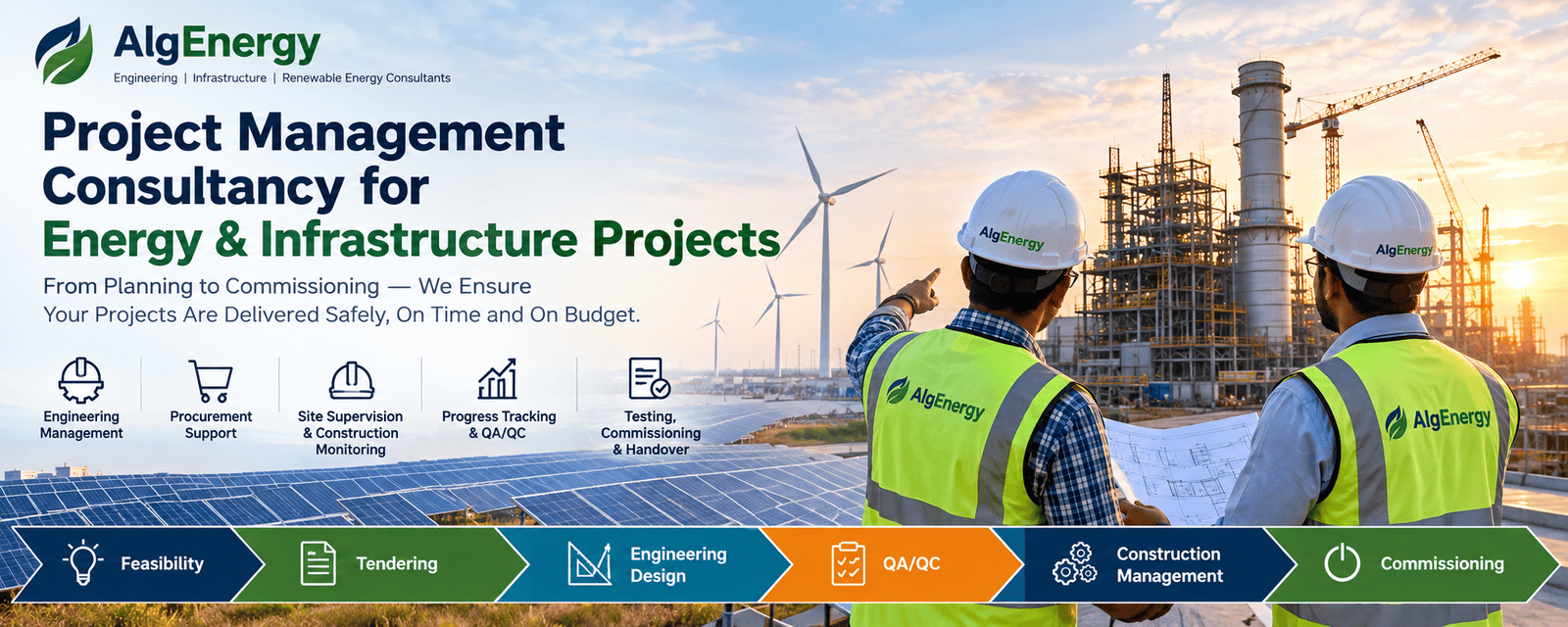
Introduction: Why Project Management Consultancy Matters in Energy and Infrastructure
Energy and infrastructure projects are becoming increasingly complex.
A modern project may involve multiple engineering disciplines, international equipment suppliers, EPC contractors, subcontractors, lenders, government authorities, technology providers and local construction teams. A project may also have demanding requirements for cost, schedule, quality, safety, environmental compliance, documentation and commissioning.
For project owners, developers and EPC contractors, managing these interfaces effectively can be as important as the engineering itself.
This is where project management consultancy for energy projects becomes valuable.
A professional Project Management Consultancy, commonly known as PMC, provides structured technical and management support throughout the project lifecycle. Depending on the contract and project requirements, the PMC may coordinate engineering, procurement, construction, quality, safety, progress monitoring, vendor interfaces, commissioning and handover.
The role is particularly valuable for:
Solar PV projects
Solar + BESS projects
Battery Energy Storage System projects
Thermal power projects
Hydro and pumped-storage projects
Industrial power and utility projects
Oil & gas infrastructure
LNG and gas-based projects
Water and wastewater projects
Manufacturing facilities
Industrial infrastructure
Transmission and electrical infrastructure
Large commercial and institutional infrastructure
A strong energy project PMC does not simply prepare progress reports. It creates a management and technical control framework that connects project objectives with actual engineering, procurement, construction and commissioning activities.
For international EPC contractors, this can also be delivered as an extended engineering and project-management team from India.
[AlgEnergy Engineering Consultancy Services] can support clients with multidisciplinary engineering, project management, site supervision, QA/QC, commissioning assistance, tender documentation and technical coordination across energy, infrastructure, industrial, renewable and water projects.
1. What Is Project Management Consultancy?
Project Management Consultancy (PMC) is a professional service through which an independent consultant or consulting organization supports the project owner, developer, investor or EPC organization in planning, coordinating, monitoring and controlling project execution.
The exact scope varies according to the project delivery model.
A PMC may act as:
Owner's representative
Project management consultant
Engineering management consultant
Owner's engineer
Construction management consultant
Technical advisor
Project execution consultant
Site supervision consultant
Engineering coordination consultant
The purpose is generally to ensure that project activities are performed according to approved scope, schedule, technical requirements, quality standards, contractual obligations and project objectives.
Project management frameworks are not limited to one specific industry. ISO 21502:2020 provides general guidance for project management applicable across organizations, project types, delivery approaches, complexity levels, sizes, costs and durations. ISO is currently developing a replacement edition, so project organizations should always verify the latest applicable requirements and project-specific procedures.
A PMC therefore needs to adapt its methodology to the actual project rather than simply applying a generic checklist.
1.1 PMC Across the Project Lifecycle
A typical project lifecycle can be represented as:
Feasibility → Concept → Engineering → Tendering → Procurement → Construction → Testing → Commissioning → Handover
A PMC may participate throughout this lifecycle or during selected phases.
For example, an owner may appoint a PMC from the feasibility stage to develop the project execution strategy.
An EPC contractor may appoint an engineering PMC consultant to manage multidisciplinary design coordination.
A financial investor may appoint an owner's engineer to independently review technical progress.
A project developer may appoint a construction management consultant during site execution.
The scope should therefore be clearly defined before appointment.
2. Why Energy Projects Need PMC
Energy projects combine technical complexity with significant commercial and schedule exposure.
Consider a utility-scale solar project.
The project may involve:
Land development
Geotechnical investigation
Solar resource assessment
PV module selection
Inverter selection
DC systems
AC systems
Transformers
Substations
Transmission systems
SCADA
Communication systems
Civil works
Roads
Drainage
Module mounting structures
Battery storage
Fire protection
Security
Operations and maintenance infrastructure
A delay in one package can affect several other packages.
For example:
Late inverter approval → delayed electrical design → delayed procurement → delayed cable installation → delayed testing → delayed commissioning.
Without effective project controls, such interface problems may remain hidden until they become critical.
A professional project management consultancy for energy projects establishes visibility across these interfaces.
2.1 Typical PMC Objectives
The objectives may include:
Maintaining project schedule
Controlling project scope
Monitoring engineering deliverables
Coordinating procurement
Tracking vendor documentation
Monitoring construction progress
Controlling quality
Supporting HSE coordination
Identifying project risks
Managing technical interfaces
Supporting testing and commissioning
Maintaining project documentation
Supporting handover
Improving communication between stakeholders
The objective is not simply to create reports.
The objective is to help management make better project decisions before problems become expensive.
3. Engineering Management
Engineering is the foundation of successful project execution.
Poor engineering coordination can create procurement delays, construction rework, equipment clashes, material shortages and commissioning problems.
For this reason, engineering project management should be treated as an important component of PMC services.
A PMC may coordinate:
Process engineering
Mechanical engineering
Piping engineering
Civil engineering
Structural engineering
Electrical engineering
Instrumentation and control
Fire protection
HVAC
Water and wastewater engineering
Architecture
Plant layout
Equipment engineering
Telecom and SCADA
Environmental engineering
3.1 Engineering Deliverable Management
A PMC can establish an engineering deliverables register containing:
Document number
Document title
Discipline
Revision
Planned submission date
Actual submission date
Review status
Client comments
Approval status
Required action
Responsible engineer
This provides management with a clear view of engineering performance.
3.2 Engineering Interface Management
Engineering disciplines rarely work independently.
Mechanical equipment affects:
Civil foundations
Structural supports
Electrical loads
Piping
Instrumentation
Operations
Maintenance access
Similarly, electrical equipment affects:
Civil buildings
Cable routing
HVAC
Fire protection
Structural requirements
Control systems
The PMC therefore has to identify interfaces early.
3.3 Design Review
Typical PMC design-review activities can include:
Review of design basis
Review of specifications
Drawing review
Design calculation review
Equipment datasheet review
P&ID review
GA drawing review
Layout review
Interdisciplinary checking
Constructability review
Operability review
Maintainability review
Safety review
Vendor document review
This helps convert engineering into construction-ready information.
4. Procurement and Vendor Coordination
Procurement is one of the most important links between engineering and construction.
A technically approved project can still experience major delays if equipment procurement is poorly coordinated.
A PMC may monitor the complete procurement cycle:
Technical Specification → RFQ → Bid Evaluation → Vendor Selection → Purchase Order → Vendor Engineering → Manufacturing → Inspection → Dispatch → Delivery
4.1 Technical Procurement Support
PMC support may include:
Preparation/review of technical specifications
Technical bid evaluation
Vendor comparison
Vendor clarification
Purchase specification review
Vendor drawing review
Vendor document review
Inspection coordination
Manufacturing progress monitoring
Expediting
Dispatch monitoring
Delivery tracking
4.2 Vendor Document Control
Major equipment packages often generate large quantities of technical documentation.
For example:
General arrangement drawings
Datasheets
Foundation drawings
Installation manuals
Operation manuals
Inspection and test plans
Quality certificates
Material certificates
Performance curves
Test reports
Spare-parts lists
Recommended maintenance schedules
The PMC should ensure that these documents are reviewed and incorporated into the project document-control system.
4.3 Expediting
Equipment delays can directly affect construction.
An effective project monitoring system should therefore identify long-lead items.
Typical long-lead equipment may include:
Transformers
Switchgear
Generators
Turbines
Pumps
Compressors
Pressure vessels
Storage tanks
BESS equipment
Inverters
Solar modules
Substation equipment
Specialized water-treatment equipment
The PMC can maintain an equipment expediting register to identify potential delays before they affect the critical path.
5. Construction Monitoring
Construction is where engineering becomes physical infrastructure.
A construction management consultant helps the owner understand whether actual site progress corresponds with the approved project plan.
Construction monitoring may include:
Civil works
Foundations
Structural erection
Equipment installation
Piping installation
Electrical installation
Instrumentation
Cable installation
Buildings
Roads
Drainage
Utility systems
Fire protection
Mechanical systems
Water systems
Testing activities
5.1 Physical Progress vs Reported Progress
One of the most important PMC responsibilities is verifying reported progress.
A contractor may report:
80% complete
But the PMC should ask:
What is the basis of the percentage?
Is material installed?
Is installation complete?
Has inspection been completed?
Are punch points closed?
Is the system ready for testing?
Is the activity on the critical path?
Has engineering approval been received?
This distinction between reported progress and verified progress is essential.
6. Site Supervision Services
Site supervision services provide technical oversight during construction and installation.
The purpose is not necessarily to replace the contractor's site management team.
Instead, the consultant represents the owner's technical interests and verifies that work is being executed according to approved requirements.
Site supervision may cover:
Work inspection
Drawing verification
Material verification
Installation inspection
Method statement review
Inspection and test plan monitoring
Quality coordination
Technical clarification
Progress verification
Punch-list preparation
Interface coordination
Testing support
6.1 Site Supervision for Energy Projects
For energy projects, site supervision may be required for:
Equipment foundations
Mechanical equipment installation
Piping installation
Storage tanks
Pumps
Cooling systems
Fire protection systems
Electrical equipment
Transformers
Switchgear
Cable installation
Solar structures
PV modules
BESS installation
Water treatment systems
The scope should always be aligned with the project risk profile.
6.2 Site Inspection Reports
A professional site inspection report may include:
Date
Location
Weather conditions where relevant
Work fronts inspected
Manpower
Equipment
Work progress
Quality observations
Safety observations
Material status
Engineering issues
Constraints
Photographs
Action items
Responsible person
Target completion date
These reports become valuable project records.
7. Progress Tracking and Project Monitoring Services
Project monitoring services are central to PMC.
A project needs measurable indicators that management can use to understand whether execution is progressing as planned.
Typical indicators include:
Engineering progress
Procurement progress
Manufacturing progress
Material delivery
Construction progress
Testing progress
Commissioning progress
Cost performance
Schedule performance
Critical-path activities
Open technical issues
Open RFIs
Open NCRs
Punch points
Safety observations
7.1 Project Schedule Management
The project schedule should identify:
Engineering activities
Procurement activities
Manufacturing
Logistics
Construction
Testing
Commissioning
Handover
The PMC can monitor:
Baseline → Planned → Actual → Forecast
This helps identify schedule slippage.
7.2 Look-Ahead Planning
A two-week, three-week or four-week look-ahead schedule can identify upcoming constraints.
For example:
Upcoming activity
Pump installation.
Required prerequisites
Foundation complete
Anchor bolts verified
Pump delivered
Lifting plan approved
Installation drawings approved
Mechanical crew available
Crane available
QA/QC inspection plan available
If one prerequisite is missing, installation may be delayed.
Look-ahead planning helps prevent such situations.
8. QA/QC Management
Quality management is not simply inspection after work is completed.
Quality should be integrated into engineering, procurement and construction.
A PMC may coordinate:
Quality plans
Inspection and Test Plans
Method statements
Material approvals
Vendor inspection
Site inspection
Test records
Non-conformance reports
Corrective actions
Punch-list management
Final documentation
8.1 Quality Documentation
Typical quality documentation includes:
Material test certificates
Inspection reports
Welding records
NDT reports
Calibration certificates
Equipment test reports
Factory acceptance test records
Site acceptance test records
Installation checklists
Pressure-test records
Electrical test records
Commissioning records
The PMC can monitor whether these documents are complete and traceable.
8.2 NCR Management
A Non-Conformance Report should not become a forgotten document.
The PMC can maintain an NCR register containing:
NCR number
Description
Location
Responsible contractor
Root cause
Corrective action
Target date
Actual closure
Verification
This creates accountability.
9. HSE Coordination
Health, safety and environmental requirements should be integrated into project execution.
International construction projects may involve different legal frameworks, client requirements and contractor systems.
The ILO's revised Code of Practice on Safety and Health in Construction emphasizes prevention, risk control and safety and health throughout the construction project lifecycle.
A PMC can coordinate with the project's HSE organization to monitor:
Permit-to-work systems
Work-at-height controls
Lifting activities
Electrical safety
Excavation safety
Confined-space activities
Fire prevention
Emergency preparedness
PPE compliance
Site housekeeping
Environmental controls
The PMC should not replace statutory HSE responsibilities unless specifically contracted to do so.
Instead, its role should be clearly defined.
10. Installation Verification
Installation verification is a critical bridge between construction and commissioning.
A piece of equipment may have arrived on site, but that does not mean it is ready for operation.
The PMC may verify:
Correct equipment
Correct location
Correct orientation
Foundation condition
Alignment
Supports
Piping connections
Electrical connections
Instrument connections
Access
Insulation
Earthing
Identification
Safety requirements
10.1 Mechanical Installation
For mechanical equipment, verification may include:
Equipment tag
Foundation
Alignment
Anchor bolts
Nozzle orientation
Piping connection
Lubrication
Coupling
Guards
Rotation direction
10.2 Electrical Installation
Verification may include:
Equipment rating
Cable routing
Termination
Earthing
Protection
Insulation resistance
Identification
Panel installation
Transformer installation
10.3 Piping Installation
Piping checks may include:
Correct line number
Pipe specification
Routing
Supports
Valve orientation
Flange alignment
Welding
Testing
Drain and vent arrangement
Insulation
Painting
These checks reduce commissioning problems.
11. Testing and Commissioning
Commissioning is where the project demonstrates that the installed systems can operate as intended.
A PMC can support commissioning planning and coordination from an early stage rather than waiting until construction is complete.
11.1 Commissioning Preparation
Typical activities include:
Commissioning philosophy
System identification
System boundaries
Test procedures
Pre-commissioning requirements
Inspection status
Punch-list management
Utility availability
Vendor support
Test equipment
Documentation
11.2 System-Based Commissioning
Large projects should generally be divided into manageable systems.
For example, a power project may include:
Water system
Fire protection system
Electrical distribution
Cooling water
Fuel system
Compressed air
HVAC
Control system
Emergency power
Process system
Each system can have its own:
Mechanical completion status
Punch list
Testing status
Pre-commissioning status
Commissioning status
Acceptance status
This creates a controlled path to project completion.
12. Documentation and Handover
A project is not complete merely because equipment is operating.
The owner also needs complete technical documentation.
Handover documentation may include:
As-built drawings
Equipment datasheets
Vendor documents
Operation manuals
Maintenance manuals
Test certificates
Commissioning records
Warranty documents
Spare-parts lists
Calibration certificates
Inspection records
Training records
Asset registers
Punch-list closure records
12.1 Digital Document Control
A modern PMC should establish document-control procedures covering:
Document numbering
Revision control
Approval status
Distribution
Transmittals
Comments
Closure
Archiving
Poor document control can create significant problems during operations.
13. PMC vs EPC: What Is the Difference?
One of the most common questions from project owners is:
What is the difference between PMC and EPC?
An EPC contractor normally has responsibility for engineering, procurement and construction under its contractual scope.
A PMC generally provides management, coordination, technical oversight and monitoring on behalf of the client or project owner.
| Area | PMC | EPC |
|---|---|---|
| Project management | Yes | Yes |
| Engineering | Review/coordination or defined engineering scope | Usually full EPC engineering |
| Procurement | Monitor/coordinate | Execute procurement |
| Construction | Monitor/supervise | Execute |
| Contractor management | Monitor/coordinate | Direct responsibility |
| Quality oversight | Yes | Own QA/QC system |
| Site supervision | Often | Yes |
| Commissioning | Coordinate/support | Execute |
| Commercial responsibility | Depends on contract | Major contractual responsibility |
| Project risk | Defined consultancy risk | Significant delivery risk |
The exact allocation depends on the contract.
FIDIC's Client/Consultant Model Services Agreement, commonly known as the White Book, is designed for consulting-engineering services including feasibility studies, detailed design, construction administration and project management. FIDIC also emphasizes that roles between an Engineer and a separate Project or Program Manager should be clearly delineated.
Therefore, a strong PMC contract should clearly define:
Authority
Responsibility
Deliverables
Reporting
Approval rights
Interface responsibilities
Commercial boundaries
Site responsibilities
HSE responsibilities
Contract administration responsibilities
14. Owner's Engineer and PMC Services
Owner's engineer services are particularly important for project developers, investors and lenders who require independent technical oversight.
The owner's engineer can support:
Technical due diligence
Design review
Equipment review
EPC contractor evaluation
Construction monitoring
Progress verification
Quality review
Testing
Commissioning
Performance assessment
Handover
For an investor, the owner's engineer provides an independent technical perspective.
For a developer, the owner's engineer can strengthen internal project-management capabilities.
For a financial institution, technical monitoring can help establish whether the project is progressing according to the technical and contractual framework.
15. Project Management Consultancy for Solar Projects
Solar projects may appear relatively simple compared with thermal or industrial projects, but utility-scale solar developments involve numerous technical and construction interfaces.
Project management consultancy for solar projects can cover:
Site development
Land and access coordination
Civil works
Module procurement
Inverter procurement
Mounting structures
DC systems
AC systems
Transformers
Substations
SCADA
Communication
Weather stations
Security
Drainage
Roads
Testing
Grid synchronization
15.1 Solar Project PMC Deliverables
Typical deliverables can include:
Project execution plan
Master schedule
Engineering deliverables register
Procurement tracker
Vendor tracker
Construction progress report
Site inspection report
Quality report
Risk register
Issue register
Monthly progress report
Commissioning plan
Handover checklist
For solar projects with storage, additional coordination is required.
16. PMC Services for Solar + BESS Projects
Solar-plus-storage projects introduce another layer of complexity.
The PMC may need to coordinate:
PV generation
Battery system
Power conversion system
Transformers
MV systems
HVAC
Fire protection
Battery management system
Energy management system
SCADA
Protection
Civil infrastructure
Grid interface
The project must be managed as an integrated energy system.
For example, a BESS delivery delay can affect:
Container installation
HVAC
Fire protection
Electrical connections
SCADA integration
Testing
Grid synchronization
Commercial operation
Therefore, energy project PMC services should identify storage-related critical paths early.
17. PMC Services for Power Projects
PMC services for power projects can be applied to:
Thermal power plants
Renewable power plants
Hydro projects
Pumped-storage projects
Captive power plants
Industrial power systems
Substations
Transmission systems
Power evacuation systems
Hybrid power projects
A power project may have hundreds or thousands of engineering interfaces.
Typical PMC responsibilities may include:
Engineering coordination
BOP coordination
Equipment tracking
Piping monitoring
Electrical monitoring
Civil coordination
Vendor coordination
Construction monitoring
QA/QC
Testing
Commissioning
For projects involving multiple contractors, the PMC becomes particularly valuable as an interface-management organization.
18. Project Execution Consultant for Industrial Projects
Industrial projects have their own execution challenges.
A project execution consultant for industrial projects may support:
Plant expansion
Manufacturing facilities
Utility systems
Process plants
Warehouses
Industrial infrastructure
Water systems
Fire protection
HVAC
Compressed air
Cooling water
Steam systems
Fuel systems
Electrical systems
The consultant must understand both engineering and construction realities.
For example, a new process pump may require:
Mechanical equipment
Foundation
Piping
Electrical power
Instrumentation
Control logic
Drainage
Access
Maintenance space
Project execution is therefore inherently multidisciplinary.
19. Infrastructure PMC Services
Infrastructure PMC services can support projects such as:
Industrial parks
Water infrastructure
Roads and site development
Utility infrastructure
Buildings
Institutional infrastructure
Energy infrastructure
Pumping stations
Water treatment facilities
Wastewater facilities
Electrical infrastructure
The exact PMC scope depends on project complexity.
A multidisciplinary consultant can provide value by connecting civil, mechanical, electrical, water, MEP and project-management requirements.
20. Engineering PMC Services for International EPC Contractors
International EPC contractors frequently face fluctuating engineering workloads.
A major project award can create a temporary requirement for additional engineering resources.
Instead of building a permanent team, an EPC contractor can use an offshore engineering partner.
This model can provide:
Engineering resource augmentation
Design support
Drawing production
Engineering checking
Technical documentation
Vendor document review
Procurement engineering
Project engineering
Project controls
Technical coordination
QA/QC support
Site engineering support
An engineering PMC consultant India can therefore function as an extension of an international EPC contractor's engineering organization.
The most effective model is not simply outsourcing drawings.
It is integrated engineering support.
21. Benefits of Outsourcing PMC and Engineering Support from India
International project organizations increasingly consider distributed engineering models.
India can offer access to multidisciplinary engineering resources across:
Mechanical
Civil
Structural
Electrical
Instrumentation
Piping
Process
Fire protection
HVAC
Water
Renewable energy
Project management
For international clients, the potential benefits include:
Technical capacity
Access to engineers across multiple disciplines.
Flexible staffing
Resources can be scaled according to project workload.
Cost efficiency
Engineering activities can be performed through an offshore delivery model.
Extended project support
Engineering teams can support project execution across different time zones.
Documentation capability
Large engineering deliverables can be coordinated through structured document systems.
Multidisciplinary integration
Multiple engineering disciplines can work under one consultancy framework.
However, cost should not be the only selection criterion.
The consultant must understand:
International codes
Client specifications
Project documentation
Engineering interfaces
Procurement requirements
Construction constraints
QA/QC requirements
Commissioning requirements
Communication protocols
22. Project Controls and Risk Management
A good PMC does not wait for problems to occur.
It identifies potential problems early.
A project risk register may include:
| Risk | Probability | Impact | Mitigation | Owner |
|---|---|---|---|---|
| Equipment delay | Medium | High | Early procurement | Procurement |
| Design delay | Medium | High | Engineering tracker | Engineering |
| Material shortage | Medium | High | Procurement monitoring | Contractor |
| Civil delay | Medium | Medium | Look-ahead planning | Construction |
| Interface conflict | High | High | Coordination meetings | PMC |
| Testing delay | Medium | High | Commissioning planning | Commissioning |
| Quality issue | Medium | High | Inspection plan | QA/QC |
Risk management should be dynamic.
New risks should be added.
Closed risks should be documented.
High-impact risks should be escalated.
23. Change Management
Energy and infrastructure projects rarely remain exactly as originally designed.
Changes may arise from:
Client requirements
Site conditions
Equipment availability
Regulatory requirements
Vendor recommendations
Constructability
Cost optimization
Design development
Grid requirements
A PMC can establish a change-control process.
Every significant change should be evaluated for:
Scope
Cost
Schedule
Engineering
Procurement
Construction
Safety
Quality
Commissioning
Documentation
A small engineering change can sometimes create significant downstream effects.
Therefore, changes should be controlled rather than informally implemented.
24. Interface Management
Interface management is one of the most valuable functions of a PMC.
Consider a substation.
It may involve:
Civil contractor
Electrical contractor
Transformer supplier
Protection supplier
SCADA supplier
Transmission contractor
Utility
Testing agency
Each party has a different scope.
The PMC can create an interface matrix.
Example
| Interface | Party A | Party B | Required Action |
|---|---|---|---|
| Transformer foundation | Civil | Electrical | Confirm dimensions |
| Cable trench | Civil | Electrical | Coordinate route |
| SCADA | Electrical | C&I | Confirm protocol |
| Grid connection | EPC | Utility | Approval |
| Fire protection | Mechanical | Electrical | Interface design |
This reduces scope gaps.
25. Construction Management Consultant Responsibilities
A construction management consultant may perform different levels of responsibility depending on the contract.
Typical services include:
Pre-construction
Construction planning
Contractor mobilization
Site readiness
Temporary facilities
Construction methodology
Resource planning
Construction
Progress monitoring
Quality coordination
Site inspection
Technical clarification
Contractor coordination
Material monitoring
Safety coordination
Completion
Punch-list management
Testing
Commissioning
Documentation
Handover
The PMC should maintain clear boundaries between monitoring and direct construction responsibility.
26. Monthly Project Progress Reporting
A professional monthly report should answer five basic questions:
Where are we?
Where should we be?
Why is there a difference?
What is the impact?
What action is required?
A typical report can contain:
Executive summary
Project dashboard
Engineering progress
Procurement progress
Construction progress
Schedule status
Cost status
Quality
HSE
Risks
Issues
Vendor status
Photographs
Decisions required
Action tracker
Forecast
The executive summary should not simply repeat the detailed report.
It should highlight decisions.
27. What Should Be Included in a PMC Scope of Work?
A good PMC scope should clearly define:
Project objectives
What is the consultant expected to achieve?
Project boundaries
Which packages and locations are included?
Engineering responsibilities
Which disciplines and deliverables are covered?
Procurement responsibilities
Will the PMC monitor procurement or execute it?
Construction responsibilities
Will the consultant supervise, inspect or manage construction?
Quality
What inspection and QA/QC responsibilities are included?
HSE
What HSE monitoring responsibilities are included?
Schedule
What project controls are required?
Reporting
What reports are required and how frequently?
Commissioning
What level of commissioning support is expected?
Handover
What documentation and closeout services are required?
This clarity reduces disputes later.
28. How to Select a PMC Consultant
Choosing the right PMC consultant is a strategic decision.
The lowest consultancy fee does not necessarily provide the lowest project cost.
Evaluate the consultant on:
1. Relevant project experience
Has the consultant worked on similar energy or infrastructure projects?
2. Multidisciplinary capability
Can the consultant coordinate mechanical, civil, electrical, C&I, water and other disciplines?
3. Site experience
Does the team understand actual construction conditions?
4. Engineering capability
Can the consultant understand and challenge engineering decisions?
5. Procurement knowledge
Can the consultant evaluate vendor and procurement risks?
6. Project controls
Does the organization have structured reporting and monitoring systems?
7. QA/QC
Can the consultant manage quality documentation and inspection processes?
8. Commissioning experience
Can the consultant support the transition from construction to operations?
9. International project capability
Can the consultant work with international EPC contractors, specifications and documentation systems?
10. Communication
Does the consultant provide clear, decision-oriented reporting?
29. Why Multidisciplinary PMC Is Better Than Isolated Project Support
An energy project does not operate in disciplinary silos.
A mechanical problem may create an electrical problem.
A civil change may affect piping.
A piping change may affect equipment.
A vendor change may affect commissioning.
Therefore, multidisciplinary PMC can provide stronger project visibility.
For example:
Equipment Selection
↓
Foundation
↓
Piping
↓
Electrical
↓
Instrumentation
↓
Civil Access
↓
Testing
↓
Commissioning
Each stage needs interface management.
A multidisciplinary PMC understands these connections.
30. AlgEnergy Approach to Project Management Consultancy
AlgEnergy Engineering Consultancy Services positions project management as part of a broader engineering lifecycle rather than as an isolated reporting activity.
The company's current service portfolio covers multidisciplinary engineering, feasibility, detailed engineering, tender documentation, technical/vendor coordination, project management and site supervision, QA/QC and commissioning support.
This integrated approach can be represented as:
Feasibility
↓
Concept Engineering
↓
Detailed Engineering
↓
Tendering
↓
Procurement
↓
Project Execution
↓
QA/QC
↓
Testing & Commissioning
The benefit of this approach is continuity.
The team involved in engineering can understand the execution requirements.
The team involved in project management can understand the technical basis.
The site team can communicate construction constraints back to engineering.
This reduces the disconnect that can occur when engineering and project execution are treated as separate activities.
31. Energy and Infrastructure Sectors Supported by PMC
Project management consultancy can be applied across a wide range of sectors.
Renewable Energy
Solar PV
Floating solar
Solar + BESS
Wind
Hybrid renewable projects
Power
Thermal power
Captive power
Balance-of-plant systems
Power evacuation
Electrical infrastructure
Energy Storage
BESS
Battery integration
Power conversion systems
Grid-connected storage
Industrial
Manufacturing
Utilities
Process infrastructure
Industrial energy systems
Water
WTP
ETP
STP
Pumping systems
Industrial wastewater
Utility water
Oil & Gas
Storage
LNG infrastructure
Fuel systems
Utility systems
Piping
Infrastructure
Industrial infrastructure
Utility infrastructure
Roads and site development
Buildings
Institutional projects
32. When Should You Appoint a PMC?
There is no single answer.
A PMC can be appointed during:
Development stage
When the project requires feasibility, planning and technical advisory.
Pre-EPC stage
When the owner needs tender preparation and contractor evaluation.
EPC award stage
When the project needs engineering and procurement coordination.
Construction stage
When the owner requires site supervision and project monitoring.
Commissioning stage
When the project needs independent completion and commissioning support.
Entire lifecycle
For complex projects, a PMC can support the project from development through handover.
Early appointment can provide an advantage because project-management processes are established before major execution activities begin.
33. PMC Deliverables Checklist
A typical project management consultancy deliverable structure may include:
Project Management
Project execution plan
Organization chart
Responsibility matrix
Communication plan
Meeting schedule
Action tracker
Engineering
Engineering deliverables register
Design review comments
Interface register
Technical query register
Procurement
Procurement tracker
Vendor list
Technical bid evaluation
Vendor document register
Expediting report
Construction
Site inspection reports
Progress reports
Look-ahead schedules
Resource reports
Construction photographs
QA/QC
Inspection reports
NCR register
ITP monitoring
Material approval tracker
Test records
HSE
HSE observation tracking
Safety meeting records
Permit monitoring
Incident tracking
Commissioning
Commissioning plan
System completion register
Punch-list register
Test records
Commissioning reports
Handover
As-built drawings
O&M manuals
Certificates
Training records
Warranty documents
Final dossier
34. The Commercial Value of Professional PMC
The commercial value of PMC should not be measured only by consultancy fees.
The larger question is:
How much project risk can effective management prevent or reduce?
Consider a hypothetical project where:
Engineering delay causes procurement delay
Procurement delay causes construction delay
Construction delay delays commissioning
Commissioning delay delays commercial operation
The financial impact may include:
Extended site overheads
Contractor claims
Idle resources
Financing costs
Lost revenue
Additional supervision
Rework
Expediting costs
A relatively small investment in project management can therefore have a much larger impact on project economics.
The PMC's role is to identify such risks early.
35. PMC for International EPC Contractors
International EPC contractors may not always need a full external PMC.
Sometimes they need a flexible technical support partner.
For example:
Scenario 1 — Engineering Backlog
An EPC contractor wins three projects simultaneously and needs additional engineering resources.
An offshore engineering PMC team can support selected disciplines.
Scenario 2 — Site Execution
The contractor has a local construction team but requires independent engineering coordination.
A project execution consultant can support engineering and site interfaces.
Scenario 3 — Owner's Engineer
A developer wants independent technical oversight of an EPC contractor.
An owner's engineer can perform technical review and progress monitoring.
Scenario 4 — Tender Preparation
An EPC contractor needs additional support preparing tender drawings, specifications and BOQs.
An engineering consultancy can provide the required documentation.
Scenario 5 — Commissioning
The owner requires an independent team to verify completion before commercial operation.
A PMC can support system completion and commissioning readiness.
This flexible model is particularly relevant for international project organizations.
36. Engineering PMC Consultant India for Global Projects
India's engineering sector offers a large multidisciplinary talent base.
For global clients, the important question is not simply:
“Can the work be done from India?”
The more important questions are:
Can the consultant understand international requirements?
Can the consultant work with EPC procedures?
Can the team use client templates?
Can the team coordinate across time zones?
Can the consultant manage document control?
Can engineering quality be independently checked?
Can the team understand construction implications?
Can the team communicate clearly?
A capable engineering PMC consultant India should therefore operate as an extension of the client's organization.
The objective is seamless integration rather than a disconnected outsourcing model.
37. Future of Project Management Consultancy
PMC is changing.
Digital project management, cloud document systems, BIM, 3D coordination, data analytics and automated reporting are changing how projects are monitored.
Future PMC systems are likely to place greater emphasis on:
Real-time progress data
Digital dashboards
Predictive risk analysis
Integrated document control
3D model coordination
Mobile site reporting
Automated reporting
Digital quality records
Data-driven decision making
However, technology cannot replace engineering judgment.
A dashboard may show that a project is delayed.
An experienced project engineer needs to understand why.
The future PMC model is therefore likely to combine:
Engineering expertise + project controls + site knowledge + digital tools + data-driven decision making.
38. Practical Questions to Ask Before Hiring a PMC
Before appointing a consultant, the project owner should ask:
Technical
Does the team understand our technology?
Can they review engineering documents?
Can they manage interfaces?
Project
Can they manage schedules?
Can they identify critical-path risks?
Can they coordinate contractors?
Procurement
Can they monitor long-lead equipment?
Can they review vendor documents?
Can they support technical evaluation?
Construction
Can they provide site supervision?
Can they verify physical progress?
Can they manage punch lists?
Quality
Can they monitor QA/QC?
Can they manage NCRs?
Can they verify testing?
Commissioning
Can they support system completion?
Can they coordinate commissioning?
Can they manage handover documentation?
International
Can they work with international EPC organizations?
Can they follow client standards?
Can they work with international contract structures?
39. FAQs About Project Management Consultancy for Energy Projects
What is project management consultancy for energy projects?
Project management consultancy for energy projects provides professional technical and management support for planning, engineering coordination, procurement monitoring, construction supervision, quality management, progress tracking, commissioning and project handover.
What does an energy project PMC do?
An energy project PMC coordinates and monitors engineering, procurement, construction, quality, HSE interfaces, project schedules, testing, commissioning and documentation according to the agreed scope.
What is the difference between PMC and EPC?
EPC generally involves engineering, procurement and construction delivery under a defined contractual scope. PMC generally provides management, technical oversight, coordination and monitoring on behalf of the owner or another project stakeholder.
What are owner's engineer services?
Owner's engineer services provide independent technical support to project owners, developers or investors. They may include design review, EPC contractor evaluation, construction monitoring, quality review, commissioning and technical due diligence.
Can PMC services be used for solar projects?
Yes. Project management consultancy for solar projects can cover engineering, procurement, construction, quality, progress monitoring, grid interface, testing and commissioning.
Can PMC support BESS projects?
Yes. BESS projects require coordination between battery systems, PCS, transformers, MV systems, HVAC, fire protection, EMS, BMS, SCADA, civil works and grid interfaces.
What are site supervision services?
Site supervision services involve monitoring and verifying construction and installation activities against approved drawings, specifications, quality requirements and project procedures.
Can an Indian PMC support international projects?
Yes. An Indian engineering consultancy can provide offshore engineering, project-management, technical coordination and project-support services to international EPC contractors and project owners, subject to project requirements and applicable regulations.
What industries require infrastructure PMC services?
Infrastructure PMC services can be used for energy, water, industrial, manufacturing, utility, transportation, institutional and other infrastructure projects.
How does PMC reduce project risk?
PMC reduces project risk by creating structured controls for engineering, procurement, construction, schedule, quality, interfaces, documentation, commissioning and project reporting.
When should a PMC be appointed?
A PMC can be appointed during feasibility, tendering, EPC award, construction, commissioning or throughout the entire project lifecycle. The appropriate timing depends on project complexity and owner requirements.
What should a PMC scope of work include?
A PMC scope should define project objectives, engineering responsibilities, procurement monitoring, construction supervision, quality, HSE coordination, schedule management, reporting, commissioning, documentation and handover responsibilities.
40. Conclusion: Choosing the Right Project Management Partner
Successful energy and infrastructure projects require more than engineering drawings and construction resources.
They require coordination.
They require visibility.
They require disciplined project controls.
They require timely technical decisions.
They require strong communication between engineering, procurement, vendors, contractors and owners.
This is the fundamental role of professional project management consultancy for energy projects.
A capable PMC can help project owners and EPC contractors connect:
Engineering + Procurement + Construction + Quality + Safety + Commissioning + Commercial Objectives
For international companies, the right engineering partner can also provide a flexible combination of engineering PMC services, owner's engineer services, project monitoring services, site supervision services and project execution support from India.
AlgEnergy Engineering Consultancy Services provides multidisciplinary engineering and project support across energy, infrastructure, industrial, renewable, water and related sectors. Its current service portfolio includes feasibility and project planning, detailed engineering, tender documentation, technical/vendor coordination, project management and site supervision, QA/QC and commissioning support.
The most effective PMC relationship is not simply that of a reporting consultant.
It is a technical partnership focused on project outcomes.
If your organization is developing a solar plant, BESS facility, power project, industrial facility, water infrastructure project or other major energy/infrastructure development, a clearly defined PMC strategy can improve project visibility and strengthen execution control.
Talk to AlgEnergy About Your Project
If you are an:
International EPC contractor
Renewable energy developer
IPP
Utility
Industrial project owner
Infrastructure developer
Investor
Government organization
Engineering contractor
and require additional engineering or project-management capacity, AlgEnergy can discuss a suitable consultancy model.
Possible engagement models include:
Full-project PMC
Owner's engineer
Engineering PMC
Project execution support
Site supervision
Construction monitoring
Engineering coordination
Procurement and vendor coordination
QA/QC support
Commissioning support
Offshore engineering support
Multidisciplinary engineering outsourcing
Talk to an AlgEnergy Project Management Consultant and discuss your project scope, schedule, engineering requirements and execution challenges.
Recommended Internal Linking Structure for This Blog
Use contextual internal links rather than placing all links in one block.
Feasibility
energy project feasibility study
Engineering Design
multidisciplinary engineering design services
.Tendering
EPC tender documentation and bid support
QA/QC
Commissioning
testing and commissioning support
Main Company Page
AlgEnergy Engineering Consultancy Services
Recommended Blogger Internal-Link Strategy
For the Blogger version, this article should become a supporting content asset rather than competing with the main commercial website.
The Blogger article should link to the main AlgEnergy website using commercial/service anchors such as:
Project management consultancy services
Engineering consultancy services
Owner's engineer services
Renewable energy engineering
Multidisciplinary engineering
Technical due diligence
At the same time, the AlgEnergy website can link back to this detailed Blogger guide using a more informational anchor such as:
Complete guide to project management consultancy for energy and infrastructure projects
This creates a useful content relationship:
Commercial Website → Informational Blog → Commercial Service Page
rather than publishing two pages that are almost identical.
Recommended External Authority Links
For the final published version, add a small number of authoritative external references rather than dozens of outbound links.
Recommended sources include:
ISO 21502 — project-management guidance
PMI Standards — project-management standards and frameworks
FIDIC — consulting engineering and international project/contract frameworks
ILO Safety and Health in Construction — construction HSE reference
These external references strengthen topical credibility while keeping the page commercially focused.
Blogger Tags
Project Management Consultancy
Energy Project PMC
Engineering Consultancy
Energy Infrastructure
Project Management Services
Owner's Engineer
Site Supervision
Construction Management
Renewable Energy
Power Projects
EPC Contractors
Engineering Outsourcing India
Infrastructure Projects
the AlgEnergy website as the primary destination:
AlgEnergy Engineering Consultancy Services
For supporting informational content, use your Blogger publication:
AlgEnergy Engineering Services Blog
For project-management authority references, I recommend linking to ISO 21502, which provides general project-management guidance, and PMI's standards resources. ISO
ISO 21502 — Project Management Guidance
PMI Project Management Standards
For international consulting-engineering/contracting context, FIDIC's Client/Consultant Model Services Agreement is relevant because it explicitly covers consulting services such as feasibility, detailed design, construction administration and project management. FIDIC
FIDIC Client/Consultant Model Services Agreement
For construction HSE authority, the ILO's revised construction safety and health code is an appropriate external reference. International Labour Organization
ILO — Safety and Health in Construction
Google Business Profile: I recommend using the Google Profile as a conversion destination, not as a normal SEO article link. Add a natural CTA such as “View AlgEnergy Engineering Consultancy Services on Google” near the end of the Blogger version rather than repeatedly linking to the Google search URL.
YouTube: Similarly, use the YouTube Studio URL only for your own content-management workflow. On the published article, link to the public YouTube video URL, not the private Studio/content-management URL. If you publish a video for this article, the strongest strategy is to embed the public video near the introduction or immediately before the FAQ section.
The external references above are deliberately limited to high-authority sources; this is preferable to filling a commercial engineering article with low-value directory links. FIDIC also stresses clear delineation of responsibilities when a separate project/program manager is used, which supports the article's emphasis on defining PMC scope and authority clearly. FIDIC