
A Complete Guide to Cooling Water, Compressed Air, Fuel and Plant Water Systems
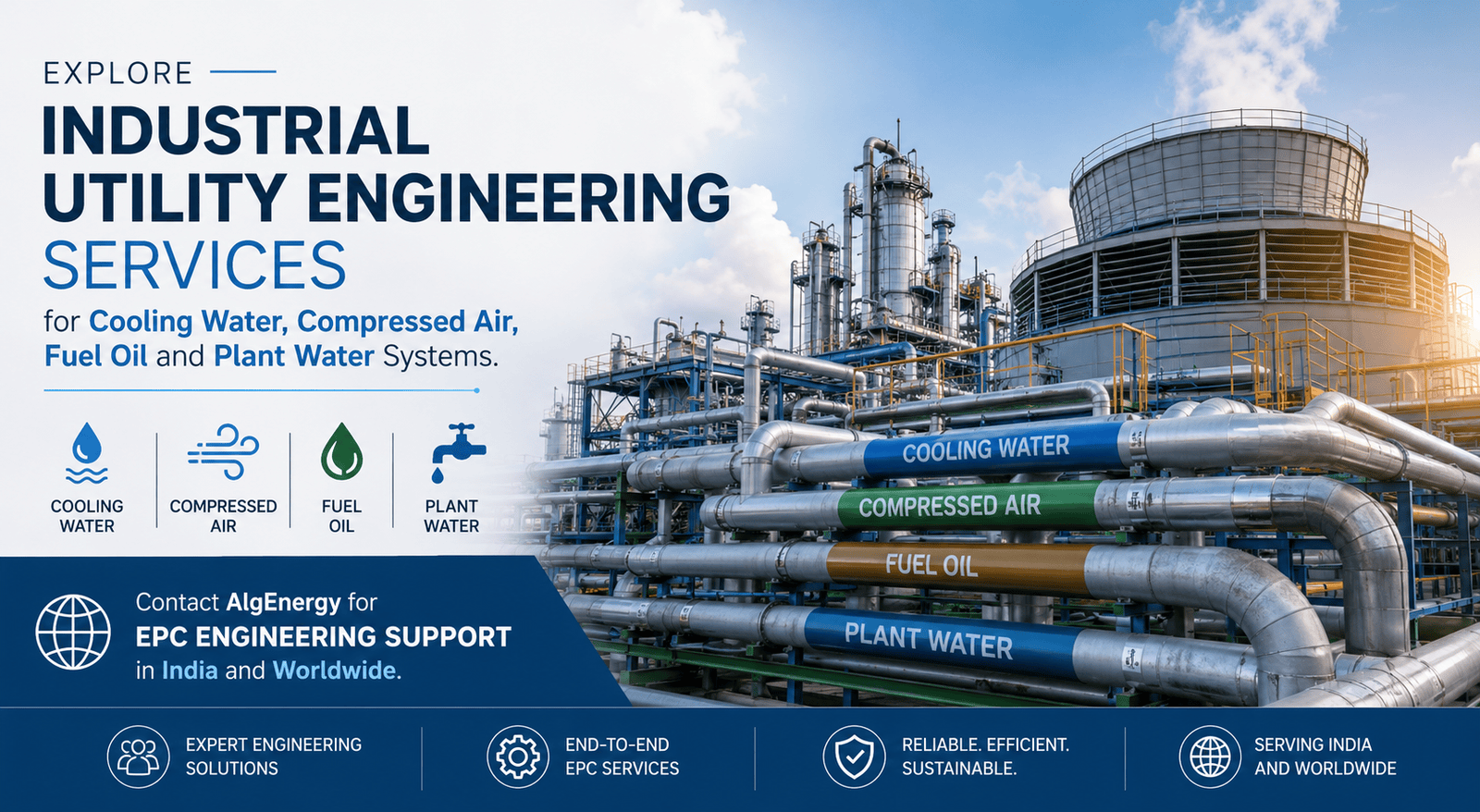
Introduction: Why Industrial Utility Engineering Matters
Industrial plants depend on reliable utility systems to operate safely, efficiently, and continuously. Whether a project involves a thermal power plant, manufacturing facility, process industry, infrastructure development, or energy project, its performance depends on the availability of properly engineered supporting systems.
Cooling water, compressed air, fuel oil, service water, potable water, firefighting water, and other plant utilities are essential to daily operations. These systems support equipment cooling, instrument operation, equipment cleaning, fuel transfer, process requirements, maintenance activities, and plant safety.
However, utility systems are sometimes treated as secondary engineering packages during project planning. In practice, inadequate utility engineering can create significant challenges, including insufficient flow rates, excessive pressure losses, equipment interface problems, piping congestion, difficult maintenance access, higher pumping costs, and construction delays.
This is why industrial utility engineering services are important for EPC contractors, engineering consultants, industrial developers, and project owners.
A well-developed utility engineering package establishes the technical basis for equipment selection, hydraulic calculations, piping design, plant layout, material specifications, procurement, and construction.
For projects in India and international markets, the objective is not simply to produce drawings. It is to develop coordinated, technically sound engineering deliverables that support project execution and long-term plant operation.
AlgEnergy Engineering Consultancy Services provides the starting point for organisations seeking engineering consultancy and design support for power, industrial, infrastructure, and renewable energy projects.
This guide explains the major industrial utility systems, their engineering requirements, essential design deliverables, coordination challenges, and how EPC contractors can benefit from specialist engineering support.
What Are Industrial Utility Engineering Services?
Industrial utility engineering services involve the engineering, design, documentation, and coordination of utility systems required to support industrial facilities and power plants.
These systems may not directly form part of the main production process, but they are essential to its operation.
For example, a thermal power plant requires cooling water for heat rejection, compressed air for instrumentation and plant services, fuel oil systems for applicable firing and auxiliary requirements, and water systems for different operational needs.
Similarly, a manufacturing plant may require cooling water, compressed air, service water, treated water, fuel distribution, drainage, and other common utilities.
The engineering scope depends on the facility, process requirements, project specifications, applicable regulations, operating conditions, and the division of responsibilities between the project owner and EPC contractor.
What Does an Industrial Utility Engineer Do?
An industrial utility engineer translates project requirements into coordinated engineering documents that can be reviewed, procured, constructed, tested, and maintained.
Typical responsibilities include:
Reviewing the project design basis and owner requirements.
Establishing utility demand and operating scenarios.
Preparing or reviewing process flow diagrams (PFDs).
Developing piping and instrumentation diagrams (P&IDs).
Preparing utility equipment and line lists.
Developing hydraulic calculations and equipment sizing inputs.
Coordinating equipment selection with relevant disciplines.
Developing equipment layouts and utility piping routing.
Preparing piping specifications and material take-offs.
Reviewing vendor drawings and technical submissions.
Coordinating mechanical, civil, structural, electrical, and instrumentation interfaces.
Supporting design reviews, constructability reviews, and technical documentation.
Addressing engineering comments and preparing revisions.
The objective is to create a coordinated engineering package that supports safe operation, efficient construction, and maintainable plant infrastructure.
1. Major Industrial Utility Systems Covered by Engineering Design
The scope of industrial utilities varies according to the facility. The following systems are commonly considered during industrial mechanical engineering and balance-of-plant engineering.
1.1 Cooling Water System Engineering
Cooling water systems remove unwanted heat from equipment and processes. They are important in thermal power plants, industrial manufacturing, chemical facilities, refineries, and other process-intensive installations.
The engineering approach depends on whether the facility uses a once-through system, a recirculating cooling water system, a closed-loop cooling circuit, or a combination of these arrangements.
Typical equipment includes:
Cooling water pumps.
Cooling towers.
Heat exchangers.
Water treatment equipment.
Strainers and filters.
Expansion tanks, where required.
Isolation and control valves.
Piping, fittings, and supporting structures.
Instrumentation for monitoring flow, pressure, temperature, and water quality.
Cooling water system design considerations
A. Cooling duty and water demand
The engineering team establishes the required cooling duty and corresponding water flow based on the heat load, allowable temperature rise, equipment requirements, and project operating conditions.
A simplified heat balance for water can be expressed as:
Q = m × Cp × ΔT
Where:
Q = heat transfer rate.
m = mass flow rate of water.
Cp = specific heat capacity.
ΔT = water temperature difference across the equipment or process.
This relationship provides a starting point for calculating cooling water requirements. Detailed design must account for actual operating conditions and equipment performance.
B. Hydraulic calculations
The cooling water network must provide the required flow and pressure at each consumer.
Calculations should consider pipe diameter, fluid velocity, friction losses, fittings, valves, elevation differences, heat exchanger pressure drops, and other system resistance.
C. Pump selection and system characteristics
Pump selection should reflect the calculated system duty, operating range, redundancy philosophy, and project requirements.
Engineers should assess the interaction between the pump performance curve and system resistance curve rather than selecting a pump solely on nominal flow rate.
D. Cooling tower coordination
For recirculating systems, cooling tower selection and arrangement depend on heat rejection requirements, ambient conditions, approach temperature, range, water quality, and operating philosophy.
The cooling tower layout must also accommodate maintenance access, air circulation, piping connections, and interactions with nearby buildings or equipment.
E. Material selection and corrosion control
Cooling water chemistry, operating temperature, pressure, and environmental conditions influence piping and equipment material selection.
The design should address corrosion, scaling, biological growth, erosion, and water treatment requirements where relevant.
Typical cooling water engineering deliverables
Depending on the project scope, deliverables may include:
Cooling water design basis.
Cooling water demand calculations.
Hydraulic calculation reports.
Cooling water PFDs and P&IDs.
Pump and heat exchanger data sheets.
Cooling tower interface documents.
Cooling water piping layouts.
Equipment general arrangement drawings.
Piping isometrics, where included.
Valve and instrument schedules.
Piping material specifications.
Equipment and line lists.
Material take-offs and bill of quantities.
Vendor drawing review comments.
A coordinated cooling water design helps reduce routing conflicts, improves equipment accessibility, and supports procurement and construction planning.
1.2 Compressed Air System Design
Compressed air is widely used in industrial plants for instrumentation, pneumatic controls, maintenance tools, cleaning applications, and other plant services.
In facilities with pneumatic instrumentation or control valves, instrument air quality and reliability are particularly important.
Industrial compressed air systems typically include air compressors, aftercoolers, moisture separators, air receivers, filters, dryers, distribution piping, and associated instruments.
The exact configuration depends on the required pressure, flow, air quality, operating conditions, and reliability requirements.
Instrument air versus service air
Instrument air and service air should not automatically be treated as interchangeable.
Instrument air generally requires controlled moisture and contaminant levels suitable for pneumatic instruments and control equipment.
Service air may serve general-purpose applications such as workshop tools and maintenance activities, subject to the intended use.
Where a common compressed air generation system supplies multiple networks, the distribution arrangement and treatment requirements must preserve the specified air quality at each point of use.
Key engineering considerations
A. Air demand assessment
The engineering team identifies connected consumers, normal demand, peak demand, intermittent loads, and credible simultaneous operating scenarios.
Demand assumptions should be documented so that compressor capacity is not based solely on the sum of equipment nameplate requirements.
B. Compressor capacity and redundancy
Compressor selection considers the required delivery pressure, capacity, operating range, energy efficiency, maintenance requirements, and availability philosophy.
Standby capacity may be required where interruption of the air supply could affect safe or continuous operation.
C. Air treatment
Moisture removal, filtration, and drying requirements depend on the specified dew point, ambient conditions, and downstream equipment requirements.
Treatment equipment should be selected and arranged according to the required air quality and the manufacturer's performance data.
D. Receiver sizing
Air receivers provide storage capacity and can help manage demand fluctuations and compressor cycling. Their sizing depends on system pressure, demand patterns, compressor control, and the required response to changes in consumption.
E. Distribution piping
Compressed air distribution design should address pressure drop, pipe routing, isolation, drainage, maintenance access, and the location of major consumers.
The design must also consider condensate management and appropriate arrangements for removing moisture from the system.
Compressed air engineering deliverables
A typical compressed air engineering package may include:
Compressed air demand calculations.
Compressor and dryer sizing inputs.
Air receiver sizing calculations.
PFDs and P&IDs.
Instrument air and service air distribution layouts.
Equipment layout drawings.
Piping routing and isometrics, where required.
Valve and instrument schedules.
Technical specifications and equipment data sheets.
Material take-offs.
Vendor document review.
Mechanical and instrumentation interface documentation.
Proper compressed air engineering helps avoid inadequate supply pressure, poor air quality, excessive leakage losses, and unnecessary energy consumption.
1.3 Fuel Oil System Engineering
Fuel oil systems may be required in thermal power plants, industrial boilers, emergency generators, and other facilities that use liquid fuels.
The system configuration depends on the fuel properties, required firing duty, storage capacity, burner requirements, applicable safety provisions, and project-specific operating philosophy.
A fuel oil system may include storage tanks, transfer pumps, filtration equipment, heating facilities where required, day tanks, supply and return piping, isolation valves, instruments, and connections to the relevant consumers.
Fuel oil engineering requirements
A. Fuel demand and storage capacity
The design basis should establish fuel consumption, operating hours, storage autonomy, delivery arrangements, and replenishment requirements.
Storage capacity should reflect project requirements and the applicable safety, environmental, and operating constraints.
B. Transfer and supply pump selection
Pump selection must consider the fuel's physical properties, operating temperature, required flow, system pressure, and equipment operating range.
Where viscosity changes significantly with temperature, the design must account for those changes.
C. Piping and pressure-loss calculations
Fuel oil piping design should consider flow requirements, friction losses, fittings, valves, elevation, pump characteristics, and the pressure requirements of downstream equipment.
D. Fuel heating and temperature control
Heating may be necessary for certain fuels to achieve suitable pumping or atomisation characteristics.
Where heating is required, the engineering design should establish temperature requirements, heating duty, control philosophy, insulation needs, and relevant safeguards.
E. Safety and environmental protection
The design should consider leak prevention, isolation, containment, drainage, fire protection interfaces, hazardous-area requirements where applicable, and emergency operating procedures.
Storage tank design, piping arrangements, and associated protection systems should comply with the applicable project specifications and statutory requirements.
Fuel oil piping engineering deliverables
Depending on the agreed scope, these may include:
Fuel oil system design basis.
Fuel consumption and transfer calculations.
Fuel oil PFDs and P&IDs.
Storage and day tank interface documentation.
Pump sizing calculations and data sheets.
Fuel oil piping layouts.
Piping isometric drawings.
Piping material specifications.
Valve and instrument schedules.
Equipment and line lists.
Material take-offs.
Vendor drawing reviews.
Fire protection and civil interface documents.
Fuel oil system engineering requires coordinated mechanical, piping, civil, electrical, instrumentation, and safety inputs.
1.4 Industrial Plant Water System Engineering
Water is used in industrial facilities for multiple purposes, including equipment cooling, cleaning, washing, process support, domestic consumption, and maintenance.
The engineering design should distinguish between different water qualities and uses rather than assuming that all consumers can be supplied from one common network.
Depending on the project, plant water systems may include:
Raw water supply.
Service water.
Potable water.
Treated water.
Demineralised water.
Cooling tower make-up water.
Process water.
Utility water.
Firewater.
Wastewater collection and treatment interfaces.
These systems have different quality, pressure, reliability, and regulatory requirements.
Key water system design considerations
Water balance: Establish the demand of individual consumers, normal and peak operating conditions, and expected losses.
Water quality: Determine the treatment requirements based on the intended use and the quality of the available source water.
Storage: Establish the required storage volume based on operating demand, supply reliability, and project design criteria.
Pumping: Select pumps based on flow, head, operating conditions, system resistance, and redundancy requirements.
Distribution: Develop piping networks that provide the required pressure and flow while maintaining access for operation and maintenance.
Treatment and wastewater interfaces: Coordinate with water treatment and wastewater specialists to ensure that the utility design reflects process requirements and applicable discharge or reuse criteria.
Typical plant water engineering deliverables
Water demand calculations and water balance.
Water system design basis.
Water supply and distribution PFDs.
P&IDs.
Pump and tank data sheets.
Hydraulic calculations.
Water treatment interface documents.
Equipment layouts.
Piping layouts and isometrics, where required.
Specifications and material take-offs.
Vendor document review comments.
For facilities with substantial water requirements, coordinated utility engineering can also support water efficiency, operational reliability, and better integration between supply, treatment, reuse, and disposal systems.
1.5 Other Industrial Utility Systems
In addition to the major systems discussed above, industrial utility engineering services may cover several supporting networks.
Firewater systems
Firewater engineering involves coordination with the project's fire protection design basis, hazard assessment, applicable codes, hydraulic requirements, and authority approvals.
Depending on the project, the scope may include firewater storage, pumping, distribution piping, hydrant networks, monitors, and interfaces with sprinkler or other fire protection systems.
Fire protection engineering should be undertaken by appropriately qualified specialists and coordinated with the relevant authorities.
Drainage and wastewater systems
Industrial drainage design may include oily water drainage, chemical drainage, stormwater drainage, sanitary wastewater, and other site-specific networks.
The design must account for the characteristics of the collected fluids, segregation requirements, site grading, hydraulic capacity, treatment interfaces, and applicable environmental requirements.
HVAC and ventilation interfaces
Utility engineering may also require coordination with heating, ventilation, and air-conditioning systems, equipment room cooling, ventilation requirements, and other building services.
These interfaces are important where mechanical equipment generates heat or requires controlled environmental conditions.
Nitrogen and other industrial gases
Certain facilities require nitrogen or other industrial gases for purging, blanketing, process support, or equipment protection.
These systems require careful consideration of gas properties, operating pressure, storage or supply arrangements, isolation, ventilation, and the hazards associated with the intended application.
The design basis must identify the relevant gas quality, demand, pressure, and applicable safety requirements.
2. Industrial Utility Engineering for Power Plants
Power plants depend on a network of utility systems that support the main generation process.
In thermal power plants, these systems may include cooling water, service water, instrument air, service air, fuel oil, firefighting water, drainage, and other balance-of-plant utilities.
Renewable energy and industrial facilities also require supporting systems, although their configuration and demand profiles differ.
2.1 Balance of Plant Engineering
Balance of plant, commonly referred to as BOP, includes supporting systems and facilities required for the operation of a power generation project beyond the main generating equipment.
The exact BOP scope varies by project and contract.
Mechanical BOP engineering may involve:
Utility system design.
Auxiliary piping systems.
Cooling water networks.
Fuel handling and transfer systems.
Compressed air systems.
Plant water systems.
Equipment layouts.
Mechanical equipment specifications.
Piping design and stress analysis interfaces.
Interdisciplinary design coordination.
The key objective is to ensure that individual utility packages function as an integrated plant system.
2.2 Coordination with Main Plant Equipment
Utility engineering requires interfaces with major equipment and other engineering disciplines.
For example, cooling water piping must connect to equipment nozzles and provide the specified flow and pressure.
Fuel oil systems must match the requirements of their intended consumers.
Compressed air distribution must satisfy the pressure and quality requirements of instruments and service users.
Water systems must be coordinated with treatment plants, storage tanks, and downstream consumers.
Equipment vendors may provide preliminary connection information during early engineering and more detailed requirements during procurement.
The engineering team must manage these changes and ensure that the relevant drawings, calculations, and specifications remain coordinated.
2.3 Plant Layout and Equipment Arrangement
Plant layout engineering determines the spatial arrangement of equipment, buildings, access routes, piping corridors, and supporting facilities.
Poor layout decisions can create unnecessary piping lengths, maintenance difficulties, access restrictions, and construction clashes.
Utility equipment arrangement should consider:
Equipment operating and maintenance clearances.
Pump suction and discharge arrangements.
Pipe routing and support locations.
Access for inspection and equipment removal.
Civil foundations and structural requirements.
Roadways and crane access.
Drainage and environmental considerations.
Electrical and instrumentation interfaces.
Future maintenance and replacement requirements.
Three-dimensional modelling and coordinated layout reviews can help identify potential conflicts before construction.
For more information about the company's engineering capabilities, visit AlgEnergy Engineering Consultancy Services.
3. Basic and Detailed Engineering for Industrial Utility Systems
A structured engineering process helps project teams move from initial requirements to coordinated, construction-ready documentation.
The exact stages and deliverables depend on the contract, project maturity, and scope of work.
3.1 Basic Engineering
Basic engineering establishes the technical foundation for subsequent detailed design.
Typical activities include:
Reviewing project requirements and available design documents.
Establishing the utility system design basis.
Identifying utility consumers and preliminary demand.
Developing preliminary PFDs and P&IDs.
Establishing equipment sizing requirements.
Preparing preliminary equipment lists and line lists.
Identifying major equipment and piping interfaces.
Developing preliminary layouts.
Preparing technical specifications and procurement inputs.
Identifying information gaps, design assumptions, and key risks.
The outcome should be a documented design basis that supports detailed engineering and equipment procurement.
3.2 Detailed Engineering
Detailed engineering develops the approved design into coordinated technical documents for procurement, fabrication, installation, testing, and commissioning.
Typical activities include:
Finalising equipment and utility demand calculations.
Developing detailed P&IDs.
Completing hydraulic calculations.
Preparing equipment layouts and piping arrangements.
Preparing piping isometrics where included in scope.
Developing piping material specifications.
Preparing valve and instrument schedules.
Preparing material take-offs.
Reviewing vendor drawings.
Coordinating supports and structural interfaces.
Resolving multidisciplinary design clashes.
Incorporating design review comments.
Maintaining document revisions and technical traceability.
Detailed engineering must use the applicable project specifications, approved vendor information, and relevant codes and standards.
3.3 Typical Engineering Deliverables Matrix
The following table provides an illustrative list of deliverables.
| Deliverable | Purpose | Typical project stage |
|---|---|---|
| Design basis | Establishes engineering assumptions and requirements | Basic engineering |
| Utility demand calculations | Quantifies flow, pressure, capacity, or consumption | Basic and detailed engineering |
| PFDs | Illustrate the major process and utility flow paths | Basic engineering |
| P&IDs | Define piping, valves, instruments, and control interfaces | Basic and detailed engineering |
| Equipment data sheets | Establish technical requirements for equipment | Basic and detailed engineering |
| Hydraulic calculations | Verify flow, head, pressure loss, and system performance | Detailed engineering |
| Equipment layout drawings | Define equipment arrangement and access | Basic and detailed engineering |
| Piping layout drawings | Define routing and spatial coordination | Detailed engineering |
| Piping isometrics | Support fabrication and installation | Detailed engineering |
| Piping specifications | Define piping materials, ratings, and component requirements | Basic and detailed engineering |
| Line and valve lists | Provide structured equipment and piping information | Detailed engineering |
| Material take-offs | Support material estimation and procurement | Detailed engineering |
| Vendor document review | Checks vendor submissions against project requirements | Procurement and detailed engineering |
| Design review comments | Record issues, decisions, and required actions | Throughout engineering |
| As-built documentation | Records verified final installed conditions | Construction closeout |
Not every project requires every deliverable. The engineering scope should identify the required documents, review responsibilities, interfaces, and approval process.
4. Industrial Utility Engineering Workflow: From Requirements to Construction
A systematic workflow improves coordination between the owner, EPC contractor, engineering consultant, and equipment vendors.
Step 1: Collect Project Information
The team reviews the scope of work, project specifications, equipment lists, process requirements, existing drawings, site information, and available vendor documents.
For brownfield projects, existing drawings should be checked against actual site conditions wherever necessary.
Step 2: Establish the Design Basis
The design basis should document relevant operating conditions, utility demand, design pressure and temperature, fluid properties, equipment requirements, material considerations, applicable standards, and project-specific criteria.
Assumptions and unresolved information should be recorded rather than hidden within calculations.
Step 3: Prepare Utility Flow Diagrams
PFDs establish the main flow paths and major equipment.
P&IDs provide a more detailed representation of piping, valves, instrumentation, and control arrangements.
These documents should be coordinated with process, mechanical, instrumentation, and safety requirements.
Step 4: Complete Engineering Calculations
Calculations may include:
Hydraulic analysis.
Pump duty assessment.
Pressure drop calculations.
Equipment sizing.
Utility demand assessment.
Heat balance calculations.
Storage capacity calculations.
Piping stress analysis where applicable.
Other project-specific mechanical calculations.
Calculation methods should be appropriate to the system and supported by traceable inputs.
Step 5: Develop Equipment and Piping Layouts
Equipment arrangement and piping routing should be developed in coordination with the plant layout, civil foundations, structures, cable routes, access requirements, and vendor connections.
Where appropriate, three-dimensional modelling can help identify spatial conflicts.
Step 6: Coordinate Procurement and Vendor Information
The engineering team develops technical specifications and data sheets and reviews vendor documents against the approved design requirements.
Vendor deviations, missing information, and changes affecting other disciplines should be tracked.
Step 7: Perform Design Reviews
Design reviews should consider technical compliance, operability, maintainability, safety, constructability, and consistency across drawings and calculations.
Review methods may include interdisciplinary checks, model reviews, HAZOP where applicable, and project-specific technical reviews.
Step 8: Issue Controlled Engineering Deliverables
Approved documents should be issued with the appropriate revision status and transmittal information.
Changes should be managed through the project's document control process so that procurement and construction teams work with current information.
Step 9: Support Construction and Commissioning
Depending on the contract, engineering support may include responses to technical queries, drawing revisions, field engineering, vendor coordination, and support for pre-commissioning and commissioning documentation.
The objective is to resolve engineering issues promptly while maintaining technical consistency and change control.
5. Applicable Codes, Standards and Regulatory Requirements
Industrial utility engineering must follow the codes, standards, regulations, and project specifications applicable to the particular installation.
Requirements vary according to the industry, system, fluid, operating conditions, location, and contractual design basis.
The following organisations provide useful reference points for engineering teams.
5.1 ASME
The American Society of Mechanical Engineers publishes codes and standards relevant to mechanical and piping engineering.
For example, ASME B31.1 Power Piping addresses piping systems associated with electric power generating stations and other covered installations.
The applicable piping code must be selected based on the system's intended service and project requirements. B31.1 should not automatically be applied to every industrial piping system.
5.2 ISO
The International Organization for Standardization publishes standards covering a wide range of engineering and management subjects.
Its official standards directory can help project teams identify relevant standards.
Applicable ISO standards may address subjects such as management systems, energy management, environmental management, and other defined areas.
Project teams should confirm the relevant edition and contractual applicability of each standard.
5.3 Central Electricity Authority of India
For applicable Indian power projects, the Central Electricity Authority (CEA) provides regulations, technical standards, and other official publications relevant to the electricity sector.
Its construction standards and regulations are useful starting points for identifying applicable power plant requirements.
The relevant regulations, amendments, and project-specific requirements should be reviewed before establishing the final design basis.
5.4 Other Applicable Requirements
Depending on the project, additional requirements may come from:
Local building and fire regulations.
Environmental and water management regulations.
Occupational health and safety requirements.
Hazardous-area classification requirements.
Industry-specific piping codes.
Client engineering standards.
Equipment manufacturer recommendations.
Contractual technical specifications.
Local authority and utility requirements.
Important: A reference to a code or standard does not by itself establish compliance. Engineering teams must determine the applicable requirements, use the appropriate editions, and document how those requirements have been addressed.
6. Common Industrial Utility Engineering Problems and Their Solutions
Industrial utility systems can encounter recurring design and execution problems. Early engineering reviews can help identify many of them before they affect construction or operation.
6.1 Incorrect Utility Demand Estimates
Problem: Utility demand is based on incomplete consumer information or unrealistic simultaneous operating assumptions.
Potential consequence: Undersized equipment, excessive installed capacity, or operational limitations.
Engineering response: Establish a traceable consumer list, identify operating scenarios, document demand assumptions, and verify major loads with process and equipment vendors.
6.2 Excessive Pressure Drop
Problem: Pipe sizing and routing do not provide sufficient pressure at downstream consumers.
Potential consequence: Reduced flow, inadequate equipment performance, or higher pumping energy.
Engineering response: Complete hydraulic calculations using appropriate fluid properties, pipe dimensions, fittings, valves, elevation differences, and equipment pressure losses.
6.3 Inadequate Pump Operating Conditions
Problem: A pump is selected without sufficient evaluation of system resistance, suction conditions, or the required operating range.
Potential consequence: Unstable operation, inadequate duty, excessive recirculation, vibration, or reliability issues.
Engineering response: Evaluate pump curves, system curves, suction conditions, operating scenarios, and the manufacturer's recommendations.
6.4 Poor Equipment Accessibility
Problem: Equipment is placed without adequate consideration of maintenance requirements.
Potential consequence: Difficult equipment removal, extended maintenance time, and avoidable plant downtime.
Engineering response: Review equipment maintenance envelopes, access routes, lifting arrangements, valve accessibility, and replacement requirements during layout development.
6.5 Piping and Structural Clashes
Problem: Piping routes are developed without adequate coordination with structures, foundations, cable trays, and other systems.
Potential consequence: Site modifications, rework, delays, and additional costs.
Engineering response: Use coordinated layouts and, where appropriate, three-dimensional model reviews and clash detection.
6.6 Incomplete Vendor Information
Problem: Engineering progresses using preliminary equipment connections or incomplete vendor data.
Potential consequence: Revisions to piping layouts, equipment foundations, and procurement documents.
Engineering response: Establish vendor information requirements, maintain a document register, identify critical information dates, and track the effect of changes on other deliverables.
6.7 Inadequate Material Specifications
Problem: Piping materials or components are specified without sufficient consideration of fluid characteristics, operating conditions, corrosion, or project requirements.
Potential consequence: Technical non-compliance, procurement difficulties, or reduced service life.
Engineering response: Develop piping specifications based on the applicable design conditions, fluid properties, codes, and client requirements.
6.8 Weak Interface Management
Problem: Different engineering disciplines develop their deliverables using inconsistent assumptions.
Potential consequence: Mismatched equipment requirements, contradictory drawings, and delayed approvals.
Engineering response: Establish clear interface responsibilities, common design inputs, coordinated review procedures, and controlled document revisions.
7. Benefits of Professional Industrial Utility Engineering Services
Working with a competent engineering partner can help project teams address resource constraints, manage complex deliverables, and improve design coordination.
7.1 Better Technical Coordination
Utility systems interact with equipment, structures, instrumentation, electrical systems, and site infrastructure.
Coordinated engineering helps align these interfaces and reduce the risk of inconsistent design information.
7.2 Improved Procurement Readiness
Clear technical specifications, data sheets, calculations, and material take-offs provide a stronger basis for equipment enquiries and procurement planning.
This can also help vendors understand the required operating conditions and technical interfaces.
7.3 Reduced Engineering Rework
Early identification of design assumptions, incomplete inputs, and layout conflicts can reduce avoidable revisions.
The actual benefit depends on project complexity, information quality, review processes, and how promptly issues are resolved.
7.4 Improved Constructability
Construction teams need drawings that are coordinated, technically clear, and suitable for the intended installation work.
Appropriate routing, access provisions, support coordination, and material documentation can help reduce site-level engineering problems.
7.5 Flexible Engineering Resources
EPC contractors and engineering consultancies may experience fluctuating workloads across different project stages.
Engineering design outsourcing can provide additional technical capacity when internal teams are fully occupied or when specialist support is required.
A clearly defined outsourcing scope helps establish deliverables, responsibilities, review cycles, and document interfaces.
7.6 Support for International EPC Projects
Engineering companies in the USA, Europe, the Middle East, and other markets may consider engineering support from India for suitable project packages.
Potential advantages include access to engineering resources, flexible team deployment, and support across defined design work packages.
The business case should be evaluated against technical capability, communication, quality assurance, schedule, information security, contract requirements, and the cost of managing interfaces.
8. Engineering Design Outsourcing from India for EPC Contractors
Engineering design outsourcing allows project owners, EPC contractors, and engineering consultancies to allocate defined technical activities to an external engineering team.
For industrial utility systems, outsourcing may cover an entire utility engineering package or selected deliverables within a larger project.
8.1 Typical Outsourced Engineering Scope
Depending on project requirements and the agreed scope, outsourced services may include:
Utility system design basis preparation.
PFD and P&ID development.
Equipment sizing calculations.
Hydraulic calculations.
Equipment data sheets.
Piping layout development.
Mechanical equipment arrangement.
Piping isometric drawings.
Piping material specifications.
Material take-offs.
Vendor document review.
Technical documentation and drawing revisions.
Interdisciplinary coordination support.
Engineering scope should be defined clearly before the work begins.
For example, a contractor may outsource the preparation of utility piping layouts and material take-offs while retaining responsibility for process design, final design approval, statutory submissions, and site supervision.
Another contractor may require a more comprehensive engineering package with defined interfaces and review milestones.
8.2 How to Structure an Outsourcing Package
A practical work package should define:
Project background and technical scope.
Design codes and project specifications.
Available inputs and expected client information.
Required deliverables and drawing formats.
Engineering software and document standards.
Design review and approval responsibilities.
Schedule and submission milestones.
Interface management procedures.
Quality checks and revision control.
Commercial terms and change management.
This structure helps prevent scope ambiguity and allows the client to evaluate proposals on a consistent basis.
8.3 Why EPC Contractors Consider Indian Engineering Partners
India has an established engineering services sector supporting domestic infrastructure and international projects.
An appropriate engineering partner may help an EPC contractor expand design capacity without immediately increasing permanent staffing.
However, the right partner should be evaluated on demonstrated technical competence, the suitability of its experience, its ability to follow project specifications, the quality of its deliverables, and its ability to coordinate with the client's engineering organisation.
Cost alone should not determine the selection.
8.4 Selecting an Engineering Outsourcing Partner
Before appointing an external engineering consultancy, review:
Relevant industry and project experience.
Mechanical and piping engineering capabilities.
Understanding of applicable codes and standards.
Software and drawing production capabilities.
Quality assurance procedures.
Technical review and checking arrangements.
Resource availability.
Communication and reporting processes.
Data security and confidentiality arrangements.
Contractual responsibility and professional liability.
References and verifiable project experience.
A well-defined pilot package can help both organisations evaluate technical quality and working arrangements before expanding the scope.
9. Industrial Utility Engineering Services by AlgEnergy Engineering Consultancy Services
AlgEnergy Engineering Consultancy Services supports engineering consultancy requirements across power, renewable energy, industrial, and infrastructure project categories.
For organisations requiring industrial utility engineering services, the most appropriate engagement model depends on the project's scope, engineering maturity, available inputs, schedule, and technical requirements.
9.1 Basic and Detailed Engineering Support
Engineering support may be structured around defined work packages for utility systems and associated mechanical deliverables.
Potential scope areas include:
Engineering design basis documentation.
Utility PFDs and P&IDs.
Mechanical equipment specifications.
Equipment arrangement and layout drawings.
Utility piping design.
Piping stress analysis interfaces.
Material take-offs.
Vendor coordination.
Engineering documentation and revisions.
The final scope should be agreed before commencement and should distinguish engineering preparation, checking, approval, and statutory responsibilities.
9.2 Power Plant and Balance of Plant Engineering
Power plant projects require coordination across major equipment, auxiliary systems, mechanical packages, and site infrastructure.
Utility engineering can be integrated with broader BOP engineering activities to support equipment interfaces, piping routes, technical documentation, and project execution.
9.3 Water and Wastewater Engineering Interfaces
Water-related engineering may involve coordination between utility distribution, water treatment, wastewater collection, equipment requirements, and civil infrastructure.
For projects with specialist treatment requirements, the scope should identify which activities are performed directly by the engineering team and which require a dedicated process or environmental specialist.
9.4 Multidisciplinary Engineering Coordination
Industrial utility packages often interact with:
Mechanical engineering.
Piping engineering.
Piping stress analysis.
Civil and structural engineering.
Electrical engineering.
Instrumentation and control.
HVAC and fire protection.
Procurement and vendor engineering.
Construction and project management.
A coordinated engineering approach helps establish clear technical interfaces and reduce inconsistencies between documents.
9.5 Support for Domestic and International Projects
AlgEnergy can be approached to discuss engineering support requirements for projects in India and international markets.
The suitability of a proposed engagement depends on the required discipline, deliverables, project schedule, contractual responsibilities, and applicable local regulations.
Planning a new industrial project or expanding your EPC engineering capacity?
Visit the AlgEnergy Engineering Consultancy Services website to discuss your requirements and identify an appropriate engineering support arrangement.
10. How to Estimate the Scope and Cost of Industrial Utility Engineering
Industrial utility engineering costs vary significantly between projects. A reliable estimate requires a defined scope, known design inputs, and an understanding of the deliverables and review responsibilities.
There is no single fee that applies to every utility engineering package.
10.1 Factors Affecting Engineering Cost
Important factors include:
Project size and complexity: A large power plant with multiple interconnected utility systems generally requires more coordination than a small standalone utility installation.
Design maturity: Developing a system from limited inputs may require more engineering effort than revising an established design.
Number of deliverables: The required number of PFDs, P&IDs, calculations, layouts, isometrics, specifications, and material take-offs influences the workload.
Vendor information: Incomplete or frequently changing vendor information can increase revisions and coordination requirements.
Software and modelling requirements: Two-dimensional drafting, three-dimensional modelling, and detailed clash detection have different resource requirements.
Applicable standards: Projects involving multiple jurisdictions or extensive client-specific requirements may need additional engineering reviews.
Schedule: Accelerated delivery may require additional resources, parallel work, and more intensive coordination.
Site conditions: Brownfield projects may require surveys, site verification, existing-system assessment, and interface management.
Review responsibilities: The estimate should identify whether independent checking, multidisciplinary reviews, site support, and commissioning support are included.
10.2 How Clients Can Obtain a More Accurate Proposal
To support a meaningful engineering proposal, clients should provide as much of the following information as possible:
Project location and industry.
Project description and operating capacity.
Utility systems requiring engineering.
Available design basis and process information.
Existing PFDs and P&IDs.
Equipment lists and preliminary vendor information.
Required engineering deliverables.
Applicable codes and project specifications.
Expected submission schedule.
Software and document format requirements.
Required checking, review, and approval arrangements.
Construction support requirements, if any.
If some information is not yet available, the proposal can identify assumptions, exclusions, information gaps, and the basis for estimating the initial work package.
11. How to Evaluate the Quality of an Industrial Utility Engineering Package
The quality of an engineering package should be assessed through a structured technical review rather than drawing appearance alone.
11.1 Design Basis and Calculations
Check whether the calculations use consistent and traceable design inputs.
The review should consider the selected methodology, operating cases, equipment requirements, assumptions, and the relevance of the calculation results to the intended system.
11.2 PFD and P&ID Consistency
Confirm that the drawings represent the agreed system configuration and that relevant equipment, piping, valves, instruments, and interfaces are identified.
Where required, compare drawings against equipment data sheets, line lists, and other engineering documents.
11.3 Equipment and Layout Coordination
Review equipment access, maintenance clearances, piping connections, foundation interfaces, and constructability.
Three-dimensional reviews can provide additional value where the project involves congested layouts or multiple interacting systems.
11.4 Material and Procurement Documentation
Verify that specifications, equipment data sheets, and material take-offs reflect the current design and the applicable project requirements.
Material quantities should be based on an appropriate document status and should account for the limitations of the estimate.
11.5 Document Control
Check revision numbers, approval status, review comments, and document transmittals.
The project team should be able to identify which documents are approved for procurement, construction, or other intended uses.
11.6 Safety and Operability
Depending on the project, review the relevant isolation arrangements, operating scenarios, maintenance requirements, and safety interfaces.
HAZOP and other formal hazard reviews should be performed where required by the project scope and applicable requirements.
12. Industrial Utility Engineering for Brownfield and Plant Expansion Projects
Not all utility engineering assignments involve new facilities.
Existing plants may require capacity expansion, equipment replacement, piping modifications, system upgrades, or integration of new production lines.
Brownfield engineering introduces additional challenges because the new design must accommodate existing equipment, operating constraints, physical obstructions, and incomplete documentation.
12.1 Existing-System Verification
Before developing modifications, the project team should establish the reliability of available drawings and equipment information.
Depending on the assignment, this may require site surveys, dimensional verification, equipment tag confirmation, and validation of existing piping routes.
12.2 Tie-In Planning
Tie-ins should be planned with attention to operating conditions, shutdown requirements, isolation, access, and the construction sequence.
The final arrangement must be coordinated with plant operations and the responsible technical authorities.
12.3 Capacity and Performance Assessment
Plant expansion may require checking whether existing pumps, compressors, pipelines, storage facilities, and treatment systems can support the additional demand.
The assessment should use verified operating data where available and should identify any assumptions or limitations.
12.4 Documentation and Change Management
Modifications should be reflected in the relevant drawings, calculations, equipment information, and operating documentation.
A controlled engineering change process helps prevent inconsistencies between the approved design and the installed plant.
13. Improving Efficiency Through Digital Engineering and Coordination
Digital engineering tools can help industrial project teams manage complex utility systems and engineering information.
The value of a tool depends on the project requirements, information quality, software interoperability, and the team's working procedures.
13.1 Computer-Aided Design
CAD tools support the preparation and revision of engineering drawings, including layouts, piping arrangements, and other mechanical documents.
Consistent drawing standards and document templates help improve coordination across the project.
13.2 Three-Dimensional Plant Modelling
Three-dimensional plant models can support equipment arrangement, piping routing, access reviews, and interdisciplinary clash detection.
A model is most effective when it is developed from coordinated design inputs and maintained through a defined review process.
13.3 Engineering Document Management
Document registers, revision tracking, comment resolution, and transmittal procedures help project teams maintain control over technical information.
These practices are particularly important where engineering work is distributed between the owner, EPC contractor, vendors, and external engineering partners.
13.4 Data Consistency Across Deliverables
Information in equipment lists, line lists, P&IDs, specifications, and material take-offs should remain consistent.
Where suitable tools and processes are available, structured engineering data can reduce repetitive manual updates and help identify discrepancies.
Digital methods should support engineering judgement and technical checking rather than replace them.
14. Industrial Utility Engineering Trends: Energy Efficiency, Reliability and Water Management
Industrial utilities are increasingly evaluated not only for initial installation cost but also for their operating efficiency, reliability, and resource consumption.
The appropriate measures depend on the facility, operating profile, environmental conditions, and business objectives.
14.1 Energy-Efficient Pumping
Pumping systems can represent a significant portion of utility energy consumption.
Engineering reviews may assess system resistance, pump operating points, equipment efficiency, control strategies, and opportunities to reduce unnecessary throttling or recirculation.
Variable-speed control may be appropriate in some applications, but its suitability should be assessed against the actual operating requirements..
14.2 Compressed Air Energy Management
Compressed air can be expensive to generate, making efficient system design and operation important.
Relevant measures may include appropriate pressure settings, leak management, compressor sequencing, air quality control, and matching generation capacity to actual demand.
The design should avoid specifying unnecessarily high pressure or excessive capacity without a clear operational justification.
14.3 Water Efficiency and Reuse
Water management may include monitoring consumption, minimising losses, improving treatment performance, and evaluating opportunities for reuse.
Reuse arrangements must consider water quality, treatment requirements, corrosion risks, scaling, and the intended application.
The feasibility of a water reuse strategy should be assessed against technical, environmental, regulatory, and economic criteria.
14.4 Maintainability and Reliability
Utility systems should be designed to support inspection, preventive maintenance, equipment replacement, and safe isolation.
Where justified by the required availability, the design may include standby equipment, alternative supply arrangements, or additional monitoring.
Reliability provisions should follow the project design basis and the consequences of equipment or system failure.
15. Frequently Asked Questions About Industrial Utility Engineering Services
What are industrial utility engineering services?
Industrial utility engineering services cover the design and coordination of supporting systems such as cooling water, compressed air, fuel oil, plant water, and other utilities required by industrial facilities and power plants.
The scope may include calculations, PFDs, P&IDs, equipment specifications, piping layouts, material take-offs, and vendor coordination.
What is included in cooling water system engineering?
Cooling water engineering may include demand calculations, hydraulic analysis, pump selection inputs, heat exchanger interfaces, cooling tower coordination, piping design, layouts, specifications, and material take-offs.
The exact deliverables depend on the project scope.
What is the difference between instrument air and service air?
Instrument air is intended for instruments and control equipment requiring specified air quality. Service air is used for general-purpose applications.
The required pressure and air quality depend on the intended consumers and the project design basis.
Why are PFDs and P&IDs important in utility engineering?
PFDs illustrate major equipment and flow paths. P&IDs provide more detailed information about piping, valves, instrumentation, and control interfaces.
Both documents help communicate the system design and coordinate detailed engineering.
What is balance of plant engineering?
Balance of plant engineering covers supporting systems and facilities required for a power plant's operation beyond the main generating equipment.
Depending on the project, it may include utility systems, auxiliary piping, mechanical equipment, and associated engineering interfaces.
Can industrial utility engineering be outsourced to India?
Yes. EPC contractors, engineering consultants, and industrial developers can outsource defined engineering activities to suitable Indian engineering service providers.
The engagement should establish the scope, deliverables, design standards, review responsibilities, schedule, information security, and contractual obligations
.
What information is required to start an industrial utility engineering project?
Useful inputs include the project description, utility demand, design basis, available PFDs and P&IDs, equipment information, applicable standards, required deliverables, schedule, and document requirements.
Where information is incomplete, assumptions and information requirements should be documented.
How much do industrial utility engineering services cost?
Costs depend on the number and complexity of utility systems, engineering maturity, required deliverables, schedule, software requirements, review responsibilities, and site support.
A reliable quotation requires a defined scope and an understanding of the available project inputs.
Are hydraulic calculations necessary for utility piping design?
Hydraulic calculations are generally important when verifying flow, pressure, pipe sizing, equipment duty, and system performance.
The required level of analysis depends on the system, project design criteria, and applicable standards.
Which codes and standards apply to industrial utility systems?
Applicable codes and standards depend on the system, fluid, operating conditions, industry, jurisdiction, and project requirements.
ASME, ISO, CEA, and other organisations publish relevant standards and regulations, but the engineering team must identify the specific requirements applicable to the project.
Can AlgEnergy support international EPC contractors?
International EPC contractors can contact AlgEnergy Engineering Consultancy Services to discuss their engineering requirements, technical deliverables, project location, and proposed scope.
The suitability and availability of services should be confirmed against the specific project requirements.
16. Discuss Your Industrial Utility Engineering Requirements with AlgEnergy
Reliable industrial utility systems begin with a clear design basis, sound calculations, coordinated engineering documents, and effective interface management.
Cooling water, compressed air, fuel oil, and plant water systems must be engineered to meet the requirements of the intended facility while supporting procurement, construction, operation, and maintenance.
For EPC contractors, engineering consultancies, power plant developers, and industrial project owners, a well-defined engineering work package can help improve technical coordination and manage design resources more effectively.
AlgEnergy Engineering Consultancy Services invites organisations in India and international markets to discuss their industrial, mechanical, and power sector engineering requirements.
Engineering support can be discussed for:
Industrial utility system engineering.
Cooling water system design.
Compressed air system engineering.
Fuel oil piping engineering.
Plant water and wastewater engineering interfaces.
Basic and detailed engineering.
Mechanical equipment layout and piping design.
Balance of plant engineering.
Engineering design outsourcing for EPC contractors.
Engineering documentation and multidisciplinary coordination.
Request an Engineering Consultation
Are you planning a new industrial facility, expanding an existing plant, preparing an EPC tender, or looking for additional engineering design capacity?
Share your project details, required utility systems, available engineering documents, target schedule, and expected deliverables.
AlgEnergy can review the information and discuss a suitable engineering support scope, subject to technical assessment and resource availability.
Website:AlgEnergy Engineering Consultancy Services
Submit your enquiry: Visit the website and use its available contact or enquiry facility to share your project requirements.
For faster technical assessment, include your company name, project location, industry, utility system requirements, and preferred method of contact.
Build a better-engineered industrial project with coordinated utility systems and practical engineering support.