Green Hydrogen Project Engineering: Feasibility, Utilities, Safety & Infrastructure
Introduction: Why Green Hydrogen Project Engineering Matters
Green hydrogen is becoming an important part of the global energy transition, particularly for applications where direct electrification can be difficult. However, developing a commercially viable hydrogen facility requires much more than selecting an electrolyzer.
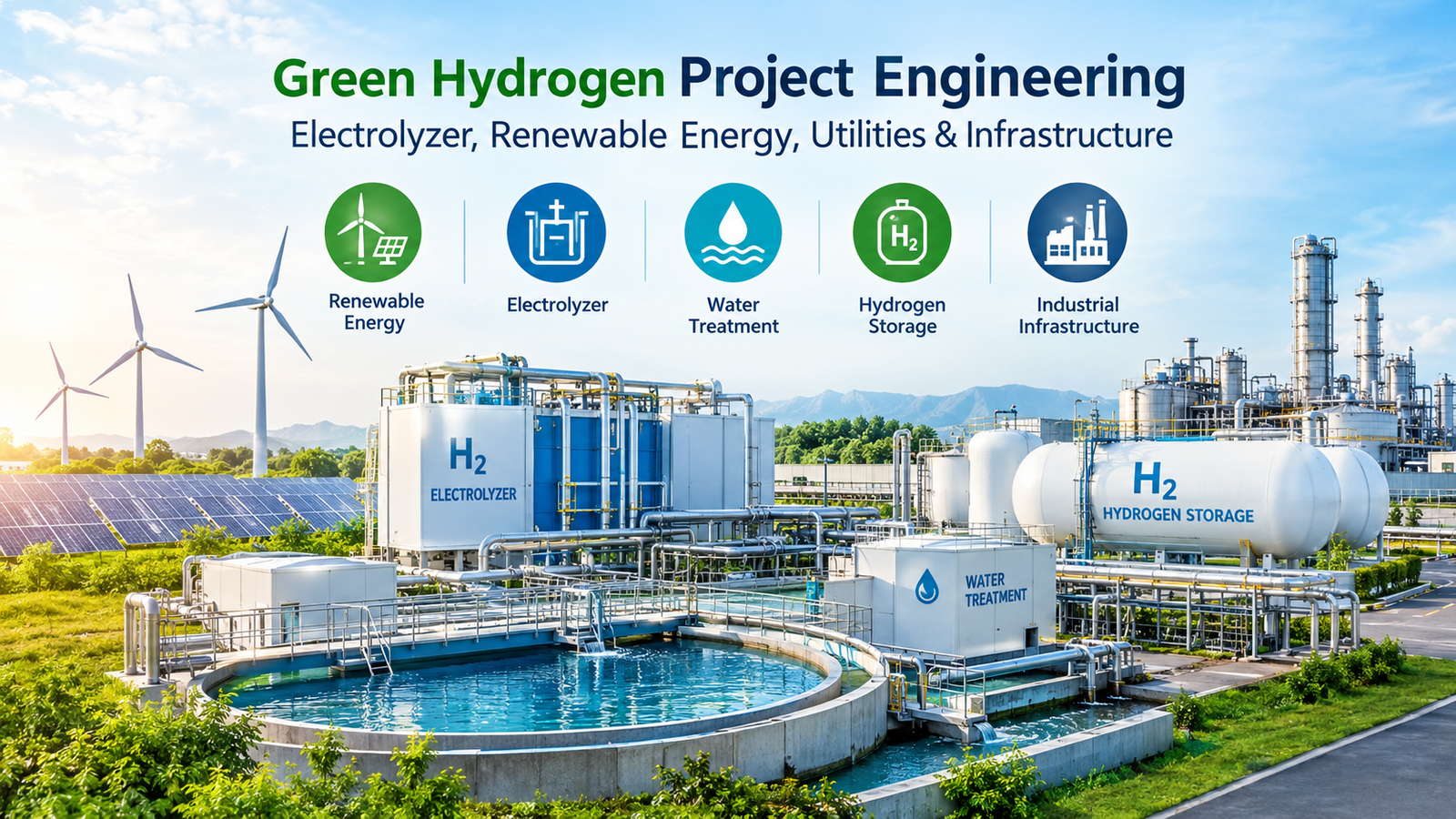
A successful project depends on coordinated engineering across renewable power, electrolysis, water systems, hydrogen conditioning, compression, storage, electrical systems, controls, piping, civil works, safety systems and project infrastructure.
This is where Green Hydrogen Project Engineering becomes critical.
A well-engineered hydrogen project connects technical feasibility with practical project execution. It helps owners, developers, investors, EPC contractors and industrial customers evaluate whether a proposed project can be built safely, operated reliably and delivered within the required commercial parameters.
AlgEnergy Engineering Consultancy Services provides engineering consultancy support for energy and infrastructure projects, helping clients move from concept and feasibility through engineering documentation, tender support, PMC, QA/QC and commissioning assistance.
Learn more about our engineering capabilities through the AlgEnergy Engineering Consultancy Services website.
According to the IEA's Global Hydrogen Review 2026, global installed electrolysis capacity surpassed 4 GW in 2025, while project development continues to face challenges related to demand, financing, regulation and infrastructure.
What Is Green Hydrogen Project Engineering?
Green Hydrogen Project Engineering is the integrated engineering process used to develop a hydrogen production facility powered primarily by renewable electricity.
The engineering scope can cover the complete project value chain:
Renewable power supply
Power evacuation and electrical distribution
Electrolyzer technology
Water treatment and purification
Hydrogen and oxygen handling
Gas purification and drying
Compression
Hydrogen storage
Cooling and utility systems
Piping and mechanical systems
Instrumentation and control
Civil and structural infrastructure
Fire protection
Hazardous-area engineering
Ventilation and gas detection
SCADA and automation
Project documentation
Construction and commissioning support
The objective is to create a safe, technically coordinated and economically viable facility.
The engineering approach also needs to consider the intended hydrogen application. A facility supplying hydrogen for industrial use may have different pressure, purity, storage and delivery requirements from one producing hydrogen for mobility, ammonia synthesis, steelmaking or synthetic fuels.
Why a Feasibility Study Is the First Step
Green Hydrogen Project Feasibility Study
Before detailed design begins, the developer needs confidence that the project concept is technically and commercially practical.
A Green Hydrogen Project Engineering feasibility assessment can evaluate several interconnected parameters.
Renewable Energy Assessment
The available renewable power resource directly affects electrolyzer utilisation.
Engineering teams may evaluate:
Solar PV potential
Wind resource
Hybrid renewable generation
Grid-connected renewable supply
Captive renewable power
Power purchase arrangements
Energy availability profile
Seasonal generation variations
Because electrolyzers are highly dependent on electricity availability, the renewable generation profile should be assessed together with hydrogen production requirements rather than evaluated separately.
Hydrogen Production Capacity
The project should establish the required hydrogen production rate.
Typical design questions include:
What is the required hydrogen output?
What is the expected operating profile?
What electrolyzer capacity is appropriate?
Is redundancy required?
What operating pressure is required?
What hydrogen purity is required?
What is the expected annual production?
How will future capacity expansion be handled?
A robust feasibility study compares alternative configurations before equipment procurement or detailed engineering.
Technology Evaluation
Electrolyzer technology selection is one of the most important decisions in hydrogen project development.
Potential technologies include:
Alkaline electrolysis
PEM electrolysis
Other emerging electrolysis technologies
Technology selection should consider efficiency, operating characteristics, water requirements, dynamic response, scale, maintainability, vendor support and project-specific operating conditions.
The IEA identifies electrolysers as a critical technology for low-emissions hydrogen production and notes that large portions of the announced project pipeline remain at early development stages.
Key Engineering Systems in a Green Hydrogen Project
1. Electrolyzer System Engineering
The electrolyzer is the core production unit, but it cannot be engineered in isolation.
Green Hydrogen Project Engineering should coordinate the electrolyzer with:
DC power supply
AC distribution
Rectifier systems
Cooling systems
Feedwater systems
Gas-liquid separation
Hydrogen purification
Oxygen handling
Instrumentation
Emergency shutdown systems
The balance-of-plant design often determines how effectively the overall system operates.
Electrolyzer Balance of Plant
The balance of plant can include:
Water circulation
Cooling
Gas separation
Gas drying
Deionised water systems
Hydrogen treatment
Nitrogen systems
Drain systems
Vent systems
Utility distribution
Instrument air where required
Good engineering coordination reduces interface risks between the electrolyzer vendor package and the overall plant.
2. Water Treatment and Utility Engineering
Why Water Quality Is Critical
Water is one of the fundamental feedstocks for electrolysis, but electrolyzers generally require carefully treated water.
The required water treatment configuration depends on the technology, feedwater quality and vendor requirements.
A project may require systems such as:
Raw water storage
Pretreatment
Filtration
Softening where applicable
Reverse osmosis
Ultrafiltration where required
Demineralisation
Mixed-bed polishing
Pure water storage
Chemical dosing
Wastewater handling
This is an area where integrated engineering is especially valuable because water treatment, mechanical systems, piping and civil infrastructure must work together.
For broader water and process engineering support, visit the AlgEnergy Engineering Consultancy Services website.
Utility Systems
Depending on plant scale, utility engineering may cover:
Cooling Water
Electrolyzers, compressors and associated equipment may require cooling systems.
The engineering scope can include:
Heat-load assessment
Cooling-water balance
Chiller selection
Cooling tower evaluation where applicable
Pumps
Expansion systems
Piping
Instrumentation
Instrument Air and Nitrogen
Hydrogen projects may require utility gases for equipment operation, purging, maintenance or commissioning.
Engineering should define:
Required pressure
Flow rate
Purity
Storage requirements
Distribution piping
Purging philosophy
Electrical Utilities
Electrical engineering can include:
Incoming power system
Transformers
Switchgear
MCCs
Rectifier systems
UPS
DC systems
Emergency power
Earthing
Lightning protection
Cable routing
Lighting
Hazardous-area electrical requirements
3. Hydrogen Compression and Storage Engineering
Hydrogen Compression
Hydrogen produced by an electrolyzer may not be available at the pressure required by the end user.
Compression engineering therefore becomes an important part of Green Hydrogen Project Engineering.
The engineering team needs to consider:
Required inlet pressure
Required discharge pressure
Hydrogen purity
Flow rate
Compressor technology
Number of compression stages
Cooling requirements
Seal arrangements
Pressure control
Relief systems
Maintenance philosophy
The compressor package must be integrated with storage, delivery and plant safety systems.
Hydrogen Storage
Storage requirements depend on the production profile and customer demand.
Storage engineering may consider:
Buffer storage
High-pressure storage
Cascade storage
Tube trailers
Above-ground systems
Underground storage where applicable
Export or transportation requirements
The purpose of storage may be to balance renewable generation with demand, provide operational flexibility, or maintain continuous downstream supply.
4. Piping and Mechanical Engineering
Hydrogen Piping Design
Hydrogen service requires careful attention to materials, joints, valves, pressure ratings, leakage control and system configuration.
A detailed piping engineering scope can include:
Process piping
Utility piping
Hydrogen piping
Oxygen piping
Water piping
Cooling-water piping
Drain piping
Vent piping
Nitrogen purge piping
Engineering deliverables may include:
Piping layouts
P&IDs
General arrangement drawings
Isometric drawings
Material specifications
Valve specifications
Line lists
Equipment connection schedules
Piping support arrangements
Stress analysis where required
An experienced engineering consultant can help coordinate process requirements with constructability and maintenance access.
5. Green Hydrogen Plant Safety Engineering
Why Hydrogen Safety Requires Specialized Engineering
Hydrogen is a highly diffusive and flammable gas. Therefore, safety should be considered from the earliest project stage rather than added after plant layout and equipment selection are complete.
The U.S. Department of Energy highlights ventilation, leak detection, flame detection, gas detection, pressure/flow monitoring, appropriate electrical classification, bonding and grounding, and fail-safe shutdown as important safety measures for large-scale electrolyzer installations.
Hydrogen Safety Systems
A well-engineered project may incorporate:
Gas Detection
Hydrogen detectors can be strategically located in areas where leakage could accumulate.
Flame Detection
Flame detection may be required around selected process and storage areas based on the hazard assessment.
Ventilation
Ventilation design is important because hydrogen can accumulate in poorly ventilated areas.
Emergency Shutdown
Emergency shutdown systems can isolate equipment and limit escalation following abnormal conditions.
Pressure Protection
Pressure relief devices and associated discharge systems should be engineered according to applicable codes and project requirements.
Fire Protection
Depending on the facility, fire protection engineering can include:
Fire water systems
Hydrants
Hose reels
Detection systems
Alarm systems
Deluge systems where required
Portable firefighting equipment
Emergency response infrastructure
6. Hazardous Area and Layout Engineering
Hydrogen Plant Layout
Plant layout has a direct influence on safety, construction cost and maintainability.
A good layout considers:
Equipment spacing
Hazardous-area classification
Access roads
Emergency access
Vent locations
Storage areas
Electrical buildings
Control rooms
Compressor locations
Fire protection access
Maintenance access
Escape routes
The layout should also minimize unnecessary piping runs and reduce potential leak points where practical.
Constructability Considerations
Detailed engineering should account for the actual construction process.
This may include:
Equipment lifting access
Module transportation
Crane access
Pipe rack arrangement
Maintenance removal routes
Construction sequencing
Temporary facilities
Electrical cable installation
Underground services
This is one reason why Green Hydrogen Project Engineering should not stop at process calculations. It must connect engineering design with real-world project execution.
7. Instrumentation, Control and Automation
Process Control for Green Hydrogen Plants
Hydrogen plants require coordinated control of electricity, water, electrolyzers, gas handling and downstream systems.
Instrumentation engineering may include:
Pressure measurement
Flow measurement
Temperature measurement
Level measurement
Gas composition measurement
Hydrogen detection
Oxygen monitoring
Control valves
Shutdown valves
Interlocks
Alarms
Emergency shutdown systems
SCADA and Plant Monitoring
A modern hydrogen facility may use SCADA or integrated control systems for:
Renewable generation monitoring
Electrolyzer performance
Hydrogen production
Utility consumption
Compressor operation
Storage pressure
Alarm management
Energy consumption
Production reporting
Effective instrumentation and control can support safer operation and better performance monitoring.
8. Civil and Structural Infrastructure
Civil Engineering Scope
A green hydrogen facility requires substantial supporting infrastructure beyond the process equipment.
Civil engineering can cover:
Site grading
Foundations
Equipment foundations
Roads
Drainage
Pipe racks
Buildings
Control rooms
Electrical rooms
Utility structures
Storage foundations
Boundary works
Structural Engineering
Structural engineering may include:
Equipment support structures
Pipe racks
Platforms
Access structures
Steel structures
Maintenance platforms
Operating platforms
Structural calculations
Foundation interfaces
The civil and structural design should be coordinated with equipment loads, piping routes and electrical requirements.
9. Electrical Engineering for Green Hydrogen Projects
Electricity is often one of the largest operating cost drivers in green hydrogen production.
Therefore, electrical design is a major component of Green Hydrogen Project Engineering.
Electrical Engineering Scope
Typical engineering deliverables may include:
Load list
Single-line diagrams
Power system studies
Transformer sizing
Switchgear sizing
Short-circuit studies
Load-flow studies
Motor starting studies where required
Cable sizing
Earthing design
Lightning protection
Electrical equipment specifications
Lighting design
Hazardous-area electrical design
The interface between renewable generation and electrolyzer loads needs careful consideration, particularly where the project uses variable renewable electricity.
10. Project Infrastructure and Hydrogen Transportation
Hydrogen Delivery Infrastructure
A hydrogen project should be designed around its intended customer and delivery model.
Possible delivery routes include:
Direct pipeline supply
Tube trailer transportation
High-pressure storage
Ammonia conversion
Liquid hydrogen pathways
Integration into an industrial process
Infrastructure requirements change significantly depending on the selected route.
The IEA reports that hydrogen pipeline projects announced globally exceed 40,000 km by 2035, while only a relatively small portion currently has operational or committed investment status. This highlights the importance of infrastructure planning in project development.
11. Engineering Deliverables for a Green Hydrogen Project
A professional Green Hydrogen Project Engineering package may include the following stages.
Pre-Feasibility Engineering
Initial studies can include:
Project concept
Site assessment
Renewable power assessment
Hydrogen production estimate
Preliminary technology selection
Preliminary utility balance
CAPEX/OPEX assessment
Preliminary project schedule
FEED and Basic Engineering
Typical deliverables may include:
Design basis
Process description
Process flow diagrams
P&IDs
Equipment list
Utility summary
Plot plan
Preliminary hydraulic calculations
Electrical load list
Instrument index
Control philosophy
Preliminary specifications
Detailed Engineering
Detailed engineering can include:
Construction-ready drawings
Equipment specifications
Piping layouts
Isometrics
2D/3D models
Structural drawings
Civil drawings
Cable schedules
Instrumentation drawings
Material take-offs
BOQ
Technical requisitions
Tender and Procurement Engineering
Engineering consultants can support:
Technical specifications
RFQ documentation
Scope of work
BOQ
Vendor evaluation
Technical bid comparison
Clarifications
Purchase requisition packages
For engineering tender, project planning and technical documentation support, explore AlgEnergy Engineering Consultancy Services.
12. Project Management, PMC and Construction Support
Engineering does not end when design documents are issued.
During project execution, owners may require support for:
Engineering coordination
Vendor document review
Site supervision
Progress monitoring
QA/QC
Inspection
Construction coordination
Technical query resolution
Commissioning support
Handover documentation
A consultancy-led project model can help the owner coordinate multiple vendors and engineering packages.
For developers without a large internal engineering team, outsourced Green Hydrogen Project Engineering can provide access to multidisciplinary technical capabilities without creating a complete in-house engineering organization.
13. Key Challenges in Green Hydrogen Project Engineering
Renewable Power Variability
Solar and wind generation are variable. The engineering model should therefore consider how the electrolyzer responds to changing power availability.
Water Availability
Water source, quality, treatment requirements and wastewater management can influence both project feasibility and operating cost.
Hydrogen Safety
Hydrogen leak detection, ventilation, electrical classification, isolation and emergency response should be integrated into the design.
Equipment Interfaces
A project may include separate suppliers for:
Renewable power
Electrolyzers
Rectifiers
Water treatment
Compression
Storage
Automation
Fire protection
Clear interface management is essential.
Offtake and Infrastructure
A technically sound hydrogen plant may still face commercial challenges when demand, transportation, storage or infrastructure is uncertain. The IEA continues to identify uncertain demand, regulatory barriers and infrastructure gaps as important constraints on hydrogen project development.
14. How AlgEnergy Can Support Green Hydrogen Projects
AlgEnergy Engineering Consultancy Services can support clients across different stages of project development.
Our engineering-oriented approach can support areas such as:
Feasibility and Pre-Project Studies
Evaluation of site conditions, utilities, technical configurations, project interfaces and preliminary techno-commercial considerations.
Basic and Detailed Engineering
Preparation and review of process, mechanical, piping, electrical, instrumentation, civil and structural engineering deliverables.
Water and Utility Systems
Engineering support for water treatment and utility systems, including systems that may be integrated with hydrogen production facilities.
Piping and Mechanical Engineering
Support for piping layouts, P&IDs, equipment interfaces, specifications, material requirements and selected stress-analysis activities.
Electrical and C&I Engineering
Engineering coordination for power distribution, electrical systems, instrumentation, control and plant monitoring.
Tender Documentation
Preparation of technical specifications, BOQs, RFQs, scope documents and technical bid evaluation support.
PMC and Site Engineering Support
Project management consultancy, construction supervision, quality assurance, inspection and commissioning support.
For complete information about AlgEnergy's engineering consultancy capabilities, visit:
https://algenergywebsite.zohosites.in/
15. Why Choose an Integrated Engineering Approach?
The major advantage of integrated Green Hydrogen Project Engineering is that the project is evaluated as one interconnected system.
For example:
Renewable Power → Electrical System → Electrolyzer → Water Treatment → Hydrogen Purification → Compression → Storage → Delivery
At the same time:
Utilities + Piping + Civil + Structural + Instrumentation + Fire Protection + Safety
must be integrated with the main process.
A weakness in one interface can affect the performance, cost or schedule of the entire project.
An engineering consultant with multidisciplinary capability can therefore help reduce interface gaps between specialized packages.
Frequently Asked Questions About Green Hydrogen Project Engineering
What is Green Hydrogen Project Engineering?
Green Hydrogen Project Engineering is the multidisciplinary engineering process used to develop hydrogen production projects based on renewable electricity. It can cover feasibility, process design, utilities, electrolyzers, piping, electrical systems, instrumentation, safety, civil works, infrastructure and project execution support.
What does a green hydrogen feasibility study include?
A feasibility study can evaluate renewable power availability, site conditions, electrolyzer technology, hydrogen production capacity, water requirements, utilities, storage, compression, infrastructure, CAPEX, OPEX, project risks and implementation strategy.
Why is water treatment important in hydrogen projects?
Electrolysis systems require appropriately treated feedwater. Water-treatment requirements depend on the electrolyzer technology and feedwater quality, so the treatment plant should be integrated with the overall process design.
Is hydrogen safety included in project engineering?
Yes. Hydrogen projects require engineering consideration of leak detection, ventilation, pressure protection, emergency shutdown, fire protection, hazardous areas, electrical systems and other risk-control measures.
Can engineering consultancy be outsourced for a green hydrogen project?
Yes. Project developers and EPC organizations can outsource selected engineering activities or multidisciplinary engineering packages depending on their internal capabilities and project requirements.
Can AlgEnergy support green hydrogen projects?
AlgEnergy Engineering Consultancy Services can provide engineering consultancy support covering feasibility, basic and detailed engineering, mechanical and piping, water and utility systems, electrical and instrumentation, tender documentation, PMC, QA/QC and commissioning-related engineering support.
Conclusion
The future of hydrogen projects will depend not only on electrolyzer technology but also on how effectively the complete project is engineered.
A successful facility needs coordinated planning for renewable electricity, electrolyzers, water treatment, utilities, piping, compression, storage, electrical systems, automation, civil infrastructure and safety.
That is why Green Hydrogen Project Engineering should begin at the feasibility stage and continue through detailed engineering, procurement, construction and commissioning.
For project developers, investors, EPC contractors and industrial users looking for multidisciplinary engineering support, AlgEnergy Engineering Consultancy Services can provide a practical engineering-led approach for energy and infrastructure projects.
Get Engineering Support for Your Green Hydrogen Project
Planning a green hydrogen project, feasibility study, tender or detailed engineering package?
Contact AlgEnergy to discuss your project requirements, engineering scope and technical deliverables.
Website:https://algenergywebsite.zohosites.in/
Recommended CTA:Request a Green Hydrogen Project Engineering Consultation
Internal Links
Use the following anchor text naturally 3–5 times within the article:
AlgEnergy Engineering Consultancy Services → https://algenergywebsite.zohosites.in/
Engineering Consultancy Services → https://algenergywebsite.zohosites.in/
Energy Project Engineering → https://algenergywebsite.zohosites.in/
Project Feasibility and Engineering Support → https://algenergywebsite.zohosites.in/