Engineering Design Outsourcing from India: A Guide for Global EPCs and Project Owners
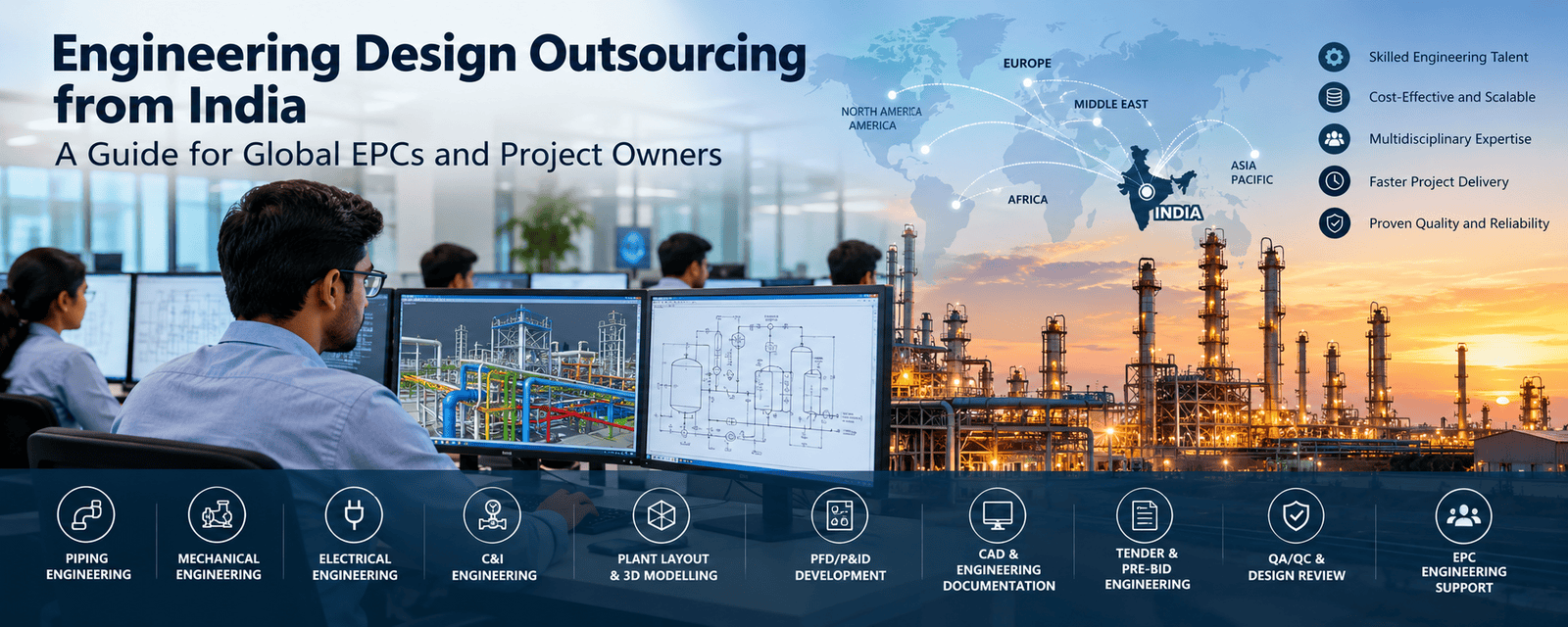
Global engineering, procurement and construction projects are becoming increasingly complex. EPC contractors, project developers, owners and industrial companies must deliver projects against demanding schedules while managing engineering quality, multidisciplinary interfaces, changing project requirements, specialist-resource constraints and cost pressures.
Maintaining every engineering discipline and specialist capability internally is not always the most efficient solution.
This is why engineering design outsourcing in India has become an important delivery strategy for international EPC companies, engineering consultants and project owners. Instead of relying entirely on permanent in-house engineering teams, organizations can engage experienced engineering partners in India for specific disciplines, defined work packages or complete multidisciplinary engineering support.
The scope can range from piping layouts, equipment engineering and electrical calculations to PFD/P&ID development, 3D plant modelling, engineering documentation, tender engineering and detailed design.
A capable offshore engineering team can function as an extension of the client's engineering organization while following the client's engineering procedures, applicable international codes, project specifications and document-control requirements.
For international organizations, the objective should not simply be to find lower-cost engineering resources. Successful outsourcing is about obtaining the right engineering capability, appropriate project controls, reliable deliverables and scalable resources at the right stage of a project.
This guide explains how engineering outsourcing works, what engineering activities can be outsourced, why India has developed into a major engineering-services destination, and what global EPCs and project owners should consider when selecting an engineering design outsourcing company in India.
1. What Is Engineering Design Outsourcing?
Engineering design outsourcing is the practice of assigning defined engineering activities, disciplines or project work packages to an external engineering organization.
Instead of building a large permanent engineering department for every discipline, companies can use an external team for specific engineering requirements.
The outsourced team may support the client's engineers during feasibility studies, FEED, tender engineering, detailed engineering, procurement, construction or project close-out.
Depending on the project, engineering design outsourcing may include:
Process engineering and preparation of PFDs and P&IDs
Mechanical equipment engineering
Static equipment design and specifications
Piping engineering and layout
Pipe stress analysis
Equipment and piping layout development
Electrical engineering
Control and instrumentation engineering
Civil and structural engineering coordination
Plant layout development
2D CAD drafting
3D plant modelling
Equipment modelling
Piping modelling
Isometric generation
Material take-offs
Bill of quantities
Equipment and material specifications
Datasheets
Engineering calculations
Tender engineering
Pre-bid engineering
Vendor drawing review
Technical bid evaluation
Design review
Interdisciplinary checking
As-built documentation
Construction engineering support
The engagement model can also vary significantly.
A project owner may outsource one clearly defined package, such as the detailed piping design for a utility system. An EPC contractor may require ten or twenty engineers for several months to supplement its internal project team. Another company may engage an Indian engineering consultant to perform multidisciplinary engineering for an entire balance-of-plant package.
The correct model therefore depends on project complexity, schedule, available internal resources and the level of responsibility the client wants the external engineering partner to assume.
Engineering outsourcing is more than drafting
One misconception is that offshore engineering primarily means converting mark-ups into CAD drawings.
Modern offshore engineering services can involve substantial engineering responsibility.
Experienced teams can support calculations, design development, equipment sizing, specifications, datasheets, piping studies, stress analysis, layouts, technical evaluations, vendor-document reviews and multidisciplinary coordination.
Drafting remains important, but it represents only one part of a much broader engineering delivery model.
For global EPC companies, the greatest value often comes when the outsourced engineering team understands the engineering intent behind the drawings rather than functioning simply as a drafting resource.
2. Why Global Companies Outsource Engineering
Engineering organizations rarely have perfectly constant workloads.
During one phase of a project, the engineering requirement may be relatively small. Several months later, detailed engineering can require a significantly larger multidisciplinary team.
Maintaining enough permanent engineers to cover every possible workload peak can increase overheads considerably.
Engineering outsourcing provides an alternative.
Access specialized engineering expertise
Large industrial and energy projects require multiple specialist disciplines.
A project may require process engineers, mechanical engineers, piping designers, stress engineers, electrical engineers, instrumentation engineers, civil engineers, structural engineers and CAD/3D specialists.
Some capabilities may only be required for a limited period.
Engineering outsourcing services in India allow international organizations to access these specialist capabilities without creating permanent positions for every project requirement.
Scale engineering resources according to workload
Engineering workload typically changes throughout the project lifecycle.
During feasibility engineering, the project may need only a small core team.
During detailed engineering, manpower requirements can increase rapidly.
Later, the requirement may reduce to vendor-document review, construction support and as-built documentation.
An outsourcing model allows engineering resources to expand and contract according to actual project demand.
Support demanding project schedules
Engineering delays can affect procurement and construction.
For example, late equipment specifications may delay enquiries. Late piping layouts may delay civil and structural engineering. Delayed cable schedules may affect electrical procurement and installation.
An offshore engineering team can provide additional capacity when the internal engineering organization is working against a compressed schedule.
Improve focus of the core project team
Outsourcing selected engineering activities can allow senior client engineers to concentrate on critical design decisions, stakeholder coordination, technology selection, interfaces and project risks.
The external team can handle defined engineering packages under agreed procedures and review cycles.
Establish additional engineering capacity without major fixed overhead
For EPC organizations with fluctuating project pipelines, permanent expansion can create long-term overhead commitments.
A scalable outsourcing arrangement can convert part of that fixed engineering capacity into project-based capacity.
Cost, however, should not be considered in isolation.
Engineering quality, experience, communication, schedule reliability, document control and technical responsibility are equally important when evaluating an offshore partner.
3. Why India Is an Engineering Outsourcing Hub
India has developed a substantial engineering and technology-services ecosystem serving international organizations.
Its value proposition extends beyond labour-cost differences. Global companies increasingly use Indian teams for design, engineering analysis, plant engineering, digital engineering and multidisciplinary project support.
Large technical talent base
India produces a substantial number of engineering graduates and has established engineering centres serving domestic and international industries.
For EPC and industrial projects, this provides access to engineers and designers with experience across areas such as:
Power generation
Renewable energy
Oil and gas
Industrial plants
Water and wastewater
Utilities
Infrastructure
Chemical and process plants
LNG and gas systems
Bioenergy
Green hydrogen
Manufacturing facilities
Experience with international engineering practices
An important consideration for global projects is familiarity with international engineering standards and project procedures.
Depending on the project and discipline, engineering teams in India commonly work with internationally recognized standards and practices such as ASME, API, NFPA, IEC, IEEE, ISO and other project-specific standards.
The applicable code must always be established at the start of the project.
Mature engineering software environment
Engineering design services in India can be delivered using established engineering and design platforms for:
CAD drafting
Plant 3D modelling
Piping design
Pipe stress analysis
Equipment design
Electrical studies
Structural analysis
Document management
Engineering calculations
Model review and coordination
The specific software platform should be agreed before project commencement to ensure compatibility with the client's systems and deliverable requirements.
Time-zone advantage
For clients in Europe, the Middle East, Africa, Asia-Pacific and North America, India's time zone can support extended engineering workflows.
A client team can issue comments or mark-ups, and the Indian engineering team can progress work during its own working hours.
However, time-zone advantage only works when collaboration is structured. Defined overlap hours, review meetings and communication protocols are essential.
Scalable multidisciplinary delivery
India's engineering ecosystem makes it possible to assemble multidisciplinary teams rather than outsourcing isolated drafting activities.
This is particularly useful for EPC projects where process, mechanical, piping, electrical, instrumentation and civil interfaces must be coordinated.
For global organizations seeking an engineering consultant in India for global projects, multidisciplinary capability can substantially simplify project coordination.
4. Piping Engineering Outsourcing
Piping is one of the most engineering-intensive areas of industrial plant design.
It connects process equipment, utilities, storage systems and packaged systems and has direct interfaces with civil structures, equipment, electrical systems, instrumentation, access requirements and construction.
For this reason, piping engineering outsourcing in India is commonly used by EPC contractors and industrial project owners.
Typical outsourced piping activities can include:
Piping design basis
The engineering team can develop or work according to an approved piping design basis covering materials, design conditions, applicable codes, corrosion allowances, insulation requirements, valve philosophy, branch connections, allowable velocities and project-specific requirements.
The engineering team can develop or work according to an approved piping design basis covering materials, design conditions, applicable codes, corrosion allowances, insulation requirements, valve philosophy, branch connections, allowable velocities and project-specific requirements.
Piping material specifications
Piping material specifications define acceptable materials and components for different services, pressure classes and design conditions.
These specifications may cover:
Pipes
Fittings
Flanges
Valves
Gaskets
Bolting
Specialty items
Piping material specifications define acceptable materials and components for different services, pressure classes and design conditions.
These specifications may cover:
Pipes
Fittings
Flanges
Valves
Gaskets
Bolting
Specialty items
Piping layouts
Piping designers develop routing based on equipment locations, process requirements, maintenance access, operating requirements, constructability and safety considerations.
Effective piping layouts must consider more than the shortest route.
They must accommodate:
Equipment nozzle orientations
Thermal expansion
Drainability
Venting
Accessibility
Maintenance clearances
Support locations
Structural constraints
Instrument connections
Operator access
Construction sequence
Pipe stress analysis
Critical piping systems may require flexibility and stress analysis.
The analysis can evaluate thermal expansion, sustained loads, occasional loads, equipment nozzle loads and support requirements according to applicable project criteria and piping codes.
The resulting recommendations may include routing modifications, guide locations, anchor locations, spring supports or other engineered support arrangements.
Piping isometrics
After routing is approved, piping isometrics provide construction information including dimensions, fittings, valves, welds, supports, material references and line identification.
After routing is approved, piping isometrics provide construction information including dimensions, fittings, valves, welds, supports, material references and line identification.
Material take-off
Accurate piping models and drawings allow preparation of material take-offs that support procurement and cost control.
A strong piping design outsourcing partner should therefore provide engineering understanding, not merely drawing production.
Accurate piping models and drawings allow preparation of material take-offs that support procurement and cost control.
A strong piping design outsourcing partner should therefore provide engineering understanding, not merely drawing production.
5. Mechanical Engineering
Mechanical systems form the operational core of many energy and industrial projects.
Mechanical engineering outsourcing can support equipment selection, specifications, calculations, vendor coordination and integration of mechanical systems into the overall plant.
Typical services include:
Mechanical systems form the operational core of many energy and industrial projects.
Mechanical engineering outsourcing can support equipment selection, specifications, calculations, vendor coordination and integration of mechanical systems into the overall plant.
Typical services include:
Static equipment engineering
Engineering support can be provided for:
Pressure vessels
Storage tanks
Heat exchangers
Separators
Process vessels
Filters
Silos
Utility vessels
Deliverables may include equipment datasheets, design specifications, technical requisitions and vendor-document review.
Engineering support can be provided for:
Pressure vessels
Storage tanks
Heat exchangers
Separators
Process vessels
Filters
Silos
Utility vessels
Deliverables may include equipment datasheets, design specifications, technical requisitions and vendor-document review.
Rotating equipment engineering
Projects may require pumps, compressors, fans, blowers and other rotating equipment.
Engineering activities can include preparation of datasheets, technical specifications, equipment selection criteria and review of vendor proposals.
Projects may require pumps, compressors, fans, blowers and other rotating equipment.
Engineering activities can include preparation of datasheets, technical specifications, equipment selection criteria and review of vendor proposals.
Package engineering
Industrial plants increasingly use packaged systems.
Examples include:
Water-treatment packages
Chemical dosing systems
Compressed-air systems
Fuel-handling systems
Fire-water systems
HVAC packages
Pumping packages
The engineering consultant can help define package boundaries, utility requirements, technical specifications and interfaces.
Equipment specifications and datasheets
A disciplined mechanical engineering process converts process and project requirements into procurement-ready technical documents.
Clear specifications reduce ambiguity during vendor enquiries and technical bid evaluation.
A disciplined mechanical engineering process converts process and project requirements into procurement-ready technical documents.
Clear specifications reduce ambiguity during vendor enquiries and technical bid evaluation.
Vendor-document review
Engineering does not end when equipment is ordered.
Vendor drawings, calculations, datasheets, foundation loads, nozzle details, electrical requirements and instrumentation interfaces must be reviewed and incorporated into the overall plant design.
For international EPC projects, outsourced mechanical engineers can support this process throughout procurement and detailed engineering.
6. Electrical Engineering
Reliable electrical engineering is fundamental to plant safety, availability and operability.
Electrical engineering outsourcing can cover generation, distribution, equipment power supply, protection, lighting, earthing and electrical interfaces across the facility.
Typical services include:
Electrical design basis
Load lists
Load-flow studies
Short-circuit calculations
Transformer sizing
Cable sizing
Cable schedules
Switchgear specifications
Motor-control-centre specifications
Single-line diagrams
Earthing and grounding layouts
Lighting layouts
Lightning protection
Emergency power systems
UPS and DC systems
Equipment datasheets
Material take-offs
Vendor drawing review
Electrical system integration
Electrical engineers must coordinate closely with mechanical, process, instrumentation and civil teams.
Motor ratings come from mechanical equipment requirements.
Cable routes depend on plant layout.
Electrical rooms require architectural and HVAC coordination.
Transformer and switchgear foundations require civil input.
Instrumentation and control systems require reliable power supplies and earthing arrangements.
This is one reason multidisciplinary engineering outsourcing can be more effective than assigning each discipline to unrelated vendors.
7. C&I Engineering
Control and instrumentation—often referred to as C&I or instrumentation and control engineering—provides the monitoring, automation and protection required for modern industrial facilities.
Typical outsourced C&I engineering activities include:
Instrument design basis
Instrument index
Instrument datasheets
I/O lists
Control philosophy
Cause-and-effect diagrams
Instrument hook-up drawings
Junction-box schedules
Cable schedules
Instrument location layouts
Control-system architecture
PLC/DCS interface documentation
Field instrumentation specifications
Fire and gas system documentation
Vendor-document review
C&I engineering depends heavily on the maturity of process documentation.
Instrument requirements, control loops and interlocks are often developed from approved P&IDs and operating philosophies.
Close coordination between process and C&I engineers is therefore essential.
An integrated offshore engineering team can manage these interfaces within a common engineering workflow.
8. Plant Layout and 3D Modelling
Plant layout is not simply the arrangement of equipment on a drawing.
A successful layout must consider process flow, safety, construction, maintenance, operation, access, underground systems, future expansion and multidisciplinary interfaces.
Plant engineering outsourcing can support development of:
Plot plans
Equipment layouts
Pipe-rack arrangements
Equipment elevations
Maintenance areas
Access platforms
Utility areas
Roads and access routes
Cable corridors
Underground utility interfaces
Buildings and electrical rooms
3D plant modelling
Modern engineering projects increasingly use coordinated 3D models to integrate different engineering disciplines.
A typical model may contain:
Process equipment
Storage tanks
Piping
Valves
Pipe supports
Structural steel
Platforms
Cable trays
Buildings
Electrical equipment
Instrumentation elements
The model provides a common environment for engineering coordination.
Clash detection and model reviews
Periodic model reviews allow the project team to identify clashes and accessibility problems before construction.
Typical review stages may be established at agreed levels of design maturity.
During these reviews, the team can assess:
Equipment access
Valve accessibility
Maintenance clearances
Piping clashes
Cable-tray conflicts
Structural interference
Platform access
Lifting requirements
Safety routes
For international clients, outsourced CAD and 3D engineering services can therefore contribute directly to constructability and design coordination.
9. PFD/P&ID Development
Process Flow Diagrams and Piping & Instrumentation Diagrams are fundamental engineering documents for process and utility systems.
Process Flow Diagrams and Piping & Instrumentation Diagrams are fundamental engineering documents for process and utility systems.
Process Flow Diagrams
PFDs provide a high-level representation of process flow and major equipment.
They typically identify major process streams, equipment, operating parameters and material flows.
PFDs provide a high-level representation of process flow and major equipment.
They typically identify major process streams, equipment, operating parameters and material flows.
Piping & Instrumentation Diagrams
P&IDs provide substantially greater engineering detail.
Depending on project requirements, they can show:
Equipment
Piping
Line numbers
Pipe sizes
Valves
Instruments
Control loops
Safety devices
Drains
Vents
Utility connections
Tie-in points
Special piping items
P&IDs become key reference documents for piping, mechanical, instrumentation, operation, safety review and commissioning.
Importance of controlled P&ID development
Poorly controlled P&ID revisions can create inconsistencies throughout detailed engineering.
A structured process should therefore define:
Document numbering
Revision control
Engineering responsibilities
Review workflow
Comment incorporation
Interdisciplinary checks
Approval status
An experienced offshore engineering team can support both initial P&ID development and subsequent revision management during detailed engineering.
10. CAD and Engineering Documentation
Even technically correct engineering can create project problems if documentation is inconsistent, uncontrolled or difficult to construct from.
Engineering drafting services in India can support the production and maintenance of project documentation throughout the engineering lifecycle.
Typical deliverables include:
General arrangement drawings
Equipment layouts
Piping layouts
Isometrics
Mechanical drawings
Electrical layouts
Cable routing drawings
Instrumentation layouts
Civil interface drawings
Equipment details
Support drawings
As-built drawings
CAD standardization
Before drafting begins, the client and engineering partner should establish:
Drawing templates
Layer standards
Line types
Symbols
Title blocks
Drawing numbering
Revision conventions
File naming
Units
Coordinate systems
Deliverable formats
This reduces rework and makes outsourced documents consistent with the client's engineering system.
Document control
Engineering outsourcing generates a significant volume of electronic information.
A formal document-control process should track:
Document number
Title
Discipline
Revision
Status
Issue date
Review comments
Approval status
Reliable document control is particularly important when teams are working across different countries and time zones.
11. Tender and Pre-Bid Engineering
Not every outsourcing assignment begins after a project is awarded.
Engineering outsourcing for EPC companies can also support tender preparation and pre-bid engineering.
This can be especially valuable when an EPC contractor is bidding for several projects simultaneously and does not want to divert its full detailed-engineering organization into every tender.
Typical pre-bid engineering activities include:
Review of employer requirements
Review of tender specifications
Technical scope definition
Design-basis development
Preliminary equipment sizing
Preliminary layouts
Plot-plan development
Preliminary PFDs and P&IDs
Equipment lists
Electrical load estimation
Material take-offs
Bill-of-quantity development
Vendor enquiry preparation
Technical evaluation support
Identification of technical deviations
Design optimization
Engineering-hour estimation
Why pre-bid engineering matters
An EPC bid based on inadequate engineering assumptions can expose the contractor to significant risk after award.
Quantities may be underestimated.
Equipment requirements may be misunderstood.
Battery limits may be unclear.
Interfaces may be missed.
A structured pre-bid engineering exercise helps the bidding organization better understand the technical scope before committing to price and schedule.
For this reason, engineering support during bidding should not be treated merely as an overhead. It can contribute to better scope definition and risk identification.
12. QA/QC and Design Review
Engineering outsourcing is only successful when deliverables meet the required technical and documentation standards.
Quality should therefore be built into the engineering workflow rather than inspected only at the end.
Engineering outsourcing is only successful when deliverables meet the required technical and documentation standards.
Quality should therefore be built into the engineering workflow rather than inspected only at the end.
Engineering QA/QC framework
A typical quality process may include:
Preparation
The responsible engineer or designer develops the calculation, drawing, datasheet or specification.
Self-check
The originator checks the deliverable for completeness and obvious errors.
Independent check
Another qualified engineer reviews calculations, inputs, assumptions and engineering consistency.
Interdisciplinary review
Documents affecting other disciplines are circulated for interface checking.
Lead engineer approval
The discipline lead confirms that the document is suitable for the intended issue stage.
Document-control verification
Revision, numbering, status and transmittal information are verified before issue.
Design reviews
Design reviews can be conducted at defined project stages.
These may include:
PFD reviews
P&ID reviews
Plot-plan reviews
Equipment-layout reviews
3D model reviews
Electrical-system reviews
Constructability reviews
Vendor-document reviews
Design reviews can be conducted at defined project stages.
These may include:
PFD reviews
P&ID reviews
Plot-plan reviews
Equipment-layout reviews
3D model reviews
Electrical-system reviews
Constructability reviews
Vendor-document reviews
Comment management
International engineering collaboration can generate hundreds or thousands of comments.
A comment register should clearly record the comment, responsible person, action, status and closure.
This creates traceability and prevents unresolved engineering issues from disappearing between revisions.
International engineering collaboration can generate hundreds or thousands of comments.
A comment register should clearly record the comment, responsible person, action, status and closure.
This creates traceability and prevents unresolved engineering issues from disappearing between revisions.
13. How Offshore Engineering Collaboration Works
Successful offshore engineering design services from India require more than sending drawings by email.
The offshore team should operate within a structured project-delivery system.
Successful offshore engineering design services from India require more than sending drawings by email.
The offshore team should operate within a structured project-delivery system.
Step 1: Define the scope
The client and engineering consultant first establish exactly what is being outsourced.
The scope should identify:
Engineering disciplines
Input documents
Deliverables
Applicable codes
Software requirements
Project standards
Schedule
Review requirements
Responsibilities
Exclusions
A responsibility matrix is useful for identifying who prepares, checks, reviews, approves and issues each deliverable.
Step 2: Establish the project team
The engineering partner mobilizes the required discipline leads, engineers, designers and document-control personnel.
For multidisciplinary projects, a project engineering manager or engineering coordinator should manage interfaces between disciplines.
The engineering partner mobilizes the required discipline leads, engineers, designers and document-control personnel.
For multidisciplinary projects, a project engineering manager or engineering coordinator should manage interfaces between disciplines.
Step 3: Conduct a kickoff meeting
The kickoff meeting should confirm technical requirements and working procedures.
Topics normally include:
Scope
Schedule
Deliverable register
Communication protocol
Engineering standards
Software
Document-control system
Review cycles
Reporting
Client approvals
The kickoff meeting should confirm technical requirements and working procedures.
Topics normally include:
Scope
Schedule
Deliverable register
Communication protocol
Engineering standards
Software
Document-control system
Review cycles
Reporting
Client approvals
Step 4: Transfer project inputs
The client provides relevant documents such as:
Design basis
Employer requirements
Existing drawings
Equipment information
Site information
Vendor data
Project specifications
Client standards
Input completeness should be checked before engineering progresses.
The client provides relevant documents such as:
Design basis
Employer requirements
Existing drawings
Equipment information
Site information
Vendor data
Project specifications
Client standards
Input completeness should be checked before engineering progresses.
Step 5: Develop the engineering schedule
The engineering team prepares a deliverable schedule linked to project priorities.
Critical documents required for procurement or construction should be identified.
The engineering team prepares a deliverable schedule linked to project priorities.
Critical documents required for procurement or construction should be identified.
Step 6: Execute engineering
Engineers and designers develop the agreed deliverables.
Internal checks and interdisciplinary reviews are performed according to the project quality procedure.
Engineers and designers develop the agreed deliverables.
Internal checks and interdisciplinary reviews are performed according to the project quality procedure.
Step 7: Conduct regular coordination meetings
Effective engineering design support for international EPC companies requires predictable communication.
Depending on project intensity, this may include:
Weekly progress meetings
Discipline meetings
Model-review sessions
Interface meetings
Technical clarification meetings
Effective engineering design support for international EPC companies requires predictable communication.
Depending on project intensity, this may include:
Weekly progress meetings
Discipline meetings
Model-review sessions
Interface meetings
Technical clarification meetings
Step 8: Track progress
Progress can be measured using the approved deliverable register.
Each deliverable can be assigned weighted stages such as preparation, checking, client review and final issue.
This gives both parties visibility of actual engineering progress.
Progress can be measured using the approved deliverable register.
Each deliverable can be assigned weighted stages such as preparation, checking, client review and final issue.
This gives both parties visibility of actual engineering progress.
Step 9: Manage revisions
Client comments, vendor information and design changes should enter a controlled revision process.
Uncontrolled changes are a major source of engineering rework.
Client comments, vendor information and design changes should enter a controlled revision process.
Uncontrolled changes are a major source of engineering rework.
Step 10: Support procurement and construction
The offshore team can remain involved after design issue.
Support may include:
Vendor-document review
Technical queries
Site clarifications
Drawing revisions
As-built documentation
Construction engineering support
This continuity helps preserve engineering knowledge throughout the project lifecycle.
14. How to Select an Indian Engineering Partner
Selecting the right engineering design outsourcing company in India should involve considerably more than comparing hourly engineering rates.
The following factors deserve careful evaluation.
Selecting the right engineering design outsourcing company in India should involve considerably more than comparing hourly engineering rates.
The following factors deserve careful evaluation.
Relevant industry experience
A company experienced in software-product engineering may not necessarily understand an industrial plant project.
Similarly, experience in building services does not automatically translate into process-plant engineering capability.
Evaluate whether the consultant has relevant experience in your sector.
For example:
Thermal power
Solar power
Renewable energy
Industrial plants
Oil and gas
LNG
Water treatment
Utilities
Bioenergy
Hydrogen
Infrastructure
Multidisciplinary capability
Complex projects benefit from coordinated engineering.
Assess whether the consultant can provide the disciplines required for your scope, such as:
Process
Mechanical
Piping
Electrical
C&I
Civil
Structural
CAD/3D
A multidisciplinary engineering design outsourcing partner can reduce the number of engineering interfaces that the client must manage.
Engineering leadership
Do not evaluate only the number of available designers.
Ask who will technically lead the work.
Experienced discipline leads and project engineering managers are critical for engineering quality, interface management and technical decision-making.
Do not evaluate only the number of available designers.
Ask who will technically lead the work.
Experienced discipline leads and project engineering managers are critical for engineering quality, interface management and technical decision-making.
Understanding of international codes
Confirm the team's experience with the standards applicable to your project.
These may include ASME, API, NFPA, IEC, IEEE, ISO and relevant national or client-specific standards.
Confirm the team's experience with the standards applicable to your project.
These may include ASME, API, NFPA, IEC, IEEE, ISO and relevant national or client-specific standards.
Software capability
Confirm software compatibility before award.
The engineering partner should understand:
Required software version
File formats
Model-sharing procedure
Licensing responsibilities
Data exchange
Client templates
Confirm software compatibility before award.
The engineering partner should understand:
Required software version
File formats
Model-sharing procedure
Licensing responsibilities
Data exchange
Client templates
QA/QC system
Ask how calculations and drawings are checked.
A credible engineering partner should be able to explain its preparation, checking, interdisciplinary review and approval workflow.
Ask how calculations and drawings are checked.
A credible engineering partner should be able to explain its preparation, checking, interdisciplinary review and approval workflow.
Project management
Engineering outsourcing still requires project management.
Assess how the consultant manages:
Schedule
Manpower
Deliverables
Progress
Technical queries
Changes
Risks
Client comments
Engineering outsourcing still requires project management.
Assess how the consultant manages:
Schedule
Manpower
Deliverables
Progress
Technical queries
Changes
Risks
Client comments
Communication
Communication problems can eliminate much of the benefit of outsourcing.
Evaluate:
Responsiveness
English-language communication
Meeting discipline
Technical clarity
Reporting format
Escalation procedure
Communication problems can eliminate much of the benefit of outsourcing.
Evaluate:
Responsiveness
English-language communication
Meeting discipline
Technical clarity
Reporting format
Escalation procedure
Data security and confidentiality
Before transferring project information, establish suitable confidentiality and information-management arrangements.
Requirements may include:
Non-disclosure agreements
Controlled project access
Authorized personnel
Secure data exchange
Client-specific IT requirements
Intellectual-property provisions
Scalability
One advantage of outsourcing is resource flexibility.
Ask whether the engineering partner can increase the project team when detailed engineering reaches peak workload.
One advantage of outsourcing is resource flexibility.
Ask whether the engineering partner can increase the project team when detailed engineering reaches peak workload.
Pilot work package
For a new relationship, a pilot package can be useful.
Instead of immediately outsourcing a very large engineering scope, the client can assign a defined package and evaluate:
Technical quality
Schedule performance
Communication
Responsiveness
Documentation
Ability to incorporate comments
A successful pilot can then develop into a larger long-term engineering relationship.
Engineering Outsourcing Models for International EPC Companies
There is no single outsourcing model suitable for every organization.
There is no single outsourcing model suitable for every organization.
Work-package model
The client assigns a clearly defined engineering package with specified inputs, outputs and schedule.
This works well for activities such as piping engineering, equipment engineering, 3D modelling or electrical design.
The client assigns a clearly defined engineering package with specified inputs, outputs and schedule.
This works well for activities such as piping engineering, equipment engineering, 3D modelling or electrical design.
Dedicated engineering team
A team of engineers and designers is allocated to the client for an agreed period.
The team operates as an extension of the client's engineering department.
This model can be useful for organizations with continuing engineering workloads.
A team of engineers and designers is allocated to the client for an agreed period.
The team operates as an extension of the client's engineering department.
This model can be useful for organizations with continuing engineering workloads.
Resource augmentation
Individual specialists are added to the client's project team.
Examples include a pipe-stress engineer, mechanical equipment engineer or senior electrical engineer.
Individual specialists are added to the client's project team.
Examples include a pipe-stress engineer, mechanical equipment engineer or senior electrical engineer.
Multidisciplinary project engineering
The engineering consultant takes responsibility for several coordinated disciplines.
This approach is useful for balance-of-plant systems and industrial project packages where multiple engineering disciplines interact closely.
The engineering consultant takes responsibility for several coordinated disciplines.
This approach is useful for balance-of-plant systems and industrial project packages where multiple engineering disciplines interact closely.
Hybrid engineering model
Some activities remain with the client's engineering team while selected work is performed offshore.
For many international EPC organizations, this provides an effective balance between direct project control and scalable offshore engineering capacity.
Some activities remain with the client's engineering team while selected work is performed offshore.
For many international EPC organizations, this provides an effective balance between direct project control and scalable offshore engineering capacity.
Benefits of Multidisciplinary Engineering Outsourcing
The real value of outsourcing becomes clearer when engineering disciplines work together.
Consider a pump installation.
The process engineer establishes operating conditions.
The mechanical engineer specifies the pump.
The piping engineer develops suction and discharge routing.
The stress engineer checks piping loads.
The civil engineer designs the foundation.
The electrical engineer provides the motor power supply.
The instrumentation engineer defines monitoring and control requirements.
The 3D model integrates all these components.
If each activity is performed independently without controlled interfaces, errors can appear even when individual calculations are technically correct.
This is why multidisciplinary engineering outsourcing should emphasize engineering coordination as strongly as discipline capability.
Engineering Outsourcing Across the Project Lifecycle
Engineering support can be used at almost every stage of an EPC project.
Engineering support can be used at almost every stage of an EPC project.
Feasibility stage
Engineering may include:
Technology evaluation
Preliminary layouts
Preliminary equipment sizing
Utility requirements
CAPEX inputs
Technical risk identification
Engineering may include:
Technology evaluation
Preliminary layouts
Preliminary equipment sizing
Utility requirements
CAPEX inputs
Technical risk identification
FEED stage
The engineering team develops the project sufficiently to define scope and establish the basis for detailed design.
The engineering team develops the project sufficiently to define scope and establish the basis for detailed design.
Tender stage
Pre-bid engineering supports quantity estimation, equipment selection, technical proposals and EPC cost development.
Pre-bid engineering supports quantity estimation, equipment selection, technical proposals and EPC cost development.
Detailed engineering
This is generally the most resource-intensive phase and may involve full multidisciplinary engineering and drafting.
This is generally the most resource-intensive phase and may involve full multidisciplinary engineering and drafting.
Procurement stage
Engineering support continues through requisitions, bid evaluations and vendor-document review.
Engineering support continues through requisitions, bid evaluations and vendor-document review.
Construction stage
The design team can answer technical queries, revise drawings and resolve field issues.
The design team can answer technical queries, revise drawings and resolve field issues.
Commissioning and close-out
Engineering support may include final documentation and as-built drawings.
A long-term engineering partner that understands the project can therefore provide continuity from early development through construction.
Engineering support may include final documentation and as-built drawings.
A long-term engineering partner that understands the project can therefore provide continuity from early development through construction.
Frequently Asked Questions About Engineering Design Outsourcing India
What is engineering design outsourcing?
Engineering design outsourcing is the use of an external engineering organization to perform defined engineering activities or complete project work packages. Services may include process, piping, mechanical, electrical, instrumentation, civil, structural, CAD, 3D modelling and engineering documentation.
Engineering design outsourcing is the use of an external engineering organization to perform defined engineering activities or complete project work packages. Services may include process, piping, mechanical, electrical, instrumentation, civil, structural, CAD, 3D modelling and engineering documentation.
Why outsource engineering design to India?
Companies consider India because of its engineering talent base, established offshore delivery ecosystem, multidisciplinary capabilities, experience with international projects and ability to scale engineering resources according to project workload.
Companies consider India because of its engineering talent base, established offshore delivery ecosystem, multidisciplinary capabilities, experience with international projects and ability to scale engineering resources according to project workload.
What engineering services can be outsourced to India?
Typical engineering design services in India include PFD/P&ID development, mechanical equipment engineering, piping design, pipe stress analysis, electrical engineering, C&I engineering, plant layout, 3D modelling, CAD drafting, tender engineering, vendor-document review and construction engineering support.
Typical engineering design services in India include PFD/P&ID development, mechanical equipment engineering, piping design, pipe stress analysis, electrical engineering, C&I engineering, plant layout, 3D modelling, CAD drafting, tender engineering, vendor-document review and construction engineering support.
Can an Indian engineering company support international EPC projects?
Yes. An appropriately experienced engineering consultant in India for global projects can work as an extension of an international EPC or owner's engineering team, provided the scope, applicable codes, project procedures, communication requirements and quality responsibilities are clearly established.
Yes. An appropriately experienced engineering consultant in India for global projects can work as an extension of an international EPC or owner's engineering team, provided the scope, applicable codes, project procedures, communication requirements and quality responsibilities are clearly established.
Can piping engineering be outsourced?
Yes. Piping engineering outsourcing in India can include piping design basis, material specifications, layouts, 3D modelling, pipe stress analysis, support engineering, isometrics and material take-offs.
Yes. Piping engineering outsourcing in India can include piping design basis, material specifications, layouts, 3D modelling, pipe stress analysis, support engineering, isometrics and material take-offs.
Can mechanical engineering be outsourced separately?
Yes. Mechanical engineering can be outsourced as an independent discipline or integrated with piping, process, electrical and C&I engineering. Typical activities include equipment datasheets, specifications, technical requisitions, equipment sizing support and vendor-document review.
Yes. Mechanical engineering can be outsourced as an independent discipline or integrated with piping, process, electrical and C&I engineering. Typical activities include equipment datasheets, specifications, technical requisitions, equipment sizing support and vendor-document review.
Can electrical and instrumentation engineering be outsourced?
Yes. Electrical and C&I engineering packages can include calculations, specifications, diagrams, layouts, cable schedules, instrument documentation, control philosophies and vendor-document reviews.
Yes. Electrical and C&I engineering packages can include calculations, specifications, diagrams, layouts, cable schedules, instrument documentation, control philosophies and vendor-document reviews.
Is offshore engineering suitable only for detailed engineering?
No. Offshore engineering can support feasibility studies, FEED, tender engineering, detailed engineering, procurement, construction and as-built documentation.
No. Offshore engineering can support feasibility studies, FEED, tender engineering, detailed engineering, procurement, construction and as-built documentation.
How does an EPC company control outsourced engineering quality?
Quality can be controlled through an approved design basis, deliverable register, responsibility matrix, engineering procedures, checking and approval workflows, interdisciplinary reviews, document control, regular progress meetings and formal comment management.
Quality can be controlled through an approved design basis, deliverable register, responsibility matrix, engineering procedures, checking and approval workflows, interdisciplinary reviews, document control, regular progress meetings and formal comment management.
What information should be provided to an offshore engineering team?
The required information depends on the scope but may include design basis documents, project specifications, applicable codes, equipment data, site information, existing drawings, client standards, software requirements, drawing templates and document-control procedures.
The required information depends on the scope but may include design basis documents, project specifications, applicable codes, equipment data, site information, existing drawings, client standards, software requirements, drawing templates and document-control procedures.
How should engineering outsourcing performance be measured?
Performance can be measured using engineering progress, deliverable status, schedule adherence, comment closure, revision levels, quality observations, responsiveness and compliance with project requirements.
Performance can be measured using engineering progress, deliverable status, schedule adherence, comment closure, revision levels, quality observations, responsiveness and compliance with project requirements.
Should an EPC company choose an outsourcing partner based mainly on engineering rates?
No. Commercial competitiveness is important, but the evaluation should also consider relevant industry experience, senior engineering capability, QA/QC, multidisciplinary coordination, project management, communication, software capability, information security and schedule reliability.
No. Commercial competitiveness is important, but the evaluation should also consider relevant industry experience, senior engineering capability, QA/QC, multidisciplinary coordination, project management, communication, software capability, information security and schedule reliability.
Build a Scalable Engineering Delivery Model with AlgEnergy
International EPC contractors and project owners do not always need to expand their permanent engineering teams to manage increasing workloads.
A structured offshore engineering relationship can provide access to specialist resources, multidisciplinary engineering capability and additional design capacity when projects require it.
The key is choosing an engineering partner that understands the complete project environment—not just individual drawings.
AlgEnergy Engineering Consultancy Services supports EPC contractors, project developers, owners and industrial organizations with multidisciplinary engineering and project support for power, renewable energy, industrial, utility and infrastructure projects.
Our engineering support can be structured around individual disciplines, defined engineering packages or broader multidisciplinary assignments.
Capabilities include:
Process engineering and PFD/P&ID support
Mechanical engineering
Static and rotating equipment engineering
Piping engineering and design
Pipe stress analysis
Electrical engineering
Control & instrumentation engineering
Plant layout development
CAD and 3D plant modelling
Engineering calculations and documentation
Tender and pre-bid engineering
Technical specifications and procurement engineering
Vendor-document review
Design review and QA/QC
Project management consultancy support
Construction engineering support
Whether your organization needs additional engineering resources for a tender, a specialist piping package, multidisciplinary detailed engineering or continuing EPC engineering support, AlgEnergy can work as an extension of your project engineering organization.
Outsource Your Engineering Work to AlgEnergy
Looking for a reliable engineering design outsourcing company in India for an upcoming international project?
Partner with AlgEnergy Engineering Consultancy Services for scalable engineering support tailored to your project scope, schedule and technical requirements.
From piping and mechanical engineering to electrical & C&I, CAD/3D modelling, tender engineering and project engineering support, our objective is to help international clients execute engineering packages through a structured, coordinated and quality-focused delivery model.
Discuss your project with AlgEnergy.
Share your project scope, required engineering disciplines, expected deliverables and schedule, and our engineering team can evaluate an appropriate execution approach.
Outsource Your Engineering Work to AlgEnergy — India-based engineering capability for global projects.