
Detailed Project Report (DPR) for Energy & Infrastructure Projects: Complete Guide
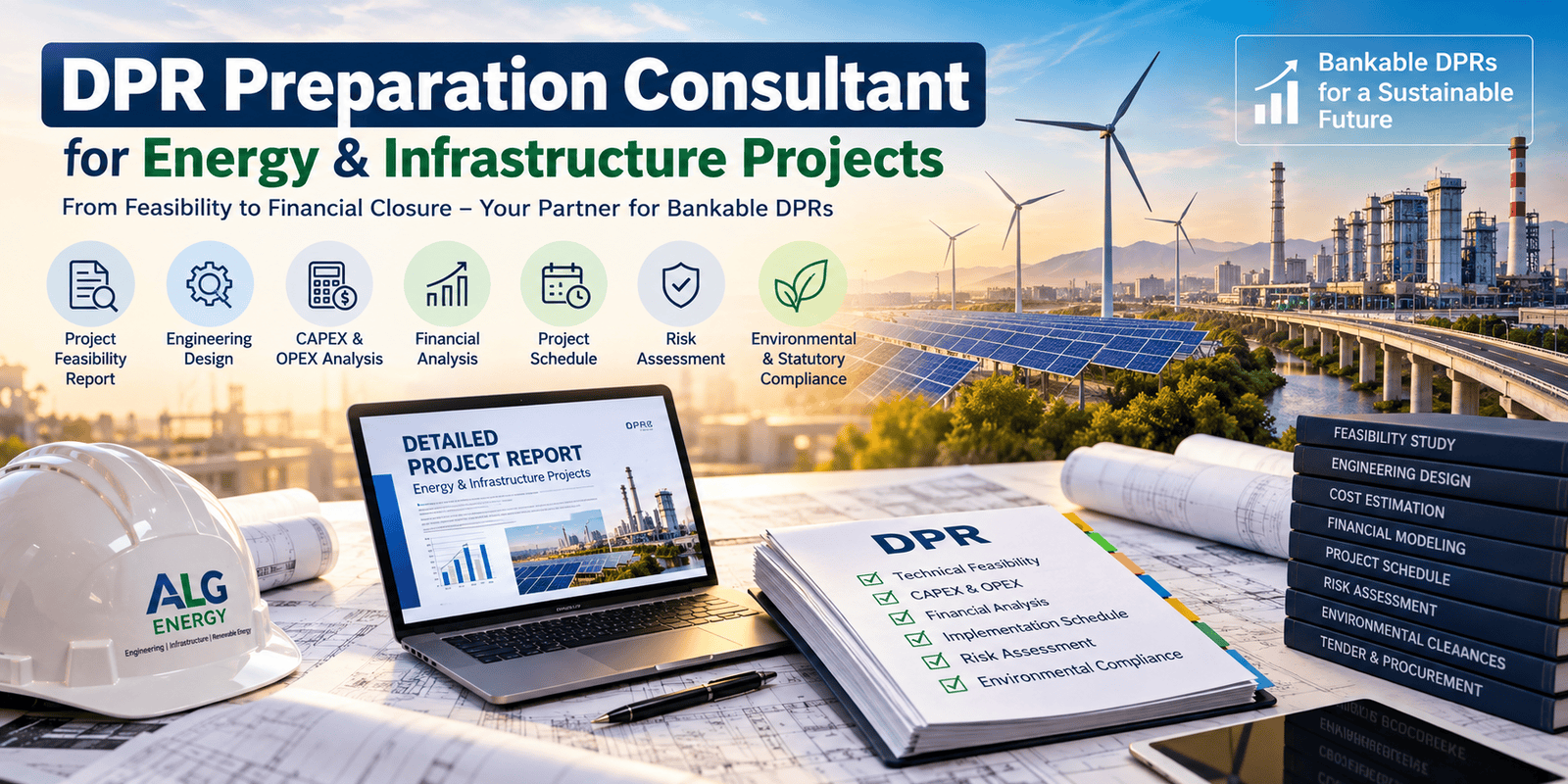
Primary Keyword: DPR preparation consultant
Secondary Keywords: detailed project report consultant, DPR preparation services, project feasibility report, techno economic feasibility study, project planning consultant, feasibility study consultant, engineering DPR consultant, energy project DPR, infrastructure project DPR, bankable DPR
Long-Tail Keywords: DPR preparation consultant for solar projects, detailed project report consultant in India, DPR consultant for infrastructure projects, energy project detailed project report, techno economic feasibility and DPR consultant, solar DPR preparation services, bankable DPR preparation consultant
Search Intent: Commercial / Project Investment
A major energy or infrastructure project rarely succeeds simply because the underlying idea is attractive. Investors, lenders, developers, government agencies, EPC contractors and project owners need evidence that the proposed project is technically feasible, commercially viable, financially sustainable and practical to execute.
That is where a DPR preparation consultant becomes important.
A Detailed Project Report (DPR) converts a project concept into a structured investment and implementation document. It brings together the project's technical concept, site conditions, capacity, technology, engineering basis, capital cost, operating cost, financial analysis, implementation schedule, procurement strategy, statutory requirements and project risks.
For a solar power plant, battery energy storage system, water treatment facility, industrial utility project, power plant, transmission infrastructure, CBG plant, hydro project, pumped storage project or other infrastructure development, the DPR provides a common technical and commercial basis for decision-making.
A well-prepared DPR should answer questions such as:
What exactly is the proposed project?
Why is the project required?
Is the proposed site suitable?
What capacity should be developed?
Which technology should be selected?
What infrastructure is required?
What will the project cost?
What will the project generate or save?
What are the operating costs?
What are the key project risks?
What approvals and clearances may be required?
How will the project be procured and implemented?
What is the expected project schedule?
Is the project financially viable?
Can the project attract investors or lenders?
What information is required before moving to EPC tendering and execution?
A professional DPR preparation process connects these questions instead of treating them as independent chapters.
For developers and investors, the objective is not simply to produce a large report. The objective is to create a decision-ready project document.
For EPC contractors, the DPR can become the foundation for scope definition, technical specifications, preliminary quantities, procurement planning and tender development.
For lenders and financial institutions, the DPR can provide a structured basis for technical and commercial review, subject to their own due diligence requirements.
For government and public-sector projects, the DPR can support project appraisal, approvals, budgeting, procurement and implementation planning.
This guide explains the major components of a professional DPR and how an experienced detailed project report consultant can support energy and infrastructure projects from concept through implementation.
1. What Is a Detailed Project Report?
A Detailed Project Report, commonly called a DPR, is a structured technical, commercial and financial document prepared to establish the feasibility and implementation framework of a proposed project.
The exact contents vary by sector, project size, client requirements, financing structure and applicable regulatory framework. A solar project DPR will not have exactly the same engineering basis as a water treatment plant, thermal power project, road, industrial facility or pumped storage project.
However, the fundamental objective remains similar:
To establish a sufficiently detailed technical, commercial and implementation basis for making an informed project decision.
A professional DPR typically connects the following areas:
Project concept
The report defines what the project is intended to achieve.
Technical feasibility
It evaluates whether the project can be technically implemented at the proposed site using the selected technology.
Site assessment
It examines land, access, utilities, resources, geotechnical conditions, environmental constraints, grid connectivity and other location-specific considerations.
Engineering
It establishes the preliminary engineering basis, equipment philosophy, system configuration, plant layout and major technical requirements.
Cost estimation
It develops CAPEX, OPEX and other project cost assumptions.
Financial analysis
It evaluates project economics through revenue assumptions, cash flow, investment requirements and financial indicators.
Implementation
It establishes procurement, contracting, construction, commissioning and project-management requirements.
Risk
It identifies technical, commercial, regulatory, environmental, schedule and financial risks.
Decision-making
Finally, the DPR brings the information together to help the project owner decide whether and how to proceed.
A DPR should therefore not be confused with a simple project report.
A document containing general descriptions and approximate costs may technically be called a project report, but it may not provide enough engineering and financial depth for investment or EPC decision-making.
The quality of a DPR depends on the quality of its assumptions, engineering, cost basis, data, calculations, risk assessment and implementation strategy.
2. Why Hire a DPR Preparation Consultant?
Developing a professional DPR requires multiple disciplines.
For a complex energy or infrastructure project, the work may involve:
Civil engineering
Structural engineering
Mechanical engineering
Electrical engineering
Instrumentation and control
Process engineering
Piping engineering
Environmental assessment
Geotechnical assessment
Hydrology
Energy-resource assessment
Grid studies
Project planning
Cost estimation
Procurement
Financial modelling
Risk assessment
Regulatory review
A project owner may have strong commercial knowledge but limited internal engineering resources. An EPC contractor may have construction capability but need additional front-end engineering support. An investor may require an independent technical assessment before committing capital.
A DPR preparation consultant can bring these disciplines together.
The value of the consultant is not merely report writing.
A good consultant should be able to understand the relationship between:
Project objective → site → technology → capacity → engineering → CAPEX → OPEX → revenue → financing → risk → implementation.
This relationship is essential.
For example, selecting a larger project capacity may increase revenue potential, but it can also increase land requirements, grid infrastructure, equipment quantities, CAPEX, financing requirements and construction complexity.
Similarly, selecting a particular technology may improve efficiency but increase equipment cost or introduce additional operating and maintenance requirements.
A DPR consultant therefore needs to evaluate the project as an integrated system.
3. Difference Between a Feasibility Study and a DPR
One of the most common questions from project developers is:
What is the difference between a feasibility study and a DPR?
The two are closely related, but they serve different purposes.
3.1 Feasibility Study
A feasibility study generally answers:
“Should this project be developed?”
It examines whether the proposed project is technically and commercially practical.
Typical areas include:
Market assessment
Site assessment
Resource availability
Technology options
Capacity options
Preliminary engineering
Preliminary CAPEX
OPEX
Revenue assumptions
Financial indicators
Regulatory considerations
Risks
Implementation options
The feasibility study may compare multiple alternatives.
For example:
Option A: 50 MW solar
Option B: 75 MW solar
Option C: 100 MW solar + BESS
The study may identify the preferred option.
3.2 Detailed Project Report
The DPR generally goes further.
It answers:
“How should the selected project be developed and implemented?”
The DPR develops the preferred project concept into a structured engineering and implementation framework.
It may include:
Detailed project configuration
Design criteria
Engineering calculations
Preliminary layouts
Equipment specifications
Major quantities
CAPEX breakdown
OPEX assumptions
Project schedule
Procurement strategy
Contracting strategy
Risk assessment
Financial model
Statutory requirements
Implementation methodology
The World Bank's project-appraisal guidance similarly emphasizes that project appraisal should consider feasibility, economic viability, commercial viability, financial considerations, risks and project-management capability rather than treating technical feasibility as an isolated question.
3.3 Feasibility → DPR → Tender
A practical project-development sequence can be:
Concept
↓
Pre-Feasibility
↓
Feasibility Study
↓
Techno-Economic Analysis
↓
DPR
↓
Detailed Engineering
↓
Tender Documentation
↓
EPC Procurement
↓
Construction
↓
Testing & Commissioning
↓
Operation
This sequence is particularly useful for large energy and infrastructure projects.
4. Project Background
The first major section of an energy project detailed project report should establish the project background.
This section explains why the project is being considered and what it intends to achieve.
It may include:
4.1 Project identification
Project name
Project location
Project owner
Developer
Client
Project type
Proposed capacity
Development stage
4.2 Project objectives
The DPR should clearly state project objectives.
Examples include:
Renewable electricity generation
Industrial power supply
Water supply
Wastewater treatment
Energy cost reduction
Grid support
Energy storage
Infrastructure development
Industrial process improvement
Decarbonization
Replacement of existing equipment
Expansion of production capacity
4.3 Project need
The report should explain the need for the project.
For example, a solar project may be proposed to supply renewable electricity to an industrial facility.
A water treatment project may address increased demand or regulatory requirements.
A BESS project may address peak demand, renewable integration or grid-support requirements.
An industrial utility project may be required to support a new production facility.
The need statement should be supported by data wherever possible.
5. Site Assessment
Site assessment is one of the most important components of a project feasibility report.
A technically attractive project can become commercially unattractive if the site has major constraints.
A professional site assessment should consider the project-specific requirements.
5.1 Land availability
For land-intensive projects, assess:
Total land requirement
Land ownership
Lease arrangements
Land-use classification
Contiguous land availability
Right of way
Access roads
Existing structures
Encroachments
Future expansion potential
For solar parks and other renewable-energy developments, site infrastructure such as transmission, roads, drainage, water and communications can materially influence project development.
5.2 Accessibility
The DPR should assess:
Road access
Heavy equipment transportation
Bridge restrictions
Port access
Railway connectivity
Construction traffic
Logistics routes
Large transformers, turbines, generators, vessels and other heavy equipment may require route surveys.
5.3 Topography
Topographical information may influence:
Site grading
Drainage
Foundations
Roads
Equipment layout
Cable routing
Pipeline routing
Civil quantities
5.4 Geotechnical conditions
Depending on project requirements, investigations may address:
Soil characteristics
Bearing capacity
Groundwater
Rock conditions
Settlement
Seismic considerations
Foundation requirements
For major infrastructure projects, geotechnical assumptions should be clearly identified and validated as the project advances.
5.5 Water availability
Projects may require water for:
Process use
Cooling
Potable use
Fire protection
Cleaning
Construction
Domestic requirements
Water source, quality, availability, treatment requirements and discharge arrangements should be evaluated.
5.6 Grid connectivity
For power projects, grid connectivity can become one of the most important project constraints.
The DPR should consider:
Nearest substation
Voltage level
Transmission capacity
Interconnection requirements
Evacuation route
Substation requirements
Protection systems
Metering
Grid-code requirements
Curtailment considerations
Transmission losses
A project should not be considered fully feasible simply because suitable land is available.
The power evacuation system must also be technically and commercially practical.
6. Technical Feasibility
Technical feasibility establishes whether the proposed project can be developed using the selected technology and site.
A strong feasibility study consultant will examine alternatives rather than automatically accepting the first technology proposed by the client.
Technical feasibility can include:
Technology maturity
Technology availability
Equipment suppliers
Performance characteristics
Capacity
Efficiency
Reliability
Availability
Maintainability
Local support
Spare-parts requirements
Operating conditions
Environmental requirements
Safety requirements
For infrastructure projects, technical feasibility should also consider constructability.
A technically sophisticated solution may not be the best solution if it is difficult to construct, maintain or procure.
7. Process and Engineering Design
The engineering section converts the project concept into a practical configuration.
The exact engineering scope depends on the sector.
For an industrial project, it may include:
Process flow diagram
P&ID philosophy
Equipment selection
Utility systems
Piping
Electrical
Instrumentation
HVAC
Fire protection
Civil works
Structural works
For a solar project:
Solar resource assessment
Module selection
Inverter configuration
DC system
AC system
Transformer system
Collection system
Substation
Transmission
SCADA
Communications
Civil works
Drainage
Roads
O&M infrastructure
For BESS:
Battery technology
Battery capacity
Power rating
Duration
PCS
Transformer
MV system
EMS
BMS
HVAC
Fire protection
SCADA
Grid connection
Civil and structural requirements
For water projects:
Raw-water system
Pretreatment
Process units
Filtration
Chemical systems
Sludge management
Storage
Pumping
Distribution
Electrical
Instrumentation
Automation
This is why an engineering DPR consultant should have multidisciplinary engineering capability.
8. Capacity and Technology Selection
Capacity selection has a direct impact on project economics.
A professional DPR preparation consultant for solar projects should not simply select capacity based on land availability.
The optimum capacity may depend on:
Resource availability
Land
Grid capacity
Transmission constraints
Energy demand
Technology
Equipment availability
CAPEX
Revenue
Financing
Regulatory limitations
Project objectives
8.1 Technology comparison
A DPR can compare alternatives using criteria such as:
| Parameter | Technology A | Technology B |
|---|---|---|
| CAPEX | Medium | High |
| Efficiency | High | Very High |
| OPEX | Medium | Low |
| Availability | High | Medium |
| Technology maturity | High | Medium |
| Maintenance | Medium | Low |
| Life | High | High |
| Project risk | Low | Medium |
The purpose of such analysis is to make the technology decision transparent.
9. CAPEX Estimation
Capital expenditure is one of the most commercially important sections of a DPR.
CAPEX represents the investment required to develop and construct the project.
A detailed CAPEX structure may include:
Land and site development
Land acquisition/lease
Site preparation
Grading
Roads
Drainage
Boundary systems
Civil and structural
Foundations
Buildings
Structures
Equipment foundations
Pipe racks
Cable trenches
Mechanical
Major equipment
Pumps
Compressors
Tanks
Heat exchangers
Mechanical packages
Electrical
Transformers
Switchgear
Cables
Substations
Transmission
Protection systems
Instrumentation and control
DCS
PLC
SCADA
Instruments
Communication systems
Fire protection
Firewater system
Fire pumps
Hydrants
Detection
Alarm
Suppression systems
Engineering and consultancy
Feasibility
Detailed engineering
Project management
Technical consultancy
Construction
Installation
Civil construction
Mechanical erection
Electrical installation
Testing
Pre-operative expenses
Mobilization
Training
Commissioning
Trial operation
Contingency
Appropriate contingency should be established based on the project-development stage and quality of available engineering information.
A common mistake is to present one total CAPEX figure without explaining the basis.
A professional DPR should show how the number has been developed.
10. OPEX Estimation
Operating expenditure is required to understand the long-term economic performance of the project.
Typical OPEX categories include:
Personnel
Maintenance
Consumables
Utilities
Chemicals
Insurance
Spare parts
Software and licenses
Administration
Land lease
Grid charges
Waste disposal
Water
Security
Equipment replacement
For renewable-energy projects, OPEX may include module cleaning, vegetation management, inverter maintenance, electrical maintenance, security, insurance and BESS-related operating costs.
For water treatment projects, chemicals, power consumption, sludge disposal, membranes, consumables and maintenance can become major operating costs.
A good detailed project report consultant should distinguish between fixed and variable OPEX where relevant.
11. Financial Analysis
A project may be technically feasible but financially unattractive.
Therefore, financial analysis is a critical part of the DPR.
Depending on the project, the model may evaluate:
Project investment
Debt
Equity
Revenue
OPEX
Depreciation
Taxes
Interest
Cash flow
Working capital
Project life
Salvage value
Common indicators include:
Net Present Value
NPV measures the present value of future project cash flows after accounting for the required investment.
Internal Rate of Return
IRR represents the discount rate at which the project's net present value becomes zero.
Payback period
This estimates how long it takes for cumulative project cash flow to recover the initial investment.
Debt Service Coverage Ratio
DSCR is particularly relevant for debt-funded projects because lenders need to understand the project's capacity to service debt.
Levelized Cost
For energy projects, levelized cost metrics can help compare alternative technologies or project configurations.
12. Techno-Economic Feasibility Study
A techno economic feasibility study integrates technical and financial evaluation.
This is particularly important for capital-intensive projects.
The study asks:
Can the project be built?
and:
Does it make economic sense to build it?
Both questions must be answered together.
For example, suppose a technology provides better efficiency but requires significantly higher CAPEX.
The engineering team may prefer the high-efficiency technology.
The financial team may prefer the lower-cost alternative.
A techno-economic model allows the project owner to evaluate the complete lifecycle impact.
Important variables can include:
CAPEX
OPEX
Capacity factor
Efficiency
Availability
Revenue
Tariff
Financing cost
Project life
Inflation
Equipment replacement
Degradation
Taxes
Residual value
13. Financial Sensitivity Analysis
A strong bankable DPR preparation consultant should not present financial results as if they are certain.
Projects are exposed to uncertainty.
Sensitivity analysis can evaluate changes in:
CAPEX
OPEX
Revenue
Tariff
Interest rate
Exchange rate
Project schedule
Capacity factor
Fuel cost
Equipment cost
Construction cost
For example:
Scenario A – Base Case
CAPEX: Base assumption
Revenue: Base assumption
Schedule: Base assumption
Scenario B – CAPEX Increase
CAPEX increases by a defined percentage.
Scenario C – Revenue Reduction
Revenue decreases due to lower tariff or utilization.
Scenario D – Schedule Delay
Commercial operation is delayed.
Scenario E – Combined Downside
Higher CAPEX + lower revenue + schedule delay.
This gives management and investors a better understanding of the project's resilience.
14. Project Schedule
A DPR should establish a realistic project implementation schedule.
A typical project schedule may include:
Project approval
Land finalization
Surveys
Feasibility
DPR
Approvals
Detailed engineering
Tendering
Procurement
Manufacturing
Civil construction
Equipment erection
Electrical installation
Testing
Commissioning
Commercial operation
The schedule should identify critical activities.
For major projects, long-lead equipment may determine the overall project duration.
Examples include:
Transformers
Turbines
Generators
Large pumps
Switchgear
Battery systems
Process equipment
Specialized vessels
A project schedule that ignores long-lead procurement can produce an unrealistic COD target.
15. Risk Assessment
Project risk management should begin during feasibility and DPR preparation rather than after contract award.
A structured risk assessment may classify risks as:
Technical risk
Technology performance
Equipment reliability
Design gaps
Interface issues
Site risk
Land
Geotechnical conditions
Flooding
Access
Water
Climate
Commercial risk
CAPEX escalation
Vendor pricing
Currency fluctuation
Revenue assumptions
Schedule risk
Approval delays
Land delays
Procurement delays
Construction delays
Regulatory risk
Permits
Environmental approvals
Grid approvals
Statutory requirements
Financial risk
Interest rate
Exchange rate
Revenue uncertainty
Debt availability
Operational risk
Availability
Maintenance
Spare parts
Skilled manpower
A risk register can use:
| Risk | Probability | Impact | Rating | Mitigation |
|---|---|---|---|---|
| Land delay | Medium | High | High | Early land verification |
| Grid approval | Medium | High | High | Early utility coordination |
| CAPEX escalation | Medium | Medium | Medium | Budget contingency |
| Equipment delay | Medium | High | High | Early procurement |
| Technology performance | Low/Medium | High | Medium | Vendor due diligence |
ISO 31000 provides a recognized framework for identifying, analyzing, evaluating, treating, monitoring and communicating risks, making structured risk thinking relevant to project-development work.
16. Environmental and Statutory Considerations
Environmental and statutory requirements vary considerably according to location and project type.
A DPR should identify applicable requirements rather than assuming that one approval structure applies to every project.
Potential areas include:
Environmental permissions
Land approvals
Water permissions
Forest-related approvals
Pollution-control requirements
Building approvals
Fire approvals
Electrical approvals
Grid approvals
Factory permissions
Safety requirements
Local authority permissions
For international projects, the applicable country-specific regulatory framework must be incorporated.
A DPR consultant for infrastructure projects should therefore clearly distinguish between:
Applicable requirements
and
Requirements requiring confirmation during subsequent project stages.
This prevents preliminary assumptions from being mistaken for final statutory approvals.
17. Tender and Procurement Strategy
A DPR should ideally provide a bridge to procurement.
The project owner should understand how the project could be packaged and tendered.
Possible procurement models include:
EPC
EPCM
Design-build
Multiple-package contracting
Item-rate contracts
Turnkey contracts
O&M contracts
Long-term service agreements
The appropriate model depends on project complexity, owner capability, risk allocation and market conditions.
17.1 EPC strategy
An EPC model may place significant responsibility with one contractor.
The DPR can define:
Scope
Performance requirements
Major equipment
Interfaces
Testing
Commissioning
Performance guarantees
Warranty requirements
17.2 Multiple-package strategy
Large projects may divide procurement into packages.
For example:
Civil package
Mechanical package
Electrical package
Instrumentation package
Fire protection
Transmission
BESS
Solar PV
The advantage can be greater flexibility, but the project owner assumes greater interface-management responsibility.
17.3 Tender documentation
A DPR preparation services provider may also support development of:
Scope of work
Technical specifications
Datasheets
BOQ
MTO
Employer's requirements
Technical schedules
Bid evaluation criteria
Vendor qualification requirements
Commercial bid formats
This creates a natural transition from:
DPR → Tender → Procurement → EPC → PMC.
18. DPR Deliverables
A professional DPR package can contain multiple documents rather than one report.
Typical deliverables may include:
Main DPR
Executive summary
Project background
Project objectives
Site assessment
Technical feasibility
Technology selection
Capacity assessment
Engineering basis
CAPEX
OPEX
Financial analysis
Risk assessment
Environmental considerations
Implementation schedule
Procurement strategy
Conclusions
Engineering appendices
Depending on the project:
Site layout
Process flow diagram
P&IDs
Single-line diagrams
Equipment list
Equipment specifications
Preliminary datasheets
Load list
Utility summary
Water balance
Energy balance
Preliminary civil quantities
Preliminary electrical quantities
Preliminary piping quantities
Commercial appendices
CAPEX breakdown
OPEX breakdown
Cost assumptions
Vendor budgetary quotations
Market assumptions
Financial model
Sensitivity analysis
Project implementation appendices
Master schedule
Procurement schedule
Construction methodology
Project organization
Risk register
Approval matrix
The final deliverables should be tailored to the client's requirements.
19. DPR for Solar Power Projects
A DPR preparation consultant for solar projects needs to address both renewable-energy resource characteristics and conventional infrastructure requirements.
A solar DPR can include:
Solar resource
Solar irradiation
GHI
DNI where relevant
Temperature
Wind
Weather conditions
Site
Land area
Topography
Soil
Drainage
Flood risk
Access
PV system
Module technology
Module rating
String configuration
Inverter selection
DC/AC ratio
Mounting system
Tracker/fixed structure
Electrical
DC collection
AC collection
Transformers
MV system
Substation
Transmission
Protection
SCADA
Energy yield
Expected generation
Performance ratio
Losses
Degradation
Availability
Commercial
CAPEX
OPEX
Tariff
Revenue
Financial model
Grid
Interconnection
Evacuation
Transmission
Grid compliance
India's MNRE publishes solar policies and guidelines, including guidelines relevant to grid-connected solar and renewable projects with energy storage. Project-specific DPRs should therefore be checked against the applicable current policy and regulatory framework rather than relying on generic templates.
20. DPR for Solar + BESS Projects
Solar-plus-storage projects require an integrated DPR.
The solar plant and BESS should not be evaluated as two unrelated assets.
The analysis should consider:
Solar generation profile
BESS capacity
BESS power rating
Duration
Charging strategy
Dispatch strategy
Round-trip efficiency
Degradation
Battery replacement
PCS
EMS
BMS
HVAC
Fire protection
Grid interface
Revenue model
The economic model should evaluate whether the storage system creates sufficient value relative to its capital and operating cost.
Possible value streams can include:
Peak shifting
Energy arbitrage
Renewable firming
Grid support
Capacity services
Ancillary services
The exact revenue model depends on the market and contractual structure.
A strong energy project DPR should therefore define the operating philosophy before calculating the financial return.
21. DPR for Water Infrastructure
Water infrastructure projects require a different technical approach.
A water-sector DPR may include:
Water demand
Raw-water source
Raw-water quality
Treatment philosophy
Process selection
Hydraulic profile
Pumping
Storage
Distribution
Sludge management
Chemical systems
Electrical systems
Instrumentation
SCADA
Civil infrastructure
Environmental requirements
For wastewater projects, the DPR may cover:
Influent characteristics
Flow variation
Biological treatment
Primary treatment
Secondary treatment
Tertiary treatment
Sludge treatment
Reuse
Discharge standards
For industrial clients, water and wastewater engineering may need to integrate with the production process and utility systems.
22. DPR for Industrial Projects
Industrial projects require an integrated engineering approach.
A DPR may need to connect:
Process → Utilities → Equipment → Piping → Electrical → Instrumentation → Civil → Fire Protection → Environment → Operations.
Important systems may include:
Compressed air
Cooling water
DM water
Raw water
Steam
Fuel systems
HVAC
Fire protection
Electrical distribution
Wastewater
Chemical handling
Equipment engineering may include:
Pressure vessels
Heat exchangers
Storage tanks
Pumps
Compressors
Cooling systems
Fuel systems
The engineering DPR consultant should understand equipment interfaces rather than evaluating each package separately.
23. DPR for Power Projects
Power projects require detailed technical coordination.
Depending on the technology, a power-project DPR may cover:
Generation technology
Plant capacity
Fuel
Heat balance
Main equipment
Balance of plant
Cooling system
Water system
Fuel handling
Ash handling where applicable
Electrical system
Switchyard
Transmission
Control systems
Fire protection
Environmental systems
For hydroelectric and pumped-storage projects, additional areas can include:
Hydrology
Geology
Reservoir
Dam
Water conductor system
Powerhouse
Turbine
Generator
Transmission
Construction methodology
The Central Electricity Authority maintains project-appraisal and DPR guidance for hydroelectric and pumped-storage schemes, illustrating why sector-specific DPR requirements can be materially different from generic project-report formats.
24. Bankable DPR: What Does It Mean?
The term bankable DPR is frequently used in infrastructure and energy projects.
A bankable DPR should not be understood as a guarantee that a lender will finance the project.
Instead, it should mean that the project documentation has sufficient technical, commercial and financial quality to support lender and investor due diligence.
A lender may examine:
Technology
Site
EPC cost
OPEX
Revenue
Contracts
Offtake
Permits
Grid
Construction schedule
Project risks
Sponsor capability
Debt structure
Financial model
Sensitivity analysis
Therefore, bankable DPR preparation should be approached with greater discipline than a basic concept report.
The report should make assumptions transparent.
It should identify what has been verified and what remains subject to confirmation.
It should avoid unsupported claims.
It should distinguish:
Fact
from
Assumption
from
Estimate
from
Requirement for further investigation.
That distinction significantly improves the credibility of the document.
25. What Makes a Good DPR?
A high-quality DPR should have five characteristics.
25.1 Technically credible
Engineering assumptions should be reasonable and traceable.
25.2 Commercially realistic
Costs and revenues should reflect realistic market conditions.
25.3 Financially transparent
The financial model should clearly identify assumptions.
25.4 Implementation-focused
The report should explain how the project can actually be developed.
25.5 Risk-aware
The report should identify uncertainties rather than hiding them.
A good DPR should not attempt to make every project appear attractive.
If a project has a major technical or commercial weakness, the DPR should identify it.
That is one of the most important differences between professional consultancy and promotional documentation.
26. Common Mistakes in DPR Preparation
Many project reports fail because of avoidable issues.
Mistake 1: Using a generic template
A solar DPR, BESS DPR, water-treatment DPR and industrial DPR should not look identical.
Templates are useful for structure, but engineering content must be project-specific.
Mistake 2: Unrealistic CAPEX
Underestimating CAPEX can make the financial model appear attractive while creating problems later.
Mistake 3: Ignoring site constraints
Land, access, flooding, water, geotechnical conditions and transmission can materially affect project viability.
Mistake 4: Treating financial analysis separately
The financial model must be linked to the engineering configuration.
Mistake 5: No sensitivity analysis
A single financial scenario does not adequately show project resilience.
Mistake 6: Ignoring procurement
Long-lead equipment and procurement strategy can determine the actual project schedule.
Mistake 7: Weak risk assessment
A DPR should identify major risks and mitigation measures.
Mistake 8: No implementation strategy
A technically sound project still requires a practical execution plan.
Mistake 9: Poor documentation
Tables, assumptions, drawings and calculations should be consistent throughout the report.
Mistake 10: Overstating certainty
Preliminary engineering should not be presented as final design.
27. How AlgEnergy Approaches DPR Preparation
AlgEnergy Engineering Consultancy Services positions its engineering capability around multidisciplinary project support from feasibility and planning through engineering, tendering, project execution and commissioning support.
For a DPR assignment, the practical approach can be structured around several stages.
Stage 1 – Project understanding
The consultant first understands:
Client objectives
Project scope
Site
Capacity
Technology
Commercial objectives
Development stage
Required deliverables
Stage 2 – Data collection
Relevant information is gathered, including:
Site information
Surveys
Existing drawings
Utility information
Resource data
Grid information
Client requirements
Market information
Stage 3 – Technical assessment
The engineering team evaluates:
Site
Technology
Capacity
Configuration
Major systems
Interfaces
Stage 4 – Preliminary engineering
The project configuration is developed.
Stage 5 – Cost estimation
CAPEX and OPEX are developed using the available project information and appropriate cost assumptions.
Stage 6 – Financial model
The technical and commercial assumptions are translated into financial indicators.
Stage 7 – Risk assessment
Technical, commercial, regulatory and implementation risks are identified.
Stage 8 – Implementation plan
Procurement, construction and commissioning activities are structured.
Stage 9 – DPR compilation
All technical and commercial sections are integrated into the final DPR.
Stage 10 – Review
The document is reviewed for consistency between:
Engineering → Cost → Schedule → Financial Model → Risk.
This integrated approach is particularly useful for projects where multiple engineering disciplines must work together.
28. Multidisciplinary Engineering Behind a DPR
A DPR becomes stronger when engineering disciplines are coordinated from the beginning.
A typical energy or infrastructure project may involve:
Civil
Site development
Roads
Drainage
Foundations
Buildings
Structural
Steel structures
Equipment supports
Pipe racks
Platforms
Mechanical
Equipment
Pumps
Tanks
Heat exchangers
Utility systems
Piping
Piping layouts
Pipe routing
P&IDs
Isometrics at appropriate project stages
Supports
Stress analysis coordination
Electrical
Load calculations
Power distribution
Transformers
Switchgear
Substations
Instrumentation and Control
Control philosophy
Instruments
PLC/DCS
SCADA
Communication
Fire Protection
Firewater
Detection
Alarm
Suppression
Project Management
Planning
Procurement
Cost
Schedule
Interfaces
Risk
This multidisciplinary approach helps avoid engineering decisions that solve one problem while creating another.
29. DPR and Detailed Engineering: What Is the Difference?
A DPR should not be confused with complete detailed engineering.
The DPR establishes the project's development basis.
Detailed engineering subsequently develops construction-ready documentation.
For example:
DPR stage
Preliminary layout
Equipment selection
Preliminary sizing
CAPEX
Project configuration
Detailed engineering stage
Final calculations
Final equipment datasheets
IFC drawings
Detailed piping
Final cable schedules
Final structural design
Construction drawings
Vendor document integration
Therefore, a DPR can be considered an important bridge between feasibility and detailed design.
30. DPR and Technical Due Diligence
DPR preparation and technical due diligence are related but different services.
A DPR asks:
“How should the proposed project be developed?”
Technical due diligence asks:
“Is the proposed project technically sound based on the available information?”
An investor may therefore commission:
Feasibility study
DPR
Technical due diligence
Financial due diligence
Legal due diligence
The technical due diligence team may review:
DPR
Design
CAPEX
EPC contract
Equipment
Site
Schedule
Technology
Construction progress
Risks
This creates another potential service pathway for developers and investors.
31. DPR and Project Management Consultancy
The DPR should ideally prepare the project for execution.
Once the project moves into implementation, the client may require:
PMC
Owner's engineer
Engineering management
Procurement support
Vendor document review
Construction supervision
QA/QC
Progress monitoring
Testing
Commissioning
This creates the project-development sequence:
Feasibility
→
DPR
→
Tender
→
EPC Procurement
→
PMC / Owner's Engineer
→
Construction
→
Commissioning
An engineering consultancy capable of supporting multiple stages can provide continuity between the original project assumptions and actual implementation.
32. How to Select a DPR Preparation Consultant
Selecting the right consultant is important because DPR quality can directly affect later project decisions.
Before appointing a DPR preparation consultant, ask:
1. Does the consultant understand the project sector?
Experience in solar is not automatically experience in hydro, BESS, water or industrial projects.
2. Does the consultant have multidisciplinary engineering capability?
Complex projects need more than one discipline.
3. Can the consultant develop CAPEX and OPEX?
Engineering-only DPRs may not provide adequate investment analysis.
4. Can the consultant develop a financial model?
The financial model should connect to engineering assumptions.
5. Does the consultant understand procurement?
The DPR should support tendering and EPC strategy.
6. Can the consultant support international projects?
For international projects, knowledge of applicable codes, standards and client requirements is important.
7. Can the consultant support implementation?
Experience in construction, commissioning or PMC can improve the practicality of the DPR.
8. Are assumptions clearly documented?
A transparent DPR is easier for investors and lenders to review.
33. DPR Preparation Consultant in India for International Projects
India has a large engineering and technical-services ecosystem, making Indian engineering consultants relevant to international developers and EPC contractors seeking multidisciplinary engineering resources.
For international projects, the consultant should be capable of working with:
Client specifications
International codes
Project-specific standards
EPC specifications
International procurement requirements
Multinational vendor documentation
Remote engineering coordination
Digital document-management systems
The consultant should also understand that local regulations remain the responsibility of the applicable project jurisdiction.
A detailed project report consultant in India supporting an international project should therefore distinguish between:
International engineering practice
Client requirements
Country-specific statutory requirements
Local authority approvals
This is particularly relevant to projects in Africa, the Middle East, Europe, Central Asia, Japan and other international markets.
34. Why the DPR Should Be Written for the Decision Maker
A technically accurate report can still fail if decision makers cannot understand it.
A good DPR should begin with an executive summary.
The executive summary should answer:
What is the project?
Where is it located?
What is the capacity?
What technology is proposed?
What is the estimated investment?
What is the expected output?
What is the implementation period?
What are the major risks?
What are the financial indicators?
What decision is recommended?
Senior management should not need to read 200 pages to understand the project's fundamental proposition.
The detailed technical sections should then provide evidence supporting the executive summary.
35. Recommended DPR Structure
A comprehensive DPR can be structured as follows:
Chapter 1 – Executive Summary
Chapter 2 – Project Background
Chapter 3 – Project Objectives and Need
Chapter 4 – Market Assessment
Chapter 5 – Site Assessment
Chapter 6 – Resource Assessment
Chapter 7 – Technology Evaluation
Chapter 8 – Capacity Selection
Chapter 9 – Technical Feasibility
Chapter 10 – Engineering Design Basis
Chapter 11 – Process Description
Chapter 12 – Major Equipment
Chapter 13 – Civil and Structural Requirements
Chapter 14 – Electrical Systems
Chapter 15 – Instrumentation and Control
Chapter 16 – Water and Utility Systems
Chapter 17 – Fire Protection
Chapter 18 – Environmental and Statutory Requirements
Chapter 19 – CAPEX
Chapter 20 – OPEX
Chapter 21 – Financial Analysis
Chapter 22 – Sensitivity Analysis
Chapter 23 – Risk Assessment
Chapter 24 – Procurement Strategy
Chapter 25 – Project Implementation Strategy
Chapter 26 – Project Schedule
Chapter 27 – Project Organization
Chapter 28 – Conclusions and Recommendations
Appendices
Drawings
Calculations
Equipment lists
Cost estimates
Financial model
Site information
Technical specifications
Supporting studies
The final structure should always be customized to the project.
36. Internal Linking Strategy for DPR SEO
For a website targeting project-development leads, internal linking should guide visitors from informational content toward commercial service pages.
The recommended content funnel is:
Feasibility Study
↓
DPR Preparation
↓
Techno-Economic Analysis
↓
Detailed Engineering
↓
Tender Documentation
↓
Technical Due Diligence
↓
PMC / Owner's Engineer
The DPR article should therefore link naturally to relevant AlgEnergy service pages wherever those pages exist.
Recommended anchor-text themes include:
Feasibility study services
Detailed project report services
Techno-economic feasibility study
Engineering consultancy services
Detailed engineering services
Tender documentation
Technical due diligence
Project management consultancy
Renewable energy engineering
Solar and BESS engineering
Avoid using the same exact anchor text repeatedly.
Google should be able to understand the relationship between pages through the site's content structure.
37. Suggested Internal Links for AlgEnergy
Within the article, use contextual links such as:
“AlgEnergy's feasibility and project-planning services”
Link to the relevant feasibility/service page.
“multidisciplinary engineering consultancy”
Link to the main engineering consultancy page.
“tender and bid documentation”
Link to the relevant tender-service page.
“project management and site supervision”
Link to the relevant PMC/project-management page.
“renewable energy and BESS engineering”
Link to the renewable-energy service page.
If a dedicated page does not yet exist, create one rather than sending every internal link to the homepage.
This can improve both SEO architecture and lead conversion.
38. External Linking Strategy
External links should be selective and authoritative.
Recommended categories include:
Government
Use official government sources for:
Renewable-energy policies
Energy regulations
Project guidelines
Environmental requirements
For Indian renewable-energy projects, MNRE is an appropriate primary source.
Central Electricity Authority
For applicable Indian power-sector projects, CEA can provide relevant technical and project-appraisal guidance.
World Bank
The World Bank provides useful material on infrastructure project appraisal, feasibility, commercial viability, financial analysis, risk and PPP project development.
ISO
ISO 31000 can be referenced for general risk-management principles.
Other authorities
Depending on the project, additional sources may include:
International Energy Agency
IFC
Asian Development Bank
European Investment Bank
National utilities
Grid operators
Local regulatory authorities
External links should support the article rather than distract from the commercial objective.
39. SEO Keyword Distribution Strategy
The primary keyword should appear naturally in high-value locations.
Primary keyword
DPR preparation consultant
Recommended placements:
SEO title
H1 or opening section
First 100–150 words
One H2/H3
Body content
FAQ
CTA
Meta description
Image alt text where appropriate
Do not force the exact phrase into every section.
Secondary keywords
Naturally distribute:
detailed project report consultant
DPR preparation services
project feasibility report
techno economic feasibility study
project planning consultant
feasibility study consultant
engineering DPR consultant
energy project DPR
infrastructure project DPR
bankable DPR
Long-tail keywords
Use naturally in dedicated sections:
DPR preparation consultant for solar projects
detailed project report consultant in India
DPR consultant for infrastructure projects
energy project detailed project report
techno economic feasibility and DPR consultant
solar DPR preparation services
bankable DPR preparation consultant
The objective should be semantic coverage, not keyword stuffing.
40. SEO Content Cluster Around DPR Services
One DPR article should become part of a larger topic cluster.
Recommended supporting articles include:
Cluster 1 – Feasibility
What Is a Project Feasibility Study?
Technical Feasibility Study for Energy Projects
Techno-Economic Feasibility Study Guide
Renewable Energy Feasibility Study
Solar Project Feasibility Study
Cluster 2 – DPR
Detailed Project Report Preparation
Bankable DPR for Energy Projects
Solar DPR Preparation
Infrastructure Project DPR
DPR for BESS Projects
Cluster 3 – Engineering
Engineering Design Outsourcing
Detailed Engineering Services
Multidisciplinary Engineering Consultancy
Solar Engineering Consultancy
BESS Engineering Consultancy
Cluster 4 – Procurement
EPC Tender Documentation
Technical Specification Preparation
BOQ and MTO Preparation
Technical Bid Evaluation
Vendor Engineering Review
Cluster 5 – Execution
PMC Services
Owner's Engineer Services
Construction Supervision
QA/QC Consultancy
Commissioning Support
This cluster creates a stronger topical relationship between AlgEnergy's services.
41. Frequently Asked Questions
What is a DPR preparation consultant?
A DPR preparation consultant develops the technical, commercial, financial and implementation framework for a proposed project. The consultant may coordinate feasibility studies, engineering, cost estimation, financial analysis, risk assessment, procurement strategy and project planning.
What does a DPR contain?
A DPR typically contains project background, site assessment, technical feasibility, technology selection, engineering basis, capacity, CAPEX, OPEX, financial analysis, risks, environmental considerations, implementation schedule and procurement strategy.
What is the difference between DPR and feasibility study?
A feasibility study generally determines whether a project is practical and viable, while a DPR develops the selected project concept into a more detailed technical, commercial and implementation framework.
Is a DPR required for every project?
Not necessarily. The requirement depends on the project size, financing structure, client, sector, regulatory requirements and development stage. However, a structured project-development report is highly useful for major capital projects.
What is a bankable DPR?
A bankable DPR is a technically and commercially robust project report prepared to support investment and lender due diligence. It does not itself guarantee financing.
Can a DPR consultant prepare a financial model?
Yes. Depending on the scope, a DPR consultant can develop CAPEX, OPEX, revenue assumptions, project cash flow, NPV, IRR, DSCR, payback and sensitivity analysis.
Can a DPR consultant prepare DPRs for solar projects?
Yes. A solar DPR can cover site assessment, resource analysis, plant configuration, PV technology, energy yield, electrical infrastructure, grid connectivity, CAPEX, OPEX, financial analysis and implementation planning.
Can a DPR include BESS?
Yes. A BESS DPR can evaluate battery capacity, power rating, duration, PCS, EMS, BMS, HVAC, fire protection, electrical infrastructure, grid connection, operating strategy, degradation, replacement and project economics.
Can a DPR consultant support international projects?
Yes, provided the consultant has the required engineering capabilities and experience. International projects also require compliance with the applicable country-specific regulations, codes, client standards and grid requirements.
How long does DPR preparation take?
The timeline depends on project size, sector, data availability, site investigations, engineering depth, regulatory requirements and client review cycles. A small project may require substantially less time than a large power, infrastructure or industrial development.
How much does DPR preparation cost?
There is no universal price. The fee depends on project capacity, engineering disciplines, site work, number of alternatives, financial modelling requirements, drawings, surveys and expected deliverables.
Can the same consultant prepare DPR and detailed engineering?
Yes. This can provide continuity, although the scope and level of engineering should be clearly defined for each project stage.
Can the DPR be used for EPC tendering?
A well-developed DPR can provide the technical and commercial basis for subsequent tender documentation. Depending on project requirements, additional detailed engineering may still be required before issuing an EPC tender.
What is techno-economic feasibility?
Techno-economic feasibility combines technical assessment with economic and financial analysis to determine whether a project is technically practical and economically attractive.
Why is site assessment important in a DPR?
Site conditions affect land requirements, civil works, access, drainage, foundations, water, grid connectivity, logistics, construction cost and schedule. Site constraints can materially change project economics.
Should a DPR include risk analysis?
Yes. Risk analysis helps identify technical, commercial, regulatory, environmental, financial and schedule risks and establishes potential mitigation measures.
What sectors can require DPR preparation?
DPRs may be used for:
Solar power
Wind
BESS
Hybrid renewable energy
Thermal power
Hydro
Pumped storage
Water treatment
Wastewater treatment
Industrial utilities
CBG
Biomass
LNG
Infrastructure
Manufacturing
Power evacuation
Industrial facilities
What information does a consultant need to prepare a DPR?
Typical inputs may include project objectives, location, capacity, site information, resource data, existing studies, client specifications, utility information, grid information, financial assumptions and applicable regulatory requirements.
42. Why Choose an Integrated Engineering DPR Consultant?
The best DPR is not necessarily the longest DPR.
The best DPR is one in which the major project decisions are connected.
For example:
Site
must connect with
Plant Layout
which connects with
Equipment
which connects with
CAPEX
which connects with
Schedule
which connects with
Financing
which connects with
Project Returns.
This integrated thinking reduces the risk of preparing a report that looks complete but lacks decision-making value.
An experienced DPR preparation consultant should therefore combine project-development knowledge with engineering capability.
For complex energy and infrastructure projects, multidisciplinary capability can be especially valuable because civil, mechanical, electrical, piping, process, instrumentation and project-management decisions often influence one another.
43. From DPR to Project Execution
The ultimate purpose of a DPR is not the document itself.
The purpose is to move the project forward.
A successful project-development pathway may look like:
Project Idea
↓
Preliminary Assessment
↓
Feasibility Study
↓
Techno-Economic Analysis
↓
DPR
↓
Investment Decision
↓
Detailed Engineering
↓
Tender Documentation
↓
EPC Procurement
↓
Engineering & Procurement
↓
Construction
↓
Testing & Commissioning
↓
Commercial Operation
A consultancy capable of supporting several of these stages can help maintain consistency between the original feasibility assumptions and project execution.
44. Request a DPR Preparation Proposal from AlgEnergy
If you are developing an energy, renewable-energy, infrastructure, industrial, water or utility project, the first step is to define the project's requirements clearly.
AlgEnergy Engineering Consultancy Services can support project-development requirements across feasibility, project planning, multidisciplinary engineering, tender documentation, technical coordination, project management and execution support.
Potential DPR assignments include:
Solar project DPR
Solar + BESS DPR
Renewable-energy DPR
Power project DPR
Water treatment DPR
Wastewater project DPR
Industrial infrastructure DPR
CBG project DPR
Hydro project DPR
Pumped storage project DPR
Utility infrastructure DPR
Energy project feasibility and DPR
Techno-economic feasibility studies
Infrastructure project feasibility reports
The scope can be customized according to the project development stage.
Information to include in your enquiry
To receive a meaningful proposal, provide:
Project type
Project location
Proposed capacity
Technology
Current development stage
Available site information
Required completion date
Required deliverables
Financing/investment objective
Applicable client or regulatory requirements
The more complete the initial information, the more accurately the DPR scope can be defined.
45. Conclusion
A Detailed Project Report is much more than a technical document.
For an energy or infrastructure project, it can become the bridge between a project idea and an investment decision.
A professional DPR preparation consultant should bring together:
Project objectives
Feasibility
Site assessment
Technology selection
Engineering
Capacity
CAPEX
OPEX
Financial analysis
Risk
Environmental considerations
Procurement
Project scheduling
Implementation strategy
The most valuable DPRs are those that make assumptions transparent, connect engineering with economics, identify project risks and provide a practical pathway toward implementation.
For project developers, investors, EPC contractors and infrastructure owners, the logical project-development sequence is:
Feasibility → DPR → Techno-Economic Analysis → Tender → Engineering → Procurement → PMC → Construction → Commissioning.
If your organization is planning a solar power plant, BESS project, renewable-energy development, power project, industrial facility, water infrastructure project or other capital-intensive development, a properly structured DPR can provide the technical and commercial foundation required for the next stage.
AlgEnergy Engineering Consultancy Services provides multidisciplinary engineering and project consultancy support across energy, infrastructure, industrial, renewable-energy, water and related project sectors.
Get a Project Feasibility & DPR Proposal
If you are looking for a DPR preparation consultant, detailed project report consultant in India, engineering DPR consultant, or bankable DPR preparation consultant, discuss your project requirements with AlgEnergy.
The objective is simple:
Convert your project concept into a technically sound, commercially structured and execution-ready project plan.
Recommended CTA alternatives:
Discuss Your Project with an Engineering Consultant
Request DPR Preparation Services
Get a Techno-Economic Feasibility Proposal
Request a Bankable DPR Assessment
Talk to an Energy & Infrastructure DPR Consultant
tags:
Internal-Link Architecture
Use the following contextual anchor text inside the article once the corresponding pages are available on the AlgEnergy website:
Feasibility Study → AlgEnergy feasibility and project-planning service page
DPR Preparation Services → dedicated DPR service page
Techno-Economic Feasibility Study → dedicated techno-economic feasibility page
Detailed Engineering Services → detailed engineering service page
Tender & Bid Documentation → tender documentation service page
Technical Due Diligence → TDD service page
Project Management Consultancy → PMC service page
Renewable Energy Engineering → renewable-energy service page
Solar & BESS Engineering → solar/BESS service page
This creates the desired SEO journey:
Feasibility → DPR → Techno-Economic Analysis → Tender → Detailed Engineering → PMC
External Authority Link Map
For publication, add authoritative external links to the relevant words/phrases rather than placing a large list of unrelated links at the bottom.
World Bank project appraisal guidance — useful for project feasibility, economic viability, commercial viability, financial considerations and risk.
MNRE policies and guidelines — use for Indian renewable-energy project policy references.
Central Electricity Authority — use for applicable Indian power/hydro/pumped-storage DPR requirements.
ISO 31000 — use for general risk-management methodology.
These sources are particularly appropriate because they are primary or authoritative institutional sources rather than low-quality SEO websites. The World Bank specifically describes feasibility, economic viability, commercial viability and project-management considerations as part of project appraisal. MNRE publishes current solar and renewable-energy policies/guidelines, while CEA publishes sector-specific DPR guidance for hydro and pumped-storage projects.
AlgEnergy Website
AlgEnergy Engineering Consultancy Services
AlgEnergy Google Blog
AlgEnergy Engineering Consultancy Blog
AlgEnergy YouTube Studio
AlgEnergy Google Business Profile
AlgEnergy Engineering Infrastructure & Renewable Energy Consultants on Google
Authoritative External Sources
World Bank — Appraising Potential PPP Projects
Ministry of New and Renewable Energy — Solar Policies and Guidelines
Central Electricity Authority — Hydro Project Appraisal Division