Explore WTP, ETP and STP engineering design services covering process design, PFD/P&ID, hydraulics, equipment selection, piping, GA drawings and project documentation.
Introduction to WTP, ETP and STP Engineering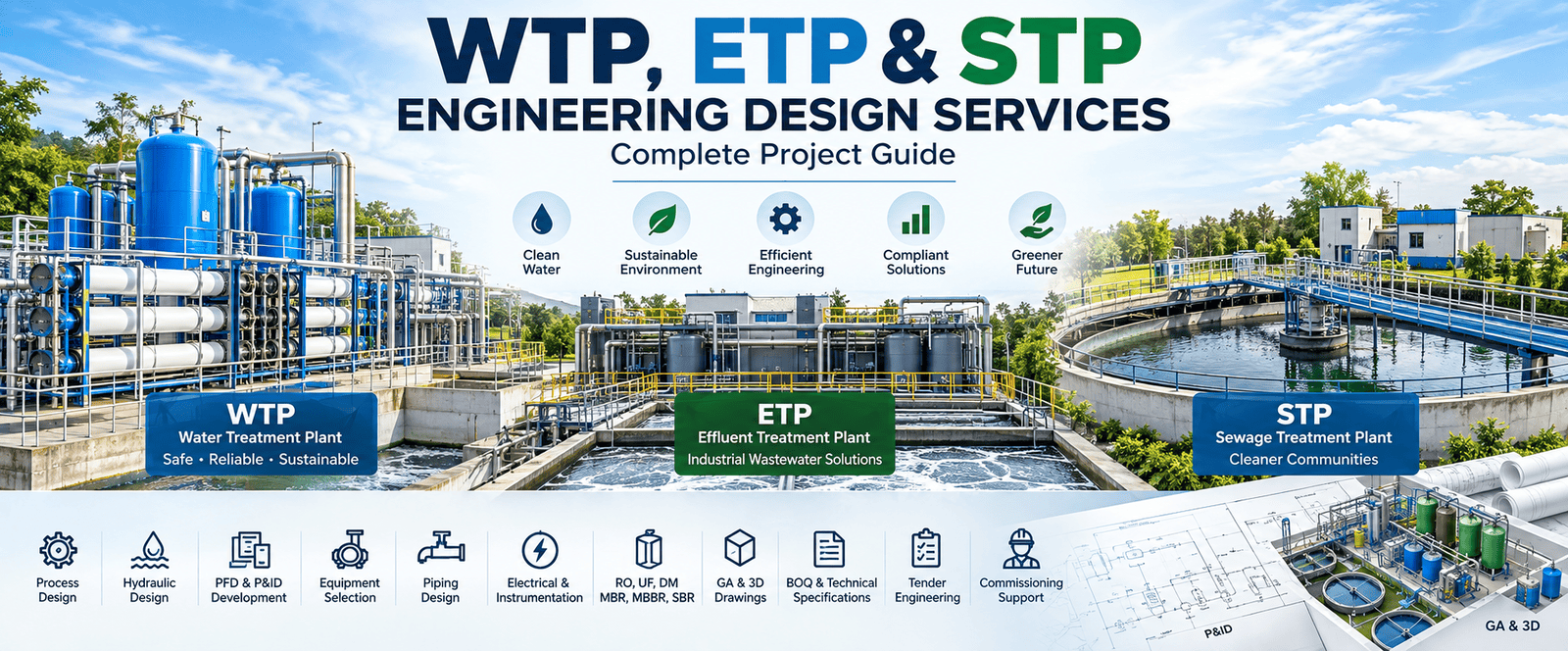
Water and wastewater infrastructure has become an essential part of modern industrial, commercial, municipal and infrastructure development. Whether a project involves a manufacturing facility, power plant, residential development, industrial park, refinery, pharmaceutical facility, food-processing plant, commercial complex or renewable-energy development, reliable water management is fundamental to successful project operation.
A properly engineered Water Treatment Plant (WTP) provides water suitable for the intended process or domestic application. An Effluent Treatment Plant (ETP) treats industrial wastewater generated from manufacturing and process operations. A Sewage Treatment Plant (STP) treats domestic sewage and wastewater generated by residential, commercial or institutional facilities.
Although WTP, ETP and STP systems have different treatment objectives, they require many of the same engineering disciplines. Process engineering, hydraulic calculations, mechanical equipment selection, piping design, civil and structural interfaces, electrical engineering, instrumentation and controls, layout development, procurement documentation, commissioning and operation considerations all need to be coordinated.
This is why WTP ETP STP engineering design services should not be viewed simply as equipment selection. A successful treatment plant requires an integrated engineering approach that connects process requirements with physical layout, equipment, piping, electrical systems, instrumentation, civil works, procurement and project execution.
AlgEnergy Engineering Consultancy Services provides multidisciplinary engineering support across energy, infrastructure, industrial and water projects. Its published capabilities include water and wastewater engineering, PFD/P&ID development, GA drawings, 2D/3D modelling, tender documentation, vendor coordination, project management and commissioning support. ALG Energy
From a project-development perspective, the objective is straightforward:
Define the water or wastewater problem → establish treatment requirements → select the appropriate process → engineer the plant → develop procurement documents → coordinate construction → support commissioning.
This guide explains the major components of professional WTP engineering, ETP engineering design and STP engineering consultancy, including process design, hydraulic design, PFD and P&ID development, equipment selection, piping, electrical and instrumentation, advanced treatment technologies, GA drawings, BOQ preparation, tender engineering and commissioning.
1. What Are WTP, ETP and STP?
Before discussing engineering design, it is important to understand the differences between the three major treatment systems.
1.1 Water Treatment Plant — WTP
A Water Treatment Plant (WTP) is designed to treat raw water and produce water that meets the required quality for drinking, industrial, process, utility or other applications.
Depending on the raw-water source and final-water requirement, treatment may include:
- Screening
- Aeration
- Coagulation
- Flocculation
- Clarification
- Filtration
- Activated carbon filtration
- Softening
- Ultrafiltration
- Reverse osmosis
- Demineralization
- Disinfection
- Chemical dosing
- Sludge handling
A WTP engineering consultant first needs to understand both the raw-water characteristics and the required treated-water quality.
The treatment process for surface water can differ significantly from groundwater treatment. Similarly, water intended for boiler makeup, cooling towers, process applications or potable use may require very different treatment trains.
The treatment philosophy therefore needs to be established before equipment sizing and detailed engineering.
1.2 Effluent Treatment Plant — ETP
An Effluent Treatment Plant (ETP) is designed to treat wastewater generated from industrial processes.
Industrial wastewater can contain:
- Suspended solids
- Oil and grease
- Organic contaminants
- COD
- BOD
- Heavy metals
- Chemicals
- Acids and alkalis
- Salts
- Nutrients
- Specific process contaminants
The exact composition depends on the industry.
For example, wastewater from a food-processing facility may have high organic loading, whereas wastewater from a metal-processing facility may contain metals and process chemicals. Pharmaceutical wastewater may contain complex organic compounds and variable loads.
Consequently, ETP engineering design must begin with wastewater characterization rather than selecting a standard package plant.
Typical ETP process stages can include:
Collection → Screening → Equalization → pH Correction → Primary Treatment → Biological Treatment → Secondary Clarification → Tertiary Treatment → Filtration → Disinfection → Reuse/Discharge
The exact configuration should be determined from wastewater characteristics, treatment objectives, discharge requirements and reuse requirements.
1.3 Sewage Treatment Plant — STP
An STP engineering consultant designs systems for treating domestic sewage generated by:
- Residential developments
- Hotels
- Hospitals
- Airports
- Educational campuses
- Offices
- Commercial buildings
- Industrial townships
- Infrastructure facilities
Typical sewage treatment processes include:
Screening → Grit Removal → Equalization → Biological Treatment → Clarification → Tertiary Treatment → Disinfection → Reuse/Discharge
Modern STPs may use technologies such as:
- MBBR
- MBR
- SBR
- Activated sludge
- Moving-bed biological systems
- Tertiary filtration
- UV disinfection
- Chlorination
- Advanced membrane systems
The appropriate technology depends on capacity, land availability, treated-water requirements, operating philosophy, energy consumption, automation requirements and lifecycle economics.
The U.S. EPA notes that wastewater treatment plants remove pollutants before treated water is released or reused, and that treatment configurations can be enhanced for additional nutrient removal. US EPA
2. Why Professional WTP ETP STP Engineering Design Services Matter
A treatment plant can fail even when individual equipment items are technically good.
Why?
Because treatment performance depends on the interaction between process, hydraulics, equipment, piping, controls and operation.
For example, an incorrectly sized equalization tank can create unstable downstream loading. Poor hydraulic design can create excessive pumping requirements. Incorrect pipe sizing can result in high pressure losses. Poor equipment arrangement can create maintenance problems.
Similarly, inadequate instrumentation can make it difficult to control pH, dissolved oxygen, flow, pressure, turbidity or conductivity.
Professional WTP ETP STP design and consultancy therefore needs to address the entire plant.
An integrated engineering approach should cover:
- Design basis
- Water/wastewater characterization
- Process selection
- Process calculations
- Hydraulic profile
- Equipment sizing
- PFD development
- P&ID development
- Piping design
- Equipment layout
- Civil interfaces
- Electrical systems
- Instrumentation and control
- Chemical systems
- BOQ
- Technical specifications
- Tender documents
- Vendor technical evaluation
- Construction support
- Commissioning
This integrated approach aligns well with AlgEnergy's multidisciplinary engineering model, which combines mechanical, electrical, C&I, civil, water, MEP and project disciplines. ALG Energy
3. WTP Engineering Design
3.1 Establishing the WTP Design Basis
Every water treatment plant design should begin with a clearly documented design basis.
Important parameters include:
- Raw-water source
- Raw-water quality
- Required capacity
- Peak flow
- Average flow
- Minimum flow
- Operating hours
- Required treated-water quality
- Water storage philosophy
- Chemical quality
- Ambient conditions
- Available land
- Power availability
- Automation philosophy
- Environmental requirements
- Applicable codes and standards
The water analysis should normally include parameters relevant to the proposed treatment process.
Depending on the source, this can include:
- pH
- Turbidity
- TDS
- Conductivity
- Hardness
- Alkalinity
- Chlorides
- Sulphates
- Iron
- Manganese
- Silica
- TOC
- Microbiological parameters
The final water-quality specification determines the downstream treatment requirements.
3.2 Conventional WTP Process
A conventional WTP may contain:
Raw Water Intake
Raw water is received from a source such as:
- River
- Reservoir
- Lake
- Canal
- Groundwater
- Municipal supply
Screening
Screens remove large debris and protect downstream equipment.
Coagulation
Chemicals are added to destabilize suspended particles.
Flocculation
Gentle mixing promotes formation of larger flocs.
Clarification
Flocs settle or are otherwise separated from the water.
Filtration
Filters remove remaining suspended particles.
Disinfection
Disinfection reduces microbiological contamination.
The precise sequence depends on raw-water quality and final-water requirements. Drinking-water guidance identifies pretreatment, coagulation/flocculation/sedimentation, filtration and disinfection among important treatment controls. US EPA
4. ETP Engineering Design for Industrial Plants
4.1 Why Industrial Wastewater Is More Complex
Industrial wastewater engineering differs from municipal sewage treatment because the wastewater composition can vary substantially from one facility to another.
A good industrial wastewater engineering consultant should therefore examine:
- Process chemistry
- Production volume
- Production schedule
- Cleaning cycles
- Batch operations
- Chemical usage
- Wastewater segregation
- Existing drainage
- Process changes
- Peak discharge
- Pollutant loading
One of the most important principles in ETP engineering is:
Do not design the treatment plant only from wastewater flow. Design it from flow plus pollutant loading and variability.
For example, two facilities may both generate 500 m³/day but have completely different COD, TSS, oil, pH and chemical characteristics.
Their ETP designs should therefore not automatically be identical.
4.2 Industrial Wastewater Characterization
Typical analysis may include:
- Flow
- pH
- Temperature
- TSS
- TDS
- BOD
- COD
- Oil and grease
- Chloride
- Sulphate
- Ammonia
- Total nitrogen
- Phosphorus
- Heavy metals
- Specific contaminants
The data should ideally represent normal operation as well as expected peak or upset conditions.
For industrial facilities, segregation can also be important.
For example:
High-strength wastewater → dedicated treatment
Oil-containing wastewater → oil separation
Acidic/alkaline wastewater → neutralization
Domestic sewage → STP
Clean stormwater → separate drainage
This can reduce treatment complexity and improve plant reliability.
5. STP Engineering Design
5.1 STP Design Basis
The STP engineering design should begin with population and wastewater generation.
Important inputs include:
- Design population
- Occupancy
- Water consumption
- Sewage generation
- Peak factor
- Infiltration/inflow
- Future expansion
- Treated-water reuse requirement
- Sludge disposal strategy
The STP should be designed around realistic flow variations rather than simply selecting a nominal capacity.
For residential and commercial developments, daily flow variation can be significant.
5.2 Biological Treatment
Biological treatment is usually one of the most important stages in sewage treatment.
The biological system uses microorganisms to reduce biodegradable organic matter and, where required, remove nitrogen.
Technologies can include:
- Activated sludge
- MBBR
- SBR
- MBR
- IFAS
- Other biological processes
Technology selection should consider:
- Footprint
- Energy consumption
- Automation
- Operator skill
- Sludge generation
- Treated-water quality
- Capital cost
- Operating cost
- Expansion requirements
EPA resources identify technologies including SBR and biological nutrient-removal processes among available municipal wastewater treatment approaches. US EPA
6. Process Design for WTP, ETP and STP
Process design is the technical foundation of the entire treatment plant.
A professional process design package typically includes:
- Design basis
- Process description
- Process flow diagram
- Mass balance
- Hydraulic calculations
- Equipment sizing
- Chemical dosing calculations
- Sludge generation estimates
- Utility requirements
- Performance guarantees
- Design criteria
6.1 Mass Balance
A mass balance helps engineers understand how contaminants move through the system.
For wastewater treatment, this can include:
Flow → BOD → COD → TSS → Nitrogen → Phosphorus → Sludge
Mass balances can support:
- Reactor sizing
- Chemical requirements
- Sludge production
- Aeration requirements
- Filter loading
- Membrane selection
6.2 Hydraulic Loading
Hydraulic loading is critical for treatment performance.
Engineers need to assess:
- Flow rates
- Retention times
- Surface loading
- Weir loading
- Filter loading
- Pipe velocity
- Pump head
- Elevation differences
Poor hydraulic design can increase energy consumption or compromise treatment performance.
7. Hydraulic Design
Hydraulic design connects the treatment process to the physical plant.
A hydraulic profile may include:
Inlet → Screening → Equalization → Treatment → Clarification → Filtration → Disinfection → Final Tank
Engineers need to determine:
- Gravity flow levels
- Pumping requirements
- Static head
- Friction losses
- Equipment head
- Minimum submergence
- Overflow levels
- Emergency overflow
- Drainage
- Sludge transfer requirements
Where possible, gravity flow can reduce pumping requirements and operating costs.
However, plant layout must balance hydraulic optimization with equipment accessibility, civil requirements and future maintenance.
8. PFD and P&ID Development for Water Treatment Plants
One of the most important engineering deliverables is the PFD P&ID for water treatment plants.
8.1 Process Flow Diagram — PFD
The PFD provides the high-level process sequence.
It normally shows:
- Major equipment
- Main process streams
- Flow direction
- Major operating data
- Chemical injection points
- Main treatment stages
A PFD is particularly useful during concept and basic engineering.
8.2 Piping & Instrumentation Diagram — P&ID
The P&ID goes much deeper.
It can identify:
- Equipment tags
- Pumps
- Valves
- Piping
- Instruments
- Control valves
- Flowmeters
- Pressure instruments
- Level instruments
- pH instruments
- Conductivity instruments
- Sampling points
- Interlocks
- Drains
- Vents
- Bypass lines
- Chemical injection systems
A properly developed P&ID becomes the interface between process engineering, mechanical engineering, piping, electrical and instrumentation teams.
AlgEnergy's published detailed-engineering capability specifically includes PFD/P&ID, GA drawings, design calculations, specifications and 2D/3D modelling. ALG Energy
9. Equipment Selection
Equipment selection is another important part of WTP ETP STP engineering design services.
Typical equipment can include:
Pumps
- Raw-water pumps
- Transfer pumps
- Feed pumps
- Backwash pumps
- Sludge pumps
- Chemical dosing pumps
- Permeate pumps
Treatment Equipment
- Screens
- Clarifiers
- Filters
- Pressure sand filters
- Activated carbon filters
- Softening units
- RO systems
- UF systems
- DM systems
- Aeration systems
- Biological reactors
Sludge Equipment
- Sludge pumps
- Thickening systems
- Filter presses
- Screw presses
- Centrifuges
- Sludge drying systems
Equipment selection should consider:
- Duty point
- Capacity
- Material of construction
- Efficiency
- Reliability
- Redundancy
- Maintenance
- Spare philosophy
- Vendor support
- Lifecycle cost
10. Piping Design for WTP, ETP and STP
Treatment plants contain multiple piping systems.
These can include:
- Raw-water piping
- Treated-water piping
- Wastewater piping
- Sludge piping
- Chemical piping
- Air piping
- Backwash piping
- Drain piping
- Overflow piping
- Utility water piping
The piping design should consider:
- Flow rate
- Pressure
- Velocity
- Material
- Corrosion
- Temperature
- Chemical compatibility
- Hydraulic losses
- Supports
- Expansion
- Accessibility
For chemical systems, material compatibility becomes especially important.
For example, chemical lines may require materials suitable for acids, alkalis, oxidizing agents or other chemicals.
11. Mechanical Engineering for Treatment Plants
Mechanical engineering covers much more than equipment selection.
It can include:
- Equipment datasheets
- Equipment specifications
- Pump selection
- Agitator selection
- Blower selection
- Tank interfaces
- Package equipment
- Mechanical calculations
- Vendor document review
- Equipment layout
- Maintenance access
Engineers also need to consider lifting and replacement.
A pump or membrane module that cannot be removed safely can create significant lifecycle problems.
Therefore, maintenance philosophy should be included during design rather than after construction.
12. Electrical and Instrumentation Engineering
Modern treatment plants increasingly depend on automation.
Typical electrical systems include:
- MCC
- PCC
- VFD
- Motor control
- Local control panels
- Distribution systems
- Cable routing
- Earthing
- Lighting
- Emergency power interfaces
Instrumentation can include:
- Flow transmitters
- Pressure transmitters
- Level transmitters
- pH analysers
- ORP analysers
- Turbidity meters
- Conductivity meters
- Dissolved oxygen sensors
- Chlorine analysers
12.1 Automation and SCADA
For larger WTP, ETP and STP facilities, PLC/SCADA systems can provide:
- Equipment status
- Alarm monitoring
- Trend analysis
- Flow monitoring
- Chemical control
- Pump sequencing
- Level control
- Interlocks
- Remote monitoring
- Data logging
Automation can improve operational consistency, but the control philosophy must be clearly defined.
13. RO Plant Engineering
RO plant engineering is often integrated with WTP systems where high-quality treated water is required.
Reverse osmosis may be used for:
- Boiler feedwater
- Process water
- High-purity applications
- Industrial reuse
- Desalination
- TDS reduction
A typical RO system may include:
Pretreatment → Cartridge Filtration → High-Pressure Pump → RO Membranes → Permeate → Post-Treatment
The design must consider:
- Feedwater TDS
- Temperature
- Recovery
- Membrane flux
- Pressure
- Fouling potential
- Scaling potential
- Antiscalant dosing
- Cleaning system
- Reject management
RO should not be treated as an isolated package. Its pretreatment and reject-management systems are equally important.
14. UF and DM Plant Engineering
14.1 Ultrafiltration — UF
UF can provide an effective barrier for suspended solids, colloids and certain macromolecules.
UF can be used upstream of RO or as part of water-reuse systems.
Important design considerations include:
- Feedwater quality
- Membrane flux
- Recovery
- Backwash
- Chemical cleaning
- Membrane replacement
- Pretreatment
14.2 Demineralization — DM
DM plants can be used where low-conductivity water is required.
Depending on project requirements, systems can include:
- Cation exchanger
- Degasser
- Anion exchanger
- Mixed-bed exchanger
Modern facilities may also use membrane-based systems in combination with RO and polishing technologies.
15. MBR, MBBR and SBR Design
Advanced biological treatment technologies provide different advantages.
15.1 MBBR Design
MBBR — Moving Bed Biofilm Reactor uses carrier media to support biological growth.
Potential advantages include:
- Compact footprint
- High biomass concentration
- Flexible operation
- Retrofit potential
However, blower energy, media retention and screening requirements need to be evaluated.
15.2 MBR Design
MBR — Membrane Bioreactor combines biological treatment with membrane separation.
MBR can produce high-quality treated water suitable for reuse applications.
Engineering considerations include:
- Membrane flux
- Biological loading
- Air scouring
- TMP
- Fouling
- Cleaning
- Energy consumption
- Sludge management
15.3 SBR Design
SBR — Sequencing Batch Reactor performs treatment in time-based cycles rather than continuous-flow stages.
Typical cycle stages can include:
- Fill
- React
- Settle
- Decant
- Idle
SBR can be useful where flexibility and compact treatment arrangements are required.
EPA resources specifically identify sequencing batch reactors as one of the municipal wastewater technologies evaluated for treatment applications. US EPA
16. Nutrient Removal Engineering
Modern wastewater projects may require nitrogen and phosphorus removal.
Nitrogen removal can involve:
Nitrification → Denitrification
Phosphorus removal can involve:
- Biological phosphorus removal
- Chemical precipitation
- Combined biological/chemical systems
EPA's nutrient-control resources discuss biological nutrient removal, chemical phosphorus removal and effluent filtration as approaches for achieving additional nutrient-control objectives. US EPA
For projects with stringent discharge limits, nutrient removal should be incorporated during the process-design stage rather than treated as an afterthought.
17. Tertiary Treatment and Water Reuse
Increasing water scarcity is encouraging industries and infrastructure developers to consider treated-water reuse.
Potential reuse applications include:
- Cooling tower makeup
- Toilet flushing
- Gardening
- Process applications
- Cleaning
- HVAC makeup
- Construction
- Industrial utilities
Depending on reuse quality, tertiary treatment can include:
- Pressure filtration
- Activated carbon
- UF
- RO
- UV
- Chlorination
- Ozone
- Advanced oxidation
The treatment train should be selected based on the actual reuse specification.
18. GA Drawings and 3D Plant Layout
A technically correct process design must eventually become a physical plant.
This is where GA and 3D drawings become important.
A General Arrangement drawing can show:
- Equipment location
- Tank dimensions
- Building arrangement
- Pipe corridors
- Platforms
- Access areas
- Maintenance zones
- Chemical storage
- Electrical rooms
- Control rooms
A 3D model can improve coordination between:
- Mechanical
- Piping
- Civil
- Structural
- Electrical
- Instrumentation
Clash detection can identify problems before construction.
AlgEnergy's published engineering scope includes GA drawings and 2D/3D modelling as part of its detailed engineering services. ALG Energy
19. Civil and Structural Interfaces
Although the process engineer defines the treatment philosophy, the civil and structural disciplines are essential to successful plant delivery.
Civil interfaces may include:
- RCC tanks
- Foundations
- Equipment plinths
- Buildings
- Roads
- Drainage
- Pipe trenches
- Cable trenches
- Chemical storage areas
Structural requirements may include:
- Equipment platforms
- Pipe racks
- Walkways
- Staircases
- Handrails
- Maintenance platforms
Early coordination prevents expensive modifications during construction.
20. Chemical Dosing Systems
Chemical dosing may be required for:
- Coagulation
- pH correction
- Disinfection
- Antiscalant
- Dechlorination
- Nutrient removal
- Sludge conditioning
A chemical system should address:
- Storage
- Dosing
- Mixing
- Injection
- Bunding
- Safety
- Ventilation
- Material compatibility
- Operator access
Chemical storage and dosing should be designed as a complete system rather than simply specifying dosing pumps.
21. Sludge Handling and Disposal
Sludge is an unavoidable consideration in many WTP, ETP and STP systems.
Potential sludge sources include:
- Clarifiers
- Biological treatment
- Chemical precipitation
- RO pretreatment
- Filter backwash
Sludge management may include:
Collection → Thickening → Dewatering → Storage → Disposal/Reuse
Equipment options include:
- Filter press
- Centrifuge
- Screw press
- Belt press
- Drying beds
The final sludge route should be considered during project development because disposal costs can materially influence lifecycle economics.
22. BOQ and Technical Specifications
A professional WTP ETP STP engineering consultant should be able to convert engineering requirements into procurement documentation.
A BOQ can include:
- Equipment
- Piping
- Valves
- Instruments
- Electrical equipment
- Cables
- Structural steel
- Tanks
- Civil works
- Installation
- Testing
- Commissioning
Technical specifications should define:
- Design conditions
- Capacity
- Materials
- Performance requirements
- Applicable standards
- Inspection requirements
- Testing
- Documentation
- Warranty
- Spares
Good specifications reduce ambiguity during procurement.
23. Tender Engineering
Tender engineering is particularly important for EPC contractors, developers and project owners.
A tender package may include:
- Scope of work
- Design basis
- Process description
- PFD
- P&ID
- Equipment specifications
- Datasheets
- BOQ
- Technical specifications
- Civil requirements
- Electrical requirements
- Instrumentation requirements
- Performance guarantees
- Testing requirements
- Commissioning requirements
AlgEnergy's published services include technical specifications, BOQ, tender documents, RFQs, scopes of work and bid-evaluation support. ALG Energy
24. Vendor Technical Evaluation
Vendor selection should not be based solely on price.
Technical evaluation may consider:
- Compliance with specifications
- Guaranteed performance
- Equipment efficiency
- Materials
- Operating cost
- Energy consumption
- Maintenance requirements
- Delivery schedule
- Previous experience
- Reference projects
- Spare availability
- Warranty
A technical bid evaluation matrix can make vendor comparison more transparent.
25. Construction and Site Engineering Support
Engineering does not stop after issuing drawings.
During construction, engineering support may be required for:
- Drawing clarification
- RFI responses
- Vendor coordination
- Site modifications
- Material approval
- Equipment installation
- Piping installation
- Instrument installation
- Inspection
- Progress monitoring
This is particularly important when the treatment plant is part of a larger industrial or infrastructure project.
AlgEnergy describes project-management and site-supervision support including engineering coordination, site supervision, progress monitoring and execution management. ALG Energy
26. Commissioning Support
Commissioning verifies whether the plant operates according to its design intent.
A commissioning plan may include:
Pre-commissioning
- Cleaning
- Flushing
- Equipment inspection
- Electrical testing
- Instrument calibration
- Rotation checks
- Leak testing
Dry Commissioning
Equipment is operated without process water to verify:
- Motor operation
- Interlocks
- Controls
- Alarms
- Valve operation
Wet Commissioning
The system is filled and operated using water.
Biological Commissioning
For biological treatment systems, biomass development and process stabilization are important.
Performance Testing
The plant is evaluated against agreed performance parameters.
AlgEnergy's published QA/QC and commissioning scope includes inspection coordination, installation verification, testing, commissioning assistance and handover support. ALG Energy
27. WTP ETP STP Engineering Deliverables
A complete engineering assignment can generate a substantial documentation package.
Typical deliverables include:
Process
- Design basis
- Process calculations
- Mass balance
- Hydraulic profile
- Process description
- PFD
- P&ID
Mechanical
- Equipment list
- Equipment datasheets
- Equipment specifications
- Mechanical calculations
- Vendor document requirements
Piping
- Piping specifications
- Line list
- Valve list
- Piping layouts
- Isometrics
- Supports
- MTO
Civil
- Tank layouts
- Foundation requirements
- Civil GA
- Equipment foundations
- Drainage layouts
Electrical
- Load list
- SLD
- MCC requirements
- Cable schedule
- Earthing
- Lighting
Instrumentation
- Instrument index
- Datasheets
- I/O list
- Control philosophy
- Cause-and-effect
- PLC/SCADA requirements
Commercial
- BOQ
- Cost estimate
- RFQ package
- Technical specifications
- Tender documents
28. Codes, Standards and Project Specifications
The exact codes and standards depend on project location, industry, client requirements and regulatory authority.
Engineering teams may need to consider applicable:
- ISO standards
- ASME standards
- API standards
- ASTM standards
- IEC standards
- NFPA requirements
- Local environmental regulations
- Water-quality regulations
- Client engineering specifications
For international projects, the consultant must understand the applicable local regulatory environment rather than automatically applying Indian requirements.
For example, a project in Africa, Europe, the Middle East, Japan or another international market may have different discharge, potable-water, electrical and environmental requirements.
29. How to Select the Right WTP ETP STP Engineering Consultant
Selecting the right consultant can significantly affect project execution.
Consider the following criteria.
29.1 Multidisciplinary Capability
Look for a company capable of coordinating:
- Process
- Mechanical
- Piping
- Civil
- Electrical
- Instrumentation
- Structural
- Project management
This reduces interface risks.
29.2 Industrial Experience
An industrial ETP requires different expertise from a small residential STP.
Check whether the consultant has experience with:
- Industrial plants
- Power plants
- Infrastructure
- Utilities
- Process industries
- Water reuse
29.3 Engineering Deliverables
Ask for examples of:
- PFD
- P&ID
- Equipment datasheets
- GA drawings
- Hydraulic calculations
- BOQ
- Tender packages
29.4 Procurement Understanding
A good consultant should understand how design decisions affect procurement.
29.5 Construction Experience
Engineering that looks good on paper may still create site problems.
Practical construction knowledge is therefore valuable.
30. Why Choose AlgEnergy for WTP, ETP and STP Engineering?
AlgEnergy Engineering Consultancy Services positions itself as a multidisciplinary engineering consultancy supporting energy, infrastructure, industrial, renewable and water projects. Its website identifies water and wastewater engineering among its capabilities and describes an integrated approach involving mechanical, electrical, C&I, civil, water, MEP and project disciplines. ALG Energy
For clients seeking WTP engineering design services in India, ETP engineering consultant for industrial plants or STP engineering design consultancy, the value of a multidisciplinary engineering partner is the ability to coordinate treatment systems with the wider project.
AlgEnergy's published engineering lifecycle covers:
Feasibility → Concept Engineering → Detailed Engineering → Tendering → Project Execution → QA/QC → Testing & Commissioning.ALG Energy
This approach can be particularly useful for:
- EPC contractors
- Industrial developers
- Power projects
- Infrastructure developers
- Renewable-energy projects
- Commercial developments
- Government projects
- International project owners
- Engineering companies requiring additional design resources
AlgEnergy also states that it supports clients in Indian and international project environments. ALG Energy
31. Integrated Engineering: Why WTP/ETP/STP Should Not Be Designed in Isolation
A water treatment plant rarely operates independently.
It interfaces with:
Civil → Mechanical → Piping → Electrical → C&I → HVAC → Fire Protection → Utilities → Project Management
For example, a new industrial ETP may require:
- Electrical power
- Instrument air
- Chemical storage
- Access roads
- Drainage
- Sludge disposal
- Control room
- Fire protection
- Process piping
- Civil foundations
This means an integrated engineering consultant can reduce interface problems.
AlgEnergy's website specifically describes its capability to coordinate multiple disciplines under one consultancy framework. ALG Energy
32. Digital Engineering and 3D Coordination
Digital engineering is increasingly important for larger treatment plants.
A 3D model can support:
- Equipment coordination
- Pipe routing
- Clash detection
- Maintenance access
- Structural coordination
- Construction planning
- Quantity extraction
For EPC projects, a coordinated model can also improve communication between engineering offices and construction teams.
The objective is not simply to create an attractive 3D model.
The objective is to produce a constructible and maintainable plant.
33. Lifecycle Cost and Energy Optimization
The lowest capital-cost treatment plant is not necessarily the most economical plant.
Lifecycle costs can include:
- Electricity
- Chemicals
- Membrane replacement
- Filter media
- Sludge disposal
- Spare parts
- Maintenance
- Operator requirements
For example, an aeration system can significantly influence STP energy consumption.
Similarly, high-pressure RO systems can have substantial energy requirements.
Therefore, technology selection should consider both:
CAPEX + OPEX
rather than CAPEX alone.
EPA's technology resources emphasize evaluating wastewater technologies based on performance and cost-effectiveness, including options for reuse and energy efficiency. US EPA
34. Water Reuse and Zero Liquid Discharge Considerations
Some industrial projects may require increasingly advanced water-management strategies.
A potential treatment sequence can be:
ETP → Tertiary Treatment → UF → RO → Reuse
For projects requiring further reduction of liquid discharge, additional concentration and evaporation technologies may be evaluated.
However, Zero Liquid Discharge (ZLD) should not automatically be specified for every industrial project.
A technical and economic assessment should consider:
- Water balance
- Wastewater characteristics
- Recovery target
- Concentrate management
- Energy consumption
- Chemical consumption
- Capital cost
- Operating cost
A good engineering consultant should evaluate whether the proposed water-reuse strategy is technically and economically justified.
35. Common WTP, ETP and STP Design Mistakes
Mistake 1: Designing Only From Flow
Flow is important, but pollutant loading determines treatment requirements.
Mistake 2: Ignoring Peak Conditions
Peak flow and peak pollutant loading can affect equipment sizing.
Mistake 3: Poor Hydraulic Profile
Poor elevations can create unnecessary pumping and operational difficulties.
Mistake 4: Inadequate Maintenance Space
Equipment should be accessible for inspection, removal and replacement.
Mistake 5: Underestimating Sludge
Sludge production and disposal should be considered from the beginning.
Mistake 6: Poor Instrumentation
Without appropriate measurement and control, sophisticated treatment systems can be difficult to operate.
Mistake 7: Selecting Technology Before Characterizing Water
Technology should follow the treatment requirement, not the other way around.
Mistake 8: Treating P&ID as a Drawing Exercise
A P&ID should reflect the actual operating and control philosophy.
Mistake 9: Ignoring Future Expansion
Where future capacity expansion is likely, the plant layout and hydraulic philosophy should consider it.
Mistake 10: Separating Engineering From Procurement
Equipment specifications need to be practical for procurement and construction.
36. WTP ETP STP Design Workflow
A professional project can follow the workflow below:
Step 1 — Client Requirement
Understand:
- Capacity
- Water source
- Wastewater source
- Required quality
- Discharge/reuse requirements
Step 2 — Data Collection
Collect:
- Laboratory analysis
- Flow data
- Site information
- Existing drawings
- Utility information
Step 3 — Design Basis
Establish:
- Design capacity
- Process criteria
- Quality requirements
- Redundancy
- Operating philosophy
Step 4 — Process Selection
Evaluate suitable treatment technologies.
Step 5 — Process Engineering
Develop:
- Mass balance
- Hydraulic calculations
- Equipment sizing
- PFD
Step 6 — P&ID Development
Define detailed equipment, piping, instruments and controls.
Step 7 — Layout Engineering
Develop:
- Equipment GA
- Pipe routing
- Civil interfaces
- Maintenance access
Step 8 — Multidisciplinary Engineering
Coordinate:
- Mechanical
- Piping
- Civil
- Structural
- Electrical
- C&I
Step 9 — Procurement Engineering
Prepare:
- Datasheets
- Specifications
- BOQ
- RFQs
Step 10 — Tendering
Support:
- Technical clarification
- Bid evaluation
- Vendor comparison
Step 11 — Construction
Provide engineering and site support.
Step 12 — Commissioning
Support:
- Pre-commissioning
- Wet commissioning
- Performance testing
- Handover
37. When Should You Hire a WTP ETP STP Engineering Consultant?
A specialist consultant is particularly useful when:
- The project has complex water chemistry.
- Industrial wastewater characteristics vary.
- Advanced treatment is required.
- Water reuse is planned.
- Multiple EPC vendors are involved.
- A detailed tender package is required.
- An existing plant requires expansion.
- International engineering standards apply.
- The owner needs independent technical evaluation.
- The project requires multidisciplinary coordination.
For EPC contractors, outsourced engineering can also provide additional engineering capacity during peak workloads.
For project developers, an independent consultant can help define technical requirements before issuing an EPC tender.
38. WTP ETP STP Engineering Services for EPC Contractors
EPC contractors often need engineering support at different project stages.
A consultant can support:
- Concept engineering
- Basic engineering
- Detailed engineering
- PFD/P&ID
- Equipment specifications
- Vendor document review
- Piping layouts
- BOQ
- Tender documentation
- Technical bid evaluation
- Construction engineering
- Commissioning
This model can be especially useful when the EPC contractor has strong construction resources but requires additional design capacity.
AlgEnergy describes its engagement model as flexible, including individual engineering packages as well as complete multidisciplinary assignments. ALG Energy
39. WTP ETP STP Engineering Services in India for International Projects
India has a large engineering-services ecosystem, and engineering outsourcing can provide project owners and EPC contractors with additional design capacity.
For international clients, an engineering partner should be capable of working with:
- International project specifications
- Client standards
- EPC documentation systems
- Multidisciplinary interfaces
- Remote coordination
- Vendor documentation
- International project schedules
The objective should not simply be lower engineering cost.
The stronger value proposition is:
engineering capacity + technical expertise + documentation quality + multidisciplinary coordination + execution understanding.
AlgEnergy's website states that it supports both Indian and international project environments. ALG Energy
For international readers, you can also connect this article with AlgEnergy's broader engineering-consultancy content through its engineering consultancy blog, which discusses engineering support for EPC contractors and international project markets. algenergyservies.blogspot.com
40. How AlgEnergy Can Support Your Next Water Project
AlgEnergy can position its water and wastewater engineering capability around the complete project lifecycle:
Feasibility
- Site assessment
- Water balance
- Wastewater assessment
- Technology evaluation
- Technical feasibility
- Preliminary cost assessment
Basic Engineering
- Design basis
- Process calculations
- PFD
- Preliminary P&ID
- Equipment selection
- Hydraulic profile
Detailed Engineering
- Detailed P&ID
- Equipment datasheets
- Piping layouts
- GA drawings
- Electrical requirements
- Instrumentation
- 2D/3D coordination
Tender Engineering
- BOQ
- Technical specifications
- Scope of work
- RFQ packages
- Bid evaluation
Execution Support
- Vendor coordination
- Drawing review
- Site support
- QA/QC
- Commissioning
This structure reflects the broader engineering lifecycle published by AlgEnergy. ALG Energy
41. Frequently Asked Questions About WTP ETP STP Engineering Design Services
What are WTP ETP STP engineering design services?
WTP ETP STP engineering design services cover the engineering required to develop water treatment, industrial effluent treatment and sewage treatment plants. Services can include process design, hydraulic calculations, PFD/P&ID, equipment selection, piping, electrical and instrumentation engineering, GA drawings, BOQ, tender documentation and commissioning support.
What does a WTP engineering consultant do?
A WTP engineering consultant develops the treatment process and supporting engineering required to convert raw water into water meeting the required quality. This may include process design, filtration, clarification, RO, UF, softening, DM and disinfection systems.
What does an ETP engineering consultant do?
An ETP engineering consultant develops treatment systems for industrial wastewater. The design depends on wastewater characteristics, flow, pollutant loading, discharge limits and reuse requirements.
What does an STP engineering consultant provide?
An STP engineering consultant develops sewage-treatment systems for residential, commercial, institutional and industrial domestic wastewater applications. Services can include process selection, hydraulic design, biological treatment, tertiary treatment, sludge management, P&ID, equipment selection and commissioning support.
What is the difference between WTP and ETP?
A WTP primarily treats raw water to produce water suitable for a defined use. An ETP treats industrial wastewater generated from manufacturing or process operations.
What is the difference between ETP and STP?
An ETP treats industrial effluent, which can contain industry-specific contaminants. An STP primarily treats domestic sewage.
What are MBBR, MBR and SBR?
MBBR uses attached-growth carrier media, MBR combines biological treatment with membrane separation, and SBR performs biological treatment in sequential time-based cycles.
Is RO always required in a WTP?
No. RO should be selected based on raw-water quality and final-water requirements. Conventional clarification, filtration and disinfection may be sufficient for some applications, while high-purity applications may require RO and additional treatment.
What drawings are required for a WTP, ETP or STP?
Typical drawings can include PFD, P&ID, equipment GA, piping layout, civil layout, structural drawings, electrical drawings, instrumentation drawings and, for larger projects, coordinated 3D models.
Why is P&ID important?
The P&ID communicates how equipment, piping, valves, instruments and control functions interact. It becomes an important engineering interface between process, mechanical, piping, electrical and instrumentation disciplines.
Can AlgEnergy support international water-treatment projects?
AlgEnergy's website states that the company provides engineering support for Indian and international project environments and offers multidisciplinary engineering services across water, infrastructure, energy and industrial projects. ALG Energy
Can an engineering consultant support tendering?
Yes. Tender engineering can include scope of work, BOQ, technical specifications, RFQs, equipment datasheets, bidder clarification and technical bid evaluation.
Can a consultant support commissioning?
Yes. Commissioning support can include inspection, testing, equipment verification, instrumentation checks, process startup assistance, performance testing and handover documentation.
42. Conclusion: Building a Reliable Water and Wastewater Treatment Plant
A successful water or wastewater treatment project requires considerably more than selecting treatment equipment.
The engineering needs to connect:
Process + Hydraulics + Equipment + Piping + Civil + Electrical + Instrumentation + Automation + Procurement + Construction + Commissioning.
This is the core value of professional WTP ETP STP engineering design services.
For WTP projects, the focus is on producing water that meets the required quality efficiently and reliably.
For ETP projects, the focus is on treating industrial wastewater according to the characteristics of the process and the applicable discharge or reuse requirements.
For STP projects, the objective is to treat domestic sewage reliably while balancing footprint, energy consumption, operating complexity, sludge generation and treated-water quality.
Advanced technologies such as RO, UF, MBR, MBBR and SBR can provide powerful solutions, but technology selection should always follow the project requirements.
The strongest project approach is therefore:
Characterize → Design → Engineer → Coordinate → Procure → Construct → Commission → Optimize.
For project owners, developers and EPC contractors looking for WTP engineering design services in India, ETP engineering design, STP engineering consultancy, industrial wastewater engineering or integrated water-treatment plant engineering, a multidisciplinary engineering partner can provide support from feasibility through detailed engineering, tendering, execution and commissioning.
Discuss your next engineering project with AlgEnergy
Recommended Internal & External Link Strategy
For SEO, I recommend not stuffing every link into the article. Use contextual anchor text.
Internal links to AlgEnergy website
| Anchor text | Recommended destination |
|---|---|
| WTP ETP STP engineering design services | AlgEnergy Engineering Consultancy Services |
| multidisciplinary engineering consultancy | AlgEnergy Engineering Consultancy Services |
| feasibility and project planning | AlgEnergy Engineering Consultancy Services |
| basic and detailed engineering | AlgEnergy Engineering Consultancy Services |
| tender and bid documentation | AlgEnergy Engineering Consultancy Services |
| project management and site supervision | AlgEnergy Engineering Consultancy Services |
| QA/QC and commissioning support | AlgEnergy Engineering Consultancy Services |
Important SEO note: Your current Zoho site has the relevant services on the homepage, including water & wastewater, basic/detailed engineering, PFD/P&ID, GA drawings, tender documentation and commissioning. If you later create dedicated URLs for Water & Wastewater Engineering, Piping Engineering, Electrical & C&I, Tender Engineering and PMC, replace these homepage links with those specific pages. This will create a substantially stronger internal-link architecture. ALG Energy
Blog-to-blog link
Use this article to internally link to your international engineering article:
Engineering Consultancy Services from India for Global EPC Contractors
Recommended anchor text:
- engineering consultancy services from India
- engineering support for global EPC contractors
- multidisciplinary engineering consultancy
- engineering outsourcing from India
External authoritative links
Use authoritative sources sparingly:
- U.S. EPA — Wastewater Treatment & Nutrient Pollution — background on wastewater treatment and nutrient pollution. US EPA
- U.S. EPA — Nutrient Control Design Manual — useful technical reference for nutrient-control design. US EPA
- U.S. EPA — Industrial Wastewater Treatment Technology Database — useful reference for industrial wastewater technologies.