Solar Feasibility Study: A Complete Guide for Solar Developers, EPC Contractors and Investors
Introduction: Why a Solar Feasibility Study Is the Foundation of a Solar Project
Developing a solar power project is not simply a matter of identifying a sunny location and installing photovoltaic modules.
A successful solar project requires coordinated decisions covering land, solar resource, technology, plant capacity, energy yield, electrical systems, civil infrastructure, grid connection, environmental constraints, capital cost, operating cost, project revenue, financing, construction, and long-term operation.
That is why a solar feasibility study is one of the most important stages in solar project development.
Before a developer commits significant resources to land acquisition, detailed engineering, grid applications, environmental studies, equipment procurement, EPC contracting, or project financing, the project needs to be evaluated from technical and commercial perspectives.
A professional solar project feasibility study provides the foundation for these decisions.
It helps answer critical questions:
Is the proposed site suitable for solar development?How much solar energy is available?What capacity can realistically be installed?Which PV technology and plant configuration are appropriate?What will the expected annual energy generation be?What grid connection and evacuation infrastructure will be required?What are the expected project CAPEX and OPEX?What are the major development and construction risks?Is the project financially attractive under the assumed commercial structure?What additional investigations are required before investment or EPC execution?For renewable-energy developers, EPC contractors, utilities, infrastructure companies, investors, and industrial clients, a well-structured feasibility study can provide greater technical clarity before major development decisions are made.
For international project owners, it can also create an efficient foundation for subsequent solar engineering services, detailed design, tender documentation, procurement, construction, commissioning, and project execution.
At AlgEnergy Engineering Consultancy Services, the solar engineering approach is structured around the complete project lifecycle—from early-stage feasibility and resource assessment through detailed engineering, tendering, construction support, commissioning, and technical evaluation. The company's solar engineering offering is designed for utility-scale, commercial and industrial, rooftop, hybrid, and solar-plus-storage projects.
What Is a Solar Feasibility Study?
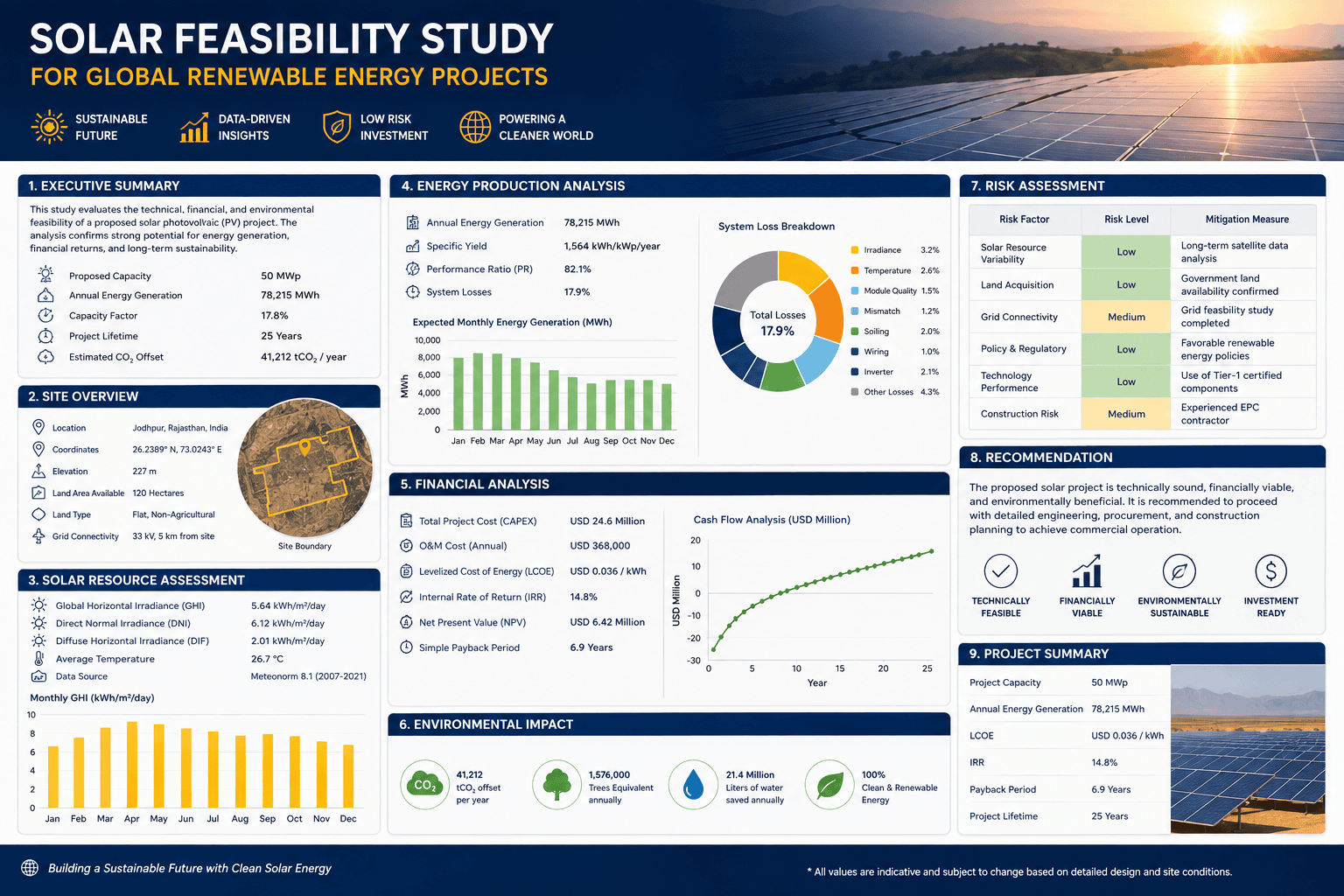
A solar feasibility study is a systematic technical, commercial, financial, environmental, and project-development assessment used to determine whether a proposed solar PV project is suitable for further development.
The study converts an initial project idea into a structured engineering and commercial concept.
A typical solar PV feasibility study examines the following areas:
Site and land
The available land, boundaries, terrain, access, drainage, land-use restrictions, and physical constraints are evaluated.
Solar resource
Solar irradiation, temperature, weather conditions, and other environmental parameters are assessed to establish the site's energy-generation potential.
Plant configuration
PV technologies, module arrangement, inverter configuration, mounting systems, DC/AC ratio, plant capacity, and preliminary electrical architecture are evaluated.
Energy generation
A solar energy yield assessment estimates how much electricity the proposed plant could generate under defined assumptions.
Grid connection
The feasibility study examines the potential point of interconnection, transmission requirements, substation requirements, evacuation infrastructure, and other grid-related considerations.
Cost
The study develops preliminary solar project cost estimation, covering CAPEX, OPEX, development costs, infrastructure, and contingency.
Financial feasibility
The technical and commercial assumptions are translated into a solar project financial model to evaluate project economics.
Risk
Technical, commercial, environmental, regulatory, financial, construction, and operational risks are identified.
A good study therefore does not simply answer whether a location has sufficient sunlight.
It evaluates whether the entire solar project can be technically developed and commercially structured.
Why a Solar Project Feasibility Study Matters
Reducing Development Risk
Solar projects require considerable investment even before construction begins.
Developers may need to spend money on:
Land acquisition or leasingDevelopment activitiesSolar resource analysisEngineeringTopographical surveysGeotechnical investigationEnvironmental studiesGrid applicationsPermitsTechnical consultantsFinancial modelingTender preparationIf a fundamental constraint is discovered only after these activities have progressed significantly, the project can experience cost escalation or delay.
A solar feasibility study provides an opportunity to identify these constraints at an earlier stage.
Potential risks can include:
Insufficient developable landDifficult terrainFloodingPoor site accessEnvironmental constraintsLimited grid capacityLong transmission distanceHigh civil-work requirementsUnexpected infrastructure costsLower-than-expected energy productionUnfavorable PPA assumptionsFinancing challengesThe objective is not to remove every project risk.
The objective is to identify the risks, understand their potential impact, and establish appropriate mitigation strategies before the project advances.
Establishing Technical Feasibility
A professional solar power plant feasibility study should establish whether the selected site, technology, and project configuration are technically compatible.
The engineering team may evaluate:
PV module technologyFixed-tilt versus tracker systemsCentral or string invertersDC/AC ratioModule orientationRow spacingInverter loadingMV collectionTransformer configurationSubstation arrangementGrid interfaceSCADA and monitoringEarthingLightning protectionInternal roadsDrainageEquipment accessThese decisions cannot be considered independently.
For example, a change in inverter selection can affect electrical architecture. A change in tracker configuration can affect row spacing, land use, energy yield, structural requirements, and civil works.
This is why multidisciplinary solar engineering consultancy is important at the feasibility stage.
Key Components of a Solar Feasibility Study
A detailed feasibility study typically consists of several interconnected engineering workstreams.
1. Solar Site Assessment
The solar site assessment is one of the first activities undertaken during project development.
The assessment establishes whether the location is suitable for the proposed solar project.
Typical considerations include:
Geographic coordinatesSite boundaryGross land areaDevelopable landLand ownershipTerrainTopographyRoadsSite accessDrainageWater bodiesExisting infrastructureSettlementsEnvironmental restrictionsTransmission linesSubstationsNearby obstructionsShading constraintsInitial site screening can use satellite imagery, GIS information, available survey data, land maps, transmission information, and solar-resource datasets.
However, the objective should always be to distinguish between gross land area and usable development area.
A land parcel may appear large on a map but become significantly smaller after accounting for:
SetbacksSlopesWater bodiesExisting roadsDrainageEnvironmental buffersTransmission corridorsBuildingsRestricted zonesA practical land assessment therefore follows a sequence such as:
Gross land area → Restricted area → Developable area → Usable PV area → Potential plant capacity
This is especially important for a utility-scale solar feasibility study, where small assumptions about land use can materially affect total capacity.
2. Solar Resource Assessment
Solar energy is fundamentally dependent on the quality and availability of the solar resource.
A solar resource assessment establishes the solar-energy characteristics of the proposed project location.
Important parameters can include:
Global Horizontal Irradiation
GHI is a major input for PV project assessment and energy-yield modeling.
Direct Normal Irradiation
DNI provides information on direct solar radiation and contributes to understanding the site's solar-resource characteristics.
Diffuse Horizontal Irradiation
DHI represents the diffuse component of solar radiation.
Temperature
Ambient temperature influences PV module operating performance and therefore affects expected energy generation.
Wind
Wind conditions are relevant to structural loading and may influence tracker and mounting-system design.
Weather Data
Long-term weather information can help establish representative operating conditions.
A professional solar irradiation analysis should document the source and basis of the resource data and clearly state any limitations.
Poorly defined resource assumptions can lead to unrealistic energy-yield forecasts and subsequently affect the project financial model.
3. Solar Energy Yield Assessment
One of the most commercially important outputs of a solar feasibility study is the expected electricity generation.
A solar energy yield assessment translates solar-resource information and the proposed plant configuration into an estimate of annual energy production.
A typical PV energy yield analysis considers:
Solar irradiationPV module characteristicsModule efficiencyModule temperatureSoilingShadingMismatchDC lossesInverter efficiencyAC lossesTransformer lossesAvailabilityCurtailmentAuxiliary consumptionGrid-related lossesModule degradationThe assessment can produce:
Annual energy generationMonthly energy generationSpecific yieldPerformance ratioCapacity factorLoss analysisP50 energy estimateP90 energy estimateThe energy-yield assessment should be linked directly to the selected project configuration.
For example, changing from fixed tilt to trackers, changing the DC/AC ratio, changing module technology, or modifying the plant layout can affect projected energy generation.
The output should subsequently feed into the solar project financial model.
4. Preliminary PV Plant Design
A feasibility study should establish a preliminary technical design rather than stopping at resource assessment.
PV Array Design
The preliminary PV configuration may define:
Module typeModule quantityString configurationDC capacityAC capacityDC/AC ratioModule orientationRow spacingInverter Configuration
The engineering team may evaluate:
Central inverter systemsString inverter systemsInverter capacityNumber of invertersLoadingEquipment locationsMounting System
Potential options include:
Fixed-tilt structuresSingle-axis trackersGround-mounted systemsThe selection should consider the site's terrain, solar conditions, energy yield, construction requirements, O&M considerations, and project economics.
Electrical Architecture
The preliminary electrical system can include:
DC collectionInvertersAC collectionTransformersMV systemsSwitchgearSubstationProtectionMeteringSCADAGrid interfacePreliminary Layout
The plant layout can identify:
PV blocksInverter stationsTransformersInternal roadsDrainageCable routingControl buildingsSubstationO&M facilitiesSecurity infrastructureTransmission corridorsThis preliminary design creates the technical foundation for subsequent detailed engineering.
5. Land Optimization and Solar Farm Layout
A well-designed solar farm feasibility study should consider how effectively the available site can be converted into an operating PV plant.
An optimized layout needs to balance:
Land utilization + Energy yield + Constructability + Electrical losses + Access + O&M + Cost
Important layout considerations include:
Module arrangementRow spacingTracker configurationInverter locationsTransformer locationsInternal roadsCable routingMaintenance accessDrainageEquipment clearancesEmergency accessO&M requirementsA layout that maximizes installed MW but creates excessive earthwork, long cable routes, difficult access, or poor maintenance conditions may not be the most effective solution.
The feasibility process should therefore consider technical and commercial optimization together.
6. Topographical and Geotechnical Assessment
Terrain has a direct influence on the constructability and cost of a solar project.
The assessment can consider:
ElevationSlopeContoursDrainageCut and fillEarthworkSoil characteristicsBearing capacityGroundwaterFloodingFoundation requirementsFor larger projects, additional information can be obtained through:
Topographical surveysDrone surveysLiDARGIS datasetsSatellite imageryGeotechnical investigationThe purpose at feasibility stage is not necessarily to replace detailed site investigation.
Instead, it is to understand the likely engineering implications and identify areas where further investigation is required.
For example, a site requiring major grading or specialized foundations may have a substantially different CAPEX profile from a relatively level site.
7. Solar Grid Connection Study
Grid connectivity is one of the most important considerations for a utility-scale solar project.
A high-quality solar grid connection study should investigate whether the project can connect to the electricity network through a practical and commercially acceptable configuration.
Key considerations include:
Nearest substationVoltage levelAvailable grid capacityProposed point of interconnectionTransmission distanceEvacuation lineSubstation requirementsTransformer capacityProtection requirementsReactive powerPower qualityGrid stabilityCurtailmentInterconnection costFor larger solar plants, the project may require:
Dedicated substationStep-up transformersTransmission linesProtection systemsMeteringGrid-control interfacesSCADA systemsThe solar transmission and evacuation study should therefore form an integral part of the feasibility assessment.
A project should not be considered technically complete simply because it has adequate sunlight.
It also needs a realistic path for moving the generated electricity to the grid or offtaker.
8. Environmental and Site Constraints
Environmental considerations should be evaluated as early as possible in the solar project development process.
Preliminary screening can consider:
Protected areasForest landWetlandsBiodiversityWildlifeAgricultural landWater resourcesLocal settlementsCultural heritageArchaeological considerationsConstruction impactsGlareNoiseWaste managementThe exact level of study depends on the project location and applicable regulations.
Early identification of environmental constraints helps the project team understand:
Which areas may need to be excludedWhich permits may be requiredWhat additional studies may be neededWhether the plant layout should be modifiedWhether development schedules could be affectedEnvironmental screening should therefore be integrated with site assessment and land-use planning rather than conducted as an isolated activity.
9. Solar Project Cost Estimation
A feasibility study must establish a realistic cost basis.
Solar project cost estimation normally considers both equipment and balance-of-plant costs.
Typical CAPEX categories may include:
PV modulesInvertersMounting systemsTrackersDC cablesAC cablesTransformersMV switchgearSubstationTransmission lineSCADAMonitoringCivil worksInternal roadsDrainageFencingSecurityBuildingsEngineeringProcurementConstructionDevelopment costsLandContingencyCost estimates should clearly identify:
CurrencyPrice basisMajor assumptionsQuantity assumptionsExclusionsContingenciesDevelopment costsGrid costsSite-specific costsA reliable cost estimate should reflect the actual site and proposed technical configuration rather than simply using a generic cost-per-MW assumption.
10. Solar Project CAPEX and OPEX
Capital expenditure represents only one side of project economics.
A feasibility study should also estimate recurring operating costs.
Typical OPEX items include:
Plant O&MPreventive maintenanceCorrective maintenanceModule cleaningVegetation managementSecurityInsuranceLand leaseGrid chargesAsset managementMonitoringSpare partsAdministrationThe combined solar project CAPEX and OPEX assumptions should then be integrated into the project's long-term financial model.
This creates the basis for comparing technical alternatives.
For example, a higher initial CAPEX option may potentially provide operational or energy-yield benefits, while a lower-cost configuration may reduce initial investment but create different lifecycle considerations.
The correct choice must be determined through project-specific techno-economic analysis.
11. Solar Project Financial Feasibility
A technically feasible project is not automatically a financially feasible project.
The solar project financial feasibility assessment connects engineering outputs with project economics.
Typical inputs include:
Plant capacityAnnual energy generationCAPEXOPEXTariffPPA assumptionsProject lifeDebtEquityInterest rateTaxesFinancing structureRevenueWorking capitalDegradationReplacement expenditureKey financial indicators can include:
NPVIRRDSCRPayback periodLCOECash flowThe most important point is consistency.
If the financial model assumes one energy-yield profile while the technical assessment uses another, the resulting project economics may not be reliable.
A robust solar project financial model therefore needs controlled interfaces between engineering, energy modeling, CAPEX, OPEX, and commercial assumptions.
12. Solar PPA Feasibility Analysis
For many solar projects, revenue is linked to a Power Purchase Agreement.
A solar PPA feasibility analysis can examine:
PPA durationTariffEscalationGeneration obligationsCurtailmentPayment securityOfftakerGrid availabilityChange-in-law provisionsTermination provisionsCommercial risksThe PPA assumptions should be consistent with the expected energy generation and project operating profile.
A mismatch between technical output and contractual obligations can create financial or operational risks.
For this reason, engineering and commercial teams should work together during the feasibility stage.
13. Solar Project Technical Due Diligence
As projects move toward acquisition, financing, investment, or EPC contracting, the requirements may move beyond feasibility toward solar project technical due diligence.
Technical due diligence may review:
Site conditionsEnergy yieldPlant designEquipmentGrid connectionCAPEXOPEXConstruction scheduleTechnical risksEPC scopePerformance assumptionsDevelopment statusThe purpose is to independently examine whether the project's technical assumptions are sufficiently supported.
This can be particularly important for investors, lenders, infrastructure funds, project owners, and companies acquiring projects from another developer.
Decision-Grade vs. Investment-Grade Solar Feasibility Study
Not every project requires the same depth of engineering.
Decision-Grade Feasibility Study
A decision-grade assessment can be used during early project screening and development.
It may include:
Site screeningSolar resource assessmentLand assessmentPreliminary layoutInitial energy yieldPreliminary grid assessmentInitial CAPEXInitial financial modelRegulatory screeningRisk assessmentThe objective is to determine whether further project-development expenditure is justified.
Investment-Grade Feasibility Study
An investment-grade assessment requires substantially more detailed information.
It can include:
Detailed site verificationAdvanced plant engineeringDetailed energy modelingGrid studiesDetailed CAPEX and OPEXFinancial modelingEnvironmental and social assessmentTechnical risk assessmentDevelopment scheduleSupporting calculationsBankability-oriented documentationThe level of detail should therefore correspond to the stage of project development and the decision that the study needs to support.
Solar Feasibility Study for Utility-Scale Projects
Large utility-scale solar projects require integrated engineering across multiple disciplines.
A utility-scale solar feasibility study may need to coordinate:
Solar resourceLandPV technologyPlant capacityPlant layoutDC systemAC systemElectrical infrastructureSubstationTransmissionCivil worksDrainageAccess roadsSCADAGrid integrationCAPEXOPEXFinancial modelThe objective is to create an engineering concept that is not only technically viable but also practical to construct, operate, maintain, and connect to the grid.
This is where multidisciplinary engineering becomes especially valuable.
Solar Feasibility Study for Commercial and Industrial Projects
Commercial and industrial solar projects have different requirements from large utility-scale plants.
The solar feasibility study may need to examine:
Existing electrical infrastructureRooftop areaStructural capacityAvailable landFactory load profileInternal consumptionExport potentialGrid connectionBackup requirementsEnergy-storage requirementsOperational constraintsFor industrial facilities, the objective may be to optimize solar generation around the customer's electricity demand rather than simply maximize installed capacity.
This requires close coordination between electrical engineering, solar design, site conditions, and operational requirements.
Solar Plus BESS Feasibility Study
The combination of solar PV and battery energy storage is becoming an important part of modern renewable-energy development.
A solar plus BESS feasibility study can evaluate:
Solar capacityBESS power ratingBESS energy capacityStorage durationCharging strategyDischarging strategyPeak shiftingCurtailment reductionGrid supportEnergy arbitrageBESS degradationReplacementRevenue opportunitiesGrid integrationCAPEX and OPEXSolar and storage should be assessed as an integrated technical and commercial system.
A battery's value depends not only on its MW and MWh rating but also on how it will be operated, how often it will cycle, how it interacts with the PV plant and grid, and what commercial services it is expected to provide.
Solar Feasibility Study Across Global Markets
The core methodology of a feasibility study remains similar across countries, but project development conditions vary significantly.
Solar Feasibility Study in the USA
Projects may need to consider:
Utility interconnectionLand ownershipZoningEnvironmental requirementsState-level requirementsUtility requirementsTransmission constraintsPPA structuresInternational engineering support can be particularly useful for developers or EPC companies that require additional technical capacity during feasibility, bidding, or detailed engineering.
Solar Feasibility Study in Europe
European projects may require consideration of:
National regulationsGrid codesPlanning requirementsLand-use restrictionsAgricultural landEnvironmental requirementsElectricity-market structureCorporate PPAsUtility PPAsA standardized engineering process combined with country-specific requirements can support multi-country project development.
Solar Feasibility Study in the Middle East
Middle Eastern solar projects often require particular attention to:
High temperaturesDustSoilingWater availabilityCleaningDesert conditionsGrid infrastructureLogisticsLand availabilityThese conditions can directly affect technology selection, energy yield, O&M strategy, and plant design.
Solar Feasibility Study in Africa
African solar projects may involve:
Grid-connected projectsRemote projectsOff-grid systemsHybrid systemsImportant considerations include:
TransmissionRoad infrastructureLogisticsGrid availabilityOfftakeCurrencyEnvironmental and social conditionsLocal development requirementsSolar Feasibility Study in Southeast Asia
Project assessments may require particular attention to:
High rainfallFloodingHumidityCorrosionTyphoons in applicable regionsGrid constraintsLand availabilityFloating solar opportunitiesSolar-plus-storage configurationsSolar Feasibility Study in South America
Important considerations can include:
Solar resourceTerrainTransmissionGrid availabilityLand ownershipEnvironmental requirementsPPA structureCurrencyLogisticsRemote projects may require more extensive transmission and access assessment.
Why Outsource Solar Feasibility and Engineering?
Renewable-energy companies do not always need to maintain a large permanent engineering organization.
Project pipelines can fluctuate significantly.
A company may have five projects during one development period and significantly more during another.
This is where solar engineering outsourcing can provide flexibility.
Outsourced engineering support can cover:
Solar feasibilitySolar site assessmentResource analysisPreliminary plant designPV layoutEnergy yieldElectrical designCivil engineeringGrid assessmentBOQTechnical specificationsTender documentationDesign reviewVendor document reviewConstruction engineeringAs-built documentationThis model allows developers and EPC contractors to expand engineering capacity without necessarily expanding permanent internal teams.
Solar Engineering Outsourcing for EPC Contractors
EPC contractors often need additional engineering resources during bidding and project execution.
A specialist partner can support:
Tender Engineering
Plant conceptPreliminary layoutEnergy estimationPreliminary BOQTechnical specificationsEquipment selectionEngineering cost inputsDetailed Engineering
PV layoutDC designAC designSLDsElectrical calculationsCable sizingEquipment schedulesEarthingLightning protectionGrid interfaceProject Engineering
Vendor document reviewDesign coordinationTechnical clarificationsSite engineeringConstruction supportCommissioning supportAs-built documentationThis approach can allow EPC companies to maintain control of project management and commercial execution while using an external engineering team for defined work packages.
Engineering Outsourcing India for Global Solar Projects
Engineering outsourcing India can provide international companies with access to multidisciplinary technical resources for solar and renewable-energy projects.
A suitable outsourcing model can include:
Dedicated engineering teamsDefined work packagesMilestone-based engineeringEngineering-hour modelsProject-based supportLong-term engineering partnershipsFor global clients, the key consideration should not simply be engineering cost.
Important evaluation criteria include:
Technical competencySolar engineering experienceMultidisciplinary capabilityQuality assuranceDocumentation qualityCommunicationDesign coordinationSchedule managementScalabilityUnderstanding of international project requirementsThe ideal outsourcing partner should function as an extension of the client's engineering organization.
Why Multidisciplinary Engineering Matters in Solar Projects
A solar project is an integrated infrastructure system.
The PV modules cannot be engineered independently of the inverter system.
The inverter system cannot be engineered independently of the MV collection network.
The electrical system cannot be separated from the substation and grid connection.
Likewise, plant layout affects roads, drainage, cable routing, equipment access, and O&M.
Therefore, effective solar engineering services require coordination between disciplines.
A multidisciplinary project team may involve:
Solar engineersElectrical engineersCivil engineersStructural engineersGrid engineersSCADA and control engineersProject engineersCost engineersDocumentation engineersThis integrated approach helps reduce interface gaps during procurement and construction.
AlgEnergy's solar engineering service model is explicitly structured around multidisciplinary engineering, project-focused design, detailed documentation, flexible engineering support, and execution-oriented engineering.
Solar Engineering Services from Feasibility to Execution
A strong solar engineering partner should be capable of supporting the project beyond the feasibility report.
The broader engineering lifecycle can include:
Feasibility → Concept Engineering → Preliminary Design → Detailed Engineering → Tender Documentation → Procurement Support → Construction Engineering → Testing → Commissioning → Handover
This approach creates continuity between early assumptions and final engineering.
For example, the plant capacity determined during feasibility should flow into:
PV block designInverter selectionTransformer sizingCable sizingSubstation designGrid connectionBOQCost estimateTender documentationMaintaining consistency across these stages helps create a more controlled project-development process.
Typical Solar Feasibility Study Deliverables
Depending on the project requirements, a professional study may include:
Executive summaryProject backgroundSite descriptionLocation and boundary assessmentSolar resource assessmentMeteorological data reviewLand assessmentTopographical assessmentPreliminary geotechnical assessmentTechnology evaluationPV module assessmentInverter assessmentPreliminary plant layoutDC/AC configurationElectrical system conceptSubstation conceptGrid connection assessmentTransmission and evacuation assessmentEnergy yield assessmentPerformance analysisCAPEX estimateOPEX estimateFinancial modelRevenue assessmentPPA assessmentEnvironmental screeningRisk registerProject implementation scheduleConclusionsRecommendationsSupporting calculations and appendicesThe actual scope should be tailored to the project stage.
How to Make a Bankable Solar Feasibility Study
A bankable solar feasibility study should focus on transparency and traceability.
Use Clearly Defined Data Sources
Every important solar-resource and technical input should have an identifiable source.
Document Major Assumptions
Assumptions concerning land, technology, equipment, energy yield, cost, grid connection, and commercial terms should be clearly documented.
Maintain Engineering Consistency
The plant layout, energy model, electrical design, cost estimate, and financial model should use compatible project assumptions.
Evaluate Sensitivities
Financial and energy outcomes should be evaluated under different assumptions where appropriate.
Identify Risks
A high-quality report should distinguish between:
Confirmed information
Engineering assumptions
Items requiring verification
Additional studies required
Maintain Revision Control
Project information will evolve.
A well-managed feasibility process should maintain revision histories and clearly identify changes in:
Site informationCapacityLayoutTechnologyEnergy yieldCAPEXGrid assumptionsCommercial assumptionsThis makes the feasibility study more useful throughout project development.
Common Mistakes in Solar Feasibility Studies
1. Looking Only at Solar Irradiation
Good solar resource does not guarantee project feasibility.
Land, grid, infrastructure, environmental conditions, and economics also matter.
2. Ignoring Grid Constraints
A project may have excellent solar conditions but insufficient evacuation capacity.
Grid assessment should therefore begin early.
3. Underestimating Site Development Costs
Roads, drainage, grading, foundations, fencing, transmission, and other balance-of-plant requirements can materially affect project costs.
4. Overestimating Energy Yield
Energy generation should be based on realistic losses, operating conditions, equipment characteristics, availability, and degradation.
5. Ignoring Constructability
A technically optimized layout is not necessarily a construction-optimized layout.
Access, installation, cable routing, drainage, equipment movement, and maintenance should also be considered.
6. Treating Feasibility as a One-Time Document
As the project develops, new information becomes available.
The feasibility model should therefore be updated as project assumptions become more mature.
How to Choose the Right Solar Feasibility Consultant
Selecting the right solar feasibility consultant is an important project-development decision.
Look for experience in:
Solar Resource Assessment
Can the consultant analyze site-specific solar-resource information and energy-yield assumptions?
Plant Engineering
Can the team prepare preliminary layouts and technical concepts?
Electrical Engineering
Can the team develop electrical concepts, grid interfaces, and equipment sizing?
Civil and Structural Coordination
Can site grading, roads, drainage, foundations, and structural interfaces be evaluated?
Cost Engineering
Can CAPEX and OPEX be developed on a transparent basis?
Technical Documentation
Can the consultant prepare professional reports, drawings, schedules, specifications, and BOQs?
Grid Engineering
Can the team evaluate substation, transmission, and evacuation requirements?
International Project Support
Can the consultant work with international developers, EPC contractors, utilities, and engineering organizations?
Scalability
Can the engineering resource grow with the project pipeline?
These capabilities are especially important for companies considering renewable energy engineering outsourcing.
How AlgEnergy Can Support Solar Project Development
AlgEnergy Engineering Consultancy Services provides solar engineering support designed to connect early project concepts with practical, execution-oriented engineering.
The service approach covers the broader solar project engineering lifecycle, including feasibility studies, site and solar-resource assessment, preliminary engineering, PV layout development, electrical engineering, grid interface, BOQ and specifications, tender support, technical bid evaluation, construction engineering, commissioning support, and technical due diligence.
The company can support a range of project types, including:
Utility-Scale Solar
Integrated engineering for large ground-mounted PV projects.
Commercial and Industrial Solar
Engineering support for industrial facilities, factories, warehouses, and commercial energy users.
Rooftop Solar
Engineering solutions considering structural interfaces, electrical integration, safety, and access.
Solar Plus Battery Energy Storage
Engineering support for solar PV and BESS integration.
Hybrid Renewable Projects
Engineering coordination for projects combining solar with other energy systems.
The service philosophy is centered on practical engineering, multidisciplinary coordination, clear documentation, technical quality, and project execution requirements.
Solar Power Engineering and Detailed Solar Design
Once feasibility has established a viable project concept, the next stage is to convert that concept into detailed engineering.
This can include:
PV plant layoutDC system designAC system designSingle Line DiagramsCable sizingVoltage-drop calculationsShort-circuit calculationsTransformer sizingEquipment specificationsEarthingLightning protectionSCADAMonitoringGrid interfaceBOQTender documentationFor clients progressing from feasibility into detailed project engineering, internal linking between this article and the Solar Power Engineering service page can help readers move naturally from educational content to the relevant engineering service.
Recommended internal-link anchor:
Solar Power Engineering
Place the link naturally in the sections “Solar Engineering Services from Feasibility to Execution” and “How AlgEnergy Can Support Solar Project Development.”
Why Choose an Engineering Partner Instead of a Report-Only Consultant?
A feasibility report is valuable, but solar project development often requires engineering continuity after the report has been completed.
Working with an engineering consultancy that can continue into detailed design can provide continuity between:
Feasibility → Design → Tender → Procurement → Construction → Commissioning
This can be particularly useful when project assumptions change during development.
For example:
A change in plant capacity may affect:
PV module quantityInverter quantityTransformer sizingCable sizingSubstation configurationLand requirementEnergy yieldCAPEXFinancial modelAn integrated engineering team can manage these interfaces more efficiently.
Conclusion: Build the Solar Project on a Strong Feasibility Foundation
A solar feasibility study is much more than a preliminary technical report.
It is a structured engineering and commercial process that helps project owners understand:
Where the project can be developed
How much solar capacity can be installed
How much energy can be generated
How the electricity can be evacuated
What the project may cost
What the project economics may look like
What risks need to be addressed
A professional feasibility process combines:
Solar Resource + Site + Land + Technology + Energy Yield + Electrical Engineering + Grid + Civil Infrastructure + CAPEX + OPEX + Finance + Risk
For renewable-energy developers, EPC contractors, utilities, investors, industrial companies, and infrastructure organizations, this integrated approach can provide a stronger foundation for project development.
The value of a feasibility study becomes even greater when the engineering partner can continue supporting the project through preliminary design, detailed engineering, tender preparation, procurement support, construction engineering, commissioning, and technical evaluation.
For international companies operating across the USA, Europe, Middle East, Africa, Southeast Asia, and South America, solar engineering outsourcing can provide scalable multidisciplinary engineering capacity without requiring a large permanent technical organization.
For companies seeking solar feasibility study services, solar engineering services, solar project consultancy, solar design outsourcing, renewable energy engineering outsourcing, or engineering outsourcing India, the right partner should provide more than calculations.
The objective should be technically sound, clearly documented, coordinated, practical, and execution-ready engineering.
A strong solar project starts with reliable information.
A reliable feasibility study turns that information into engineering decisions.
And good engineering turns those decisions into a project that can move confidently toward procurement, construction, commissioning, and long-term operation.
Build your solar project on strong engineering.
Frequently Asked Questions About Solar Feasibility Studies
What is a solar feasibility study?
A solar feasibility study is a technical, commercial, financial, environmental, and development assessment used to determine whether a proposed solar PV project is suitable for further development.
What does a solar feasibility study include?
A study can include solar resource assessment, site assessment, land evaluation, preliminary PV design, energy-yield analysis, grid assessment, CAPEX and OPEX estimation, financial modeling, environmental screening, risk assessment, and project implementation planning.
Why is a solar feasibility study important?
It helps project owners understand technical constraints, energy-generation potential, infrastructure requirements, project costs, financial assumptions, and development risks before significant project investment is committed.
How much does a solar feasibility study cost?
The cost depends on project size, location, study depth, available data, required surveys, technology, grid requirements, environmental scope, and the level of engineering detail required.
How long does a solar feasibility study take?
The duration depends on project complexity and the quality of available information. A desktop screening study generally requires less engineering effort than an investment-grade assessment requiring detailed surveys, energy modeling, grid evaluation, financial analysis, and supporting engineering.
Can solar feasibility studies be outsourced?
Yes. Developers, EPC contractors, utilities, investors, and engineering companies can outsource complete feasibility studies or individual engineering work packages.
Why outsource solar engineering to India?
International companies can use engineering teams in India to access multidisciplinary technical resources, flexible engineering capacity, design support, documentation capability, and project engineering services.
What is a bankable solar feasibility study?
A bankable solar feasibility study is a detailed and transparent technical and commercial assessment prepared with sufficient supporting information, documented assumptions, traceable calculations, and risk analysis to support investment and financing-related evaluation.
Can a solar feasibility study include battery energy storage?
Yes. A solar plus BESS feasibility study can evaluate PV and battery sizing, operating strategy, grid integration, energy yield, degradation, CAPEX, OPEX, and financial assumptions.
What is solar energy yield assessment?
Solar energy yield assessment estimates the electricity a PV plant can produce based on solar resource, plant design, equipment performance, system losses, availability, degradation, and other relevant assumptions.
Who needs solar feasibility study services?
Typical clients include:
Renewable-energy developersIndependent power producersSolar EPC contractorsUtilitiesIndustrial companiesInfrastructure investorsProject ownersFinancial institutionsEngineering companiesGovernment and institutional organizationsStart Your Solar Project with the Right Feasibility Study
Whether you are evaluating a new utility-scale solar project, preparing an EPC tender, assessing a project acquisition, planning a commercial and industrial PV system, or developing a solar-plus-BESS project, the first step is understanding the technical and commercial feasibility of the opportunity.
AlgEnergy Engineering Consultancy Services can support solar projects through feasibility, engineering design, documentation, tendering, construction support, and technical evaluation.
Solar Feasibility Study | Solar Resource Assessment | PV Plant Layout | Solar PV Engineering | Grid Engineering | Energy Yield Assessment | CAPEX/OPEX | Technical Due Diligence | Tender Engineering | Solar Engineering Outsourcing
Have a solar project under development? Start with a technically sound feasibility study and build the engineering around the actual project conditions.
Discuss Your Solar Project with AlgEnergy Engineering Consultancy Services